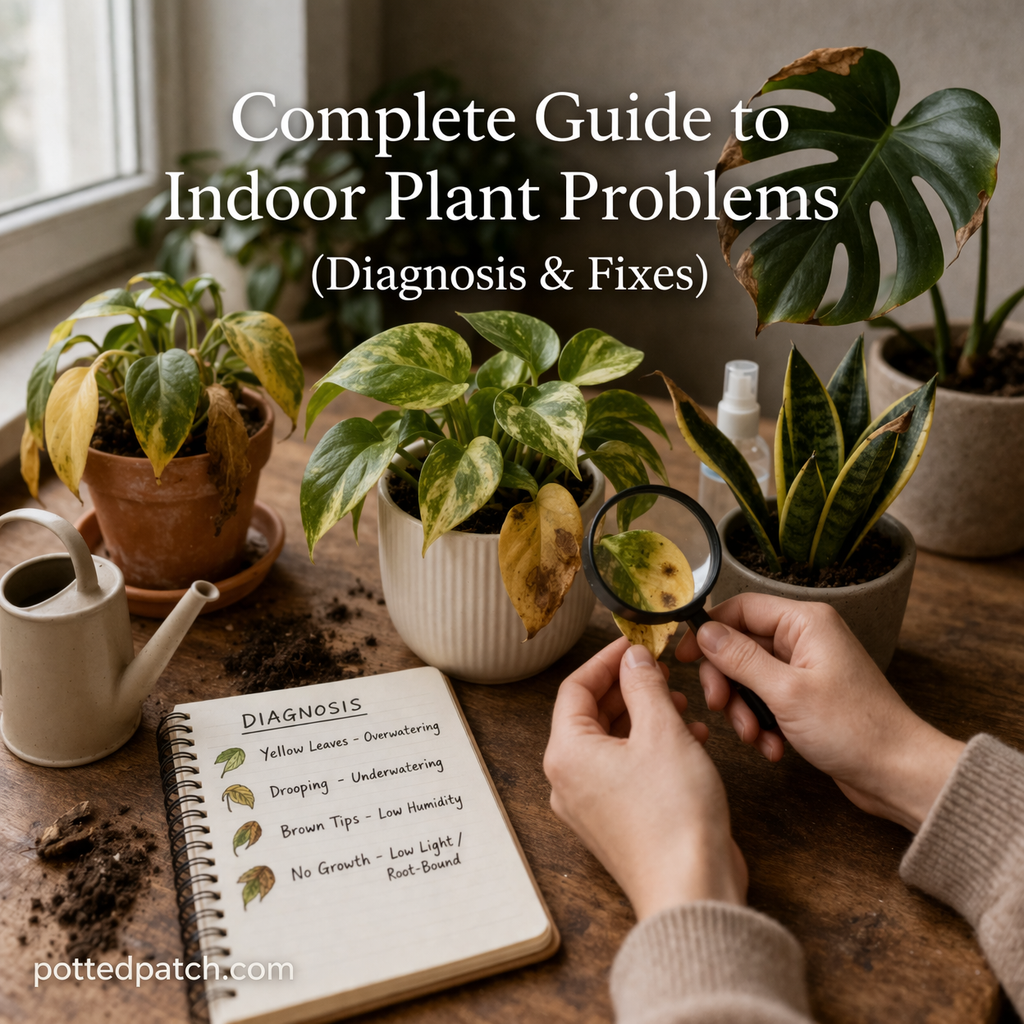
Indoor plant problems can feel confusing at first because many different issues produce similar symptoms. Yellow leaves can come from excess water, poor drainage, changing light, or normal aging. A drooping plant might be thirsty—or its roots may already be sitting in wet soil.
That is why successful troubleshooting starts with diagnosis rather than immediately reaching for the watering can.
Once you learn to look at the soil, leaves, roots, light, and recent changes together, most common houseplant problems become much easier to understand.
This guide walks through the most common indoor plant symptoms, what they may mean, and how to work toward the underlying cause step by step.
Why Indoor Plants Develop Problems
Plants respond continuously to their environment.
When water, light, soil, temperature, humidity, or root conditions move outside a plant’s preferred range, the plant often responds with visible changes.
Most indoor plant problems involve one or more of these factors:
- Overwatering
- Underwatering
- Poor lighting
- Poor drainage
- Root problems
- Temperature stress
- Low humidity
- Pests
- Nutrient problems
- Sudden environmental changes
The key is identifying patterns, not reacting to a single leaf.
One yellow lower leaf on an otherwise vigorous plant can be normal aging. Several leaves rapidly turning yellow while the soil remains wet deserves much closer attention.
In my experience, troubleshooting becomes much easier once you stop asking, “What does a yellow leaf mean?” and start asking, “What else is happening at the same time?”
For example, knowing the normal requirements of your plant gives you a useful baseline. See How Often to Water a Snake Plant or Best Light Conditions for a ZZ Plant for examples of how species-specific care influences diagnosis.
How to Diagnose Plant Problems (Step-by-Step)
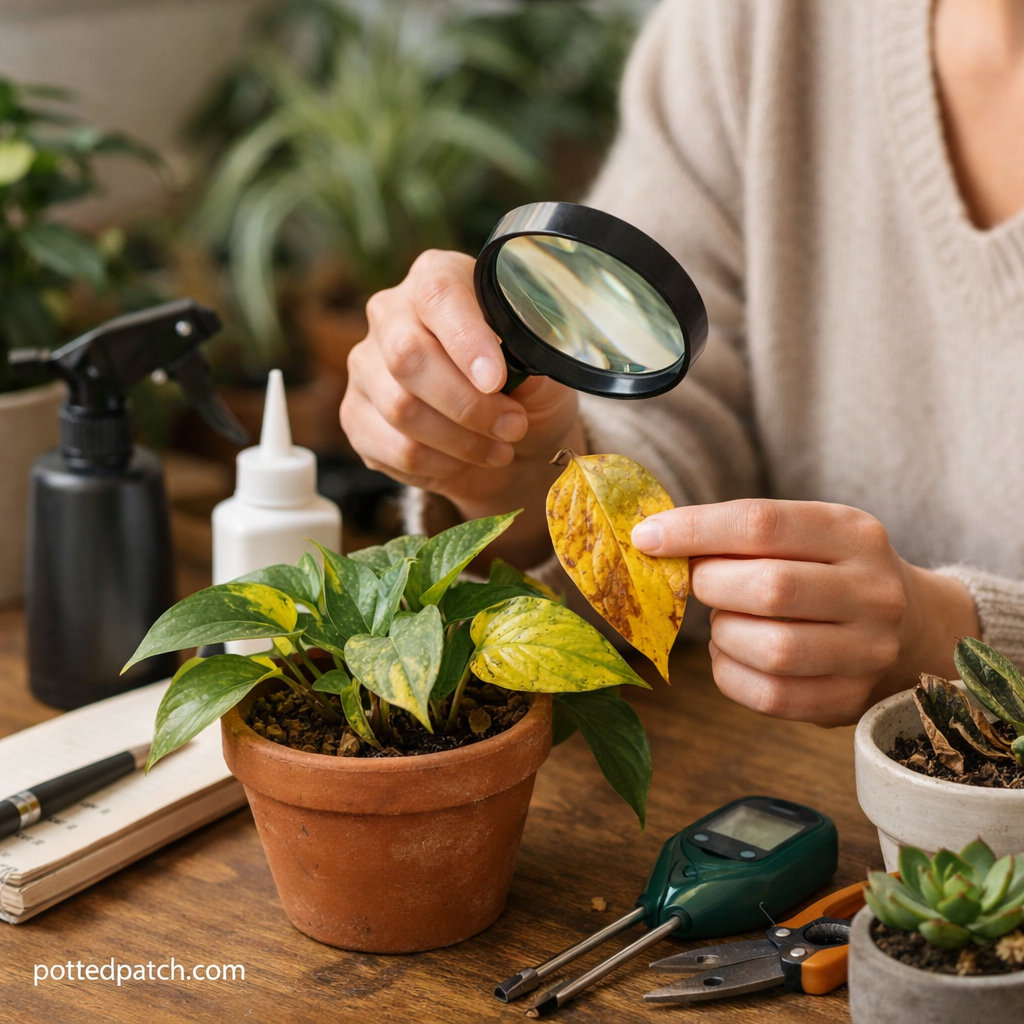
Before changing anything, examine the plant systematically.
1. Check the Soil
Start with moisture.
Push a finger into the potting mix or use another reliable method to check below the surface.
Ask:
- Is the soil wet?
- Slightly moist?
- Very dry?
- Compacted?
- Does it smell unpleasant?
- Has it remained wet unusually long?
Wet soil combined with yellowing or wilting can suggest excessive moisture or root stress.
Very dry soil combined with drooping and a lightweight pot points in a different direction.
Also consider whether the potting mix is appropriate. A Monstera, for example, benefits from a mix that balances moisture retention with drainage and aeration. Our Best Soil for a Monstera link now takes you to the complete Monstera care guide for that context.
2. Look at Leaf Condition
Next, inspect the entire plant rather than focusing only on its worst leaf.
Look for:
- Yellow leaves
- Brown tips
- Crispy edges
- Drooping
- Curling
- Spots
- Bleached areas
- Unusual softness
- Leaf drop
- Distorted new growth
Then look at where the symptoms occur.
Are only the oldest lower leaves affected? Is the newest growth damaged? Is one side of the plant worse than the other?
Location can provide useful clues.
For species-specific examples, see Why Yellow Leaves Happen on Monstera, Why Brown Tips Happen on Spider Plant, and Why Drooping Happens on Monstera.
3. Evaluate Light Exposure
Next, consider the plant’s location.
Too little light can contribute to:
- Slow or weak growth
- Long gaps between leaves
- Leaning toward a window
- Smaller new leaves
- Soil staying wet longer
Too much direct sunlight can cause:
- Bleached areas
- Scorched patches
- Crispy sections of foliage
- Faster-than-expected drying
Remember that light changes throughout the year.
I’ve seen locations that work well during winter become much more intense during summer, while spots that seem bright during summer become surprisingly dim during shorter winter days.
Species matter too. Compare the requirements in Best Light Conditions for a Snake Plant with a more light-sensitive plant such as a Best Light Conditions for a Fiddle Leaf Fig.
4. Inspect the Roots (If Needed)
Don’t pull a plant from its pot every time one leaf changes.
Root inspection becomes more useful when other evidence points toward a root problem—for example, persistent wilting despite wet soil, a foul smell, or a plant declining even though its basic care hasn’t changed.
Healthy roots vary by species but are generally firm rather than mushy.
Concerning signs include:
- Black or brown mushy roots
- Roots that easily fall apart
- An unpleasant rotting smell
- Large areas of dead root tissue
If root rot is suspected, How to Fix Root Rot on Monstera provides a species-specific example within the broader Monstera troubleshooting guide.
5. Ask What Changed
This is one of the most useful diagnostic questions.
Think back over the previous days or weeks.
Did you:
- Move the plant?
- Repot it?
- Change the soil?
- Start fertilizing?
- Water more frequently?
- Bring it home recently?
- Turn on the heater or air conditioner?
- Move it closer to a window?
Plants sometimes react to changes with a delay, so the cause may not be something you did today.
Overwatering vs Underwatering
Overwatering and underwatering are frequently confused because both can cause wilting.
Signs Associated With Overwatering
Watch for:
- Persistently wet soil
- Yellowing leaves
- Soft stems or leaves
- Leaf drop
- Musty or unpleasant soil
- Root deterioration
Overwatering is primarily about frequency and how long the root zone stays wet, not simply the volume of water poured into the pot.
Thoroughly watering a plant and allowing excess water to drain can be appropriate. Repeatedly adding more water before the potting mix has dried enough is where problems often begin.
Signs Associated With Underwatering
Look for:
- Very dry soil
- Drooping
- Crispy foliage
- Soil shrinking away from the pot
- A very lightweight container
- Dry lower leaves
If you’re unsure, check the soil rather than diagnosing from the leaves alone.
The appropriate drying period also varies considerably between plants. Compare How Often to Water a Monstera with the requirements of a snake plant or succulent.
If a ZZ plant wilts, use How to Fix Wilting on ZZ Plant before assuming it simply needs more water.
Common Plant Symptoms Explained
Yellow Leaves
Yellow foliage is a symptom, not a diagnosis.
Possible causes include:
- Excess moisture
- Poor drainage
- Root problems
- Insufficient light
- Environmental stress
- Nutrient problems
- Natural aging
Start by checking soil moisture and the pattern of yellowing.
One old bottom leaf gradually yellowing is less concerning than multiple leaves changing rapidly.
If the affected plant is a Monstera, How to Fix Yellow Leaves on Monstera covers the major causes in more detail.
Drooping Leaves
Drooping commonly gets interpreted as “needs water,” but that’s not always true.
Possible causes include:
- Dry soil
- Excessively wet soil and damaged roots
- Heat
- Cold stress
- Transplant shock
- Sudden environmental changes
Always check the soil before watering a drooping plant.
For Monsteras, Why Drooping Happens on Monstera provides more targeted troubleshooting.
Brown Leaf Tips
Brown tips can be associated with:
- Low humidity
- Inconsistent watering
- Mineral or salt buildup
- Fertilizer issues
- Root stress
- Environmental dryness
Don’t automatically increase humidity based on one brown tip.
Look at the entire care routine first.
Peace lilies are particularly useful examples because brown tips can occur for several reasons. See How to Fix Brown Tips on Peace Lily for a more focused diagnosis.
Crispy or Brown Patches
Large dry patches are different from small brown tips.
Potential causes include:
- Intense direct sunlight
- Severe dryness
- Heat
- Physical damage
- Environmental stress
If damage appears primarily on the window-facing side of the plant after moving it into stronger sunlight, sun stress becomes a more likely explanation.
Damaged leaf tissue won’t turn green again, so judge recovery by the health of new and unaffected growth.
Curling Leaves
Leaves may curl because of:
- Dry soil
- Heat
- Low humidity
- Root stress
- Excessive light
- Pest activity
Again, avoid treating the symptom alone.
A pothos with curling foliage and bone-dry soil presents a different situation from a pothos curling while sitting in saturated potting mix. Our guide to Why Is My Pothos Struggling? Common Issues Explained can help distinguish these patterns.
Slow or No Growth
Slow growth can result from:
- Insufficient light
- Seasonal changes
- Root problems
- Nutrient limitations
- A root-bound plant
- Recent repotting or environmental stress
It can also be normal.
Many houseplants grow more slowly during darker parts of the year.
Before fertilizing or repotting a slow-growing plant, check its light and overall health.
For pothos, How to Encourage New Growth on a Pothos places growth within the context of complete pothos care.
Leggy or Stretched Growth
Long stems, large spaces between leaves, or a plant strongly reaching toward a window often indicate insufficient light.
Moving the plant gradually to a brighter appropriate location may improve future growth.
Existing stretched growth generally won’t become compact again, so focus on the quality of new growth.
Leaf Drop
Some leaf loss is normal, particularly as older foliage ages.
Sudden or widespread leaf drop can be associated with:
- Major changes in light
- Watering problems
- Temperature stress
- Drafts
- Repotting
- Moving the plant
- Root damage
Fiddle leaf figs can be particularly reactive to environmental changes, which is one reason stable placement and appropriate light matter.
Root Problems (Hidden but Critical)
Roots are easy to overlook because you can’t normally see them.
Yet root health affects almost everything above the soil.
Warning signs include:
- Persistent wilting despite moist soil
- Soil that stays wet unusually long
- Unexplained widespread yellowing
- Foul-smelling potting mix
- Black or mushy roots
- Rapid decline
Root rot commonly develops when roots remain in poorly aerated, overly wet conditions.
Potential contributing factors include:
- Watering too frequently
- Poor drainage
- Dense potting mix
- Oversized containers
- Low-light conditions that reduce water use
When root rot is present, simply waiting for the top of the soil to dry may not be enough. Damaged roots may need to be evaluated and the underlying drainage or watering problem corrected.
See How to Fix Root Rot on Monstera for a practical plant-specific example.
Don’t Forget to Check for Pests
Not every declining plant has a watering problem.
Inspect leaves—especially their undersides—and stems for signs such as:
- Webbing
- Sticky residue
- Tiny moving insects
- Small bumps attached to stems
- Speckled or discolored foliage
- Distorted new growth
If you bring home a new plant, inspecting it before placing it directly among an established collection is a useful habit.
I also like to examine plants when cleaning their leaves. It’s much easier to notice a developing issue when you’re already looking closely at the stems and undersides of foliage.
If you suspect pests, separate the affected plant from nearby plants while you identify what you’re dealing with.
Environmental Stress Factors
Indoor plants can react to their surroundings even when watering and soil are appropriate.
Watch for:
- Cold drafts
- Heating vents
- Air-conditioning
- Sudden temperature swings
- Very dry air
- Hot windows
- Sudden relocation
- Major changes in light
A plant may have been perfectly comfortable in one location for months and then begin struggling when the heating system starts running in winter.
That’s why context matters.
If several plants in the same area develop similar symptoms at roughly the same time, look for a shared environmental change before assuming they independently developed unrelated problems.
Our Where to Place Indoor Plants (Room-by-Room Guide) explains how windows, rooms, drafts, temperature, and light affect placement.
Avoid the “Fix Everything at Once” Mistake
One of the easiest ways to make troubleshooting harder is to change everything at the same time.
A struggling plant gets:
- Watered
- Fertilized
- Repotted
- Moved to another window
- Pruned
- Given a completely different soil mix
Now there are six new variables.
Unless the situation requires urgent intervention, identify the most likely problem and make the smallest sensible correction first.
Then observe.
This makes it much easier to understand what actually helped.
It also reduces the chance of stressing a plant that was already trying to adapt.
When a Plant Is Recovering
Recovery isn’t always immediate.
Damaged leaves usually don’t repair themselves completely. A yellow leaf won’t normally turn healthy green again, and crispy brown tissue won’t regenerate.
Instead, look for signs such as:
- Healthy new growth
- Firm stems
- Stable existing foliage
- Improved posture
- Appropriate soil drying
- No continued spread of symptoms
New growth is often more informative than an old damaged leaf.
In my experience, this is where patience becomes part of troubleshooting. Once you’ve corrected the underlying problem, constantly changing the care routine because an old leaf still looks damaged can create new problems.
Give the plant time to respond.
When a Plant May Not Recover
Most common houseplant problems can be corrected, but severe damage can reach a point where recovery becomes difficult.
Warning signs include:
- Extensive root rot
- Completely collapsed stems
- Severe untreated pest infestations
- No healthy roots or growing points remaining
- Widespread tissue death
Even then, some plants can sometimes be saved through healthy cuttings or propagation if viable material remains.
The goal isn’t to keep every damaged leaf. It’s to determine whether healthy tissue remains and whether the underlying cause can be corrected.
Preventing Future Problems
Prevention is usually easier than rescuing a severely stressed plant.
Useful habits include:
- Check soil before watering
- Provide appropriate light
- Use pots with drainage
- Choose suitable potting mix
- Avoid dramatically oversized pots
- Inspect plants regularly
- Watch for pests
- Adjust care seasonally
- Avoid unnecessary environmental changes
Pay particular attention to transitions between seasons.
A plant may use considerably less water during darker winter conditions, while summer heat and stronger light can increase drying.
For more information on containers and root conditions, see the Complete Guide to Plant Pots, Soil, and Repotting (Indoor Plants).
A Simple Troubleshooting Checklist
When something looks wrong, work through the same basic sequence:
- Check the soil. Is it wet, moist, or very dry?
- Look at the whole plant. Is the problem isolated or widespread?
- Check the light. Has the intensity or duration changed?
- Consider recent changes. Was the plant moved, repotted, fertilized, or watered differently?
- Inspect for pests. Check leaves, stems, and new growth closely.
- Consider the roots. Investigate them if the symptoms point toward root trouble.
- Make one sensible correction. Avoid changing everything without a diagnosis.
- Watch new growth. Recovery is better judged by what happens next than by old damaged tissue.
This process won’t make every diagnosis instantaneous, but it dramatically reduces guesswork.
Final Thoughts
Most indoor plant problems are easier to solve when you treat symptoms as clues rather than answers.
Yellow leaves don’t automatically mean overwatering. Drooping doesn’t automatically mean underwatering. Brown tips don’t automatically mean low humidity.
Start with the soil. Look at the pattern of damage. Evaluate the light and environment. Think about what recently changed. Inspect for pests and investigate the roots when the evidence points in that direction.
Then make the most appropriate correction and give the plant time to respond.
The goal isn’t to prevent every imperfect leaf. Plants naturally age, adapt, and occasionally react to changing conditions.
The goal is to recognize when a pattern signals a real problem—and understand enough about the plant’s environment to find the likely cause.
With practice, you’ll stop reacting to every yellow leaf and start diagnosing plants systematically. That’s when troubleshooting becomes much less frustrating and much more useful.