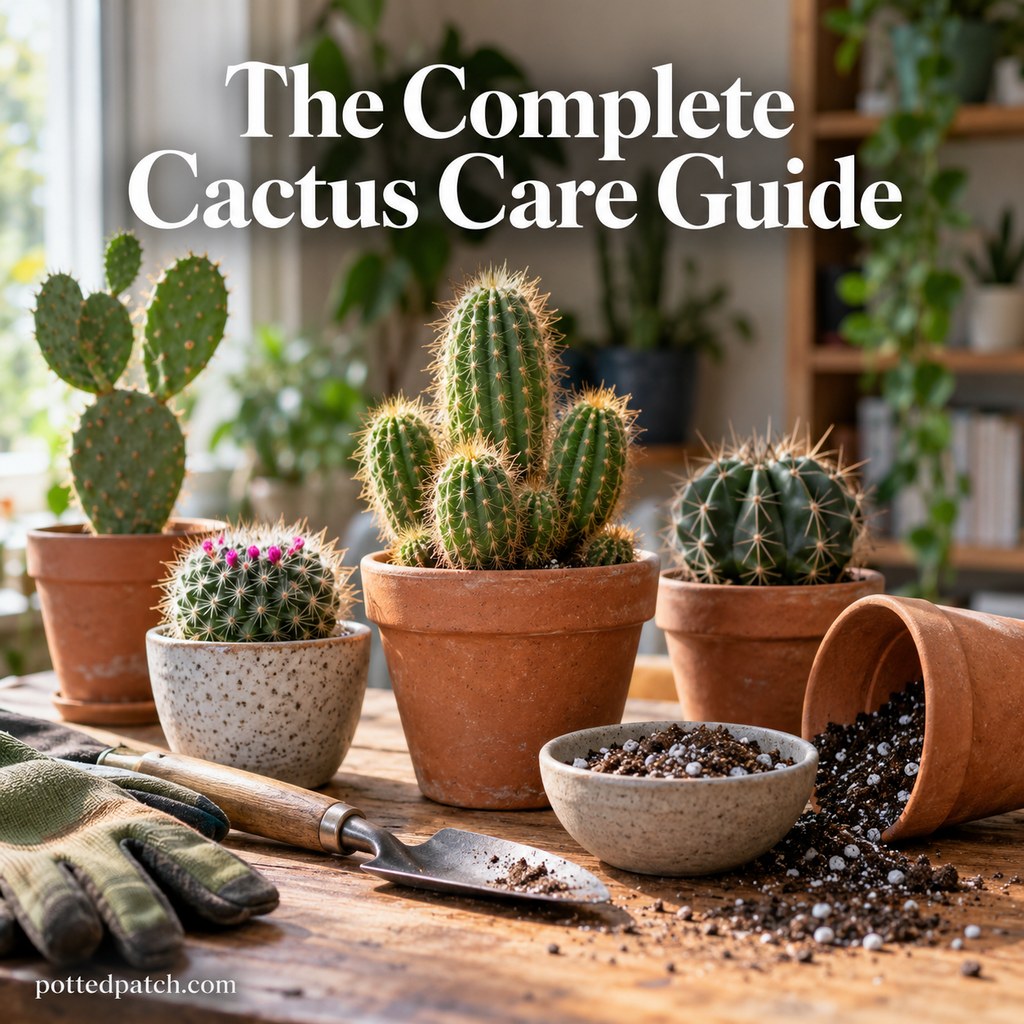
Cacti are resilient indoor plants, but the common advice to “put them in a sunny window and barely water them” leaves out some important details. In practice, I’ve found that successful cactus care depends on understanding how light, soil, pot size, temperature, and season change how quickly the root zone dries.
This guide focuses mainly on the desert cacti commonly grown as houseplants, with notes where tropical cacti need different treatment. It covers indoor care, watering, light, soil, repotting, new growth, year-round care, and the problems that are actually worth watching for.
Cactus Indoor Care Basics
True cacti belong to the Cactaceae family. They store water in their stems and have structures called areoles, which can produce spines, flowers, branches, or new growth.
That water-storage ability is what makes cactus care different from caring for many leafy houseplants.
For a typical indoor desert cactus, start with:
- Light: Very bright light, often including direct sun
- Water: Thoroughly, after the potting mix has dried
- Soil: Fast-draining and well aerated
- Pot: Appropriately sized with a drainage hole
- Humidity: Generally normal to dry household conditions
- Fertilizer: Light feeding during active growth
- Repotting: Only when roots, soil, stability, or plant size justify it
One of the biggest mistakes I’ve seen with cacti is treating their ability to survive drought as if it means they don’t need water. They do. The difference is that their roots shouldn’t remain continuously wet between waterings.
For broader principles that apply to your entire houseplant collection, see the Complete Indoor Plant Care Guide (Beginner to Advanced).
Desert Cacti vs. Tropical Cacti
Before applying any cactus-care rule, know what you’re growing.
Christmas cactus, Thanksgiving cactus, and other epiphytic cacti aren’t desert plants. They typically prefer more consistent moisture, filtered light, and somewhat different potting conditions.
So when this guide recommends allowing soil to dry thoroughly, I’m primarily talking about desert cacti.
That’s an important distinction because plants grouped together under a “cactus and succulent” sign at a store can have very different needs.
Light: Start With Your Brightest Window
For most desert cacti, light is one of the first things I evaluate.
Indoors, your brightest window is usually the logical starting point. South- and west-facing windows often provide strong light, although window size, trees, buildings, curtains, climate, and season can completely change the actual exposure.
I don’t judge cactus light by how bright the room looks to me. I watch the plant’s new growth.
Signs a Cactus Needs More Light
Look for:
- Thin or stretched new growth
- Leaning toward the window
- Pale growth
- Weak growth
- Loss of the plant’s normal compact shape
Stretched growth caused by inadequate light is called etiolation.
This is one of the more useful cactus symptoms because it leaves a fairly clear record of what happened.
If a normally rounded or thick cactus suddenly produces narrow, elongated growth, moving it into better light can improve future growth—but the stretched section won’t become thick and compact again.
I’ve found this is why catching etiolation early matters more than trying to cosmetically fix it later.
Can a Cactus Get Too Much Sun?
Yes.
The important distinction is between a cactus capable of tolerating strong sunlight and a cactus that has been acclimated to strong sunlight.
A plant that has spent months in weaker indoor light can burn if it’s moved directly into intense outdoor afternoon sun.
Sunburn may appear as:
- Pale or bleached tissue
- Yellow or tan patches
- Dry brown areas
- Damage concentrated on the sun-facing side
When moving an indoor cactus into significantly stronger light, I increase the exposure gradually rather than going from a shelf to full outdoor sun in one afternoon.
This is especially important with a newly purchased cactus because you usually don’t know how much light it received before you bought it.
For help comparing windows and rooms, see the Where to Place Indoor Plants (Room-by-Room Guide).
When a Grow Light Makes Sense
If natural light consistently produces weak or stretched growth, a grow light can be useful.
Follow the light manufacturer’s guidance for distance and duration rather than assuming closer is always better.
A timer also makes maintaining a consistent day/night cycle much easier.
Watering: Soak, Drain, Then Wait
For desert cacti, I use a simple principle:
Let the potting mix dry thoroughly, then water the root zone properly.
That doesn’t mean giving the cactus a tablespoon of water every few days.
When it’s ready:
- Water the soil thoroughly.
- Make sure the root zone is actually becoming wet.
- Allow excess water to drain through the pot.
- Empty standing water from the saucer or outer container.
- Wait for the mix to dry before watering again.
How I Check Whether a Cactus Needs Water
The top of the soil isn’t enough.
I’ve seen pots where the surface looks dusty and completely dry while the center remains noticeably damp.
Depending on the container, you can check by:
- Feeling through a drainage hole
- Using a wooden skewer
- Checking several inches below the surface
- Learning the difference between the pot’s wet and dry weight
That last method becomes surprisingly useful once you’ve owned the same plant for a while.
A freshly watered pot has a very different weight from one containing thoroughly dry cactus mix.
Why I Don’t Use “Every Two Weeks”
A fixed schedule ignores too many variables.
Drying time changes with:
- Light
- Season
- Pot size
- Pot material
- Soil composition
- Temperature
- Humidity
- Plant size
- Root system
A small cactus in terracotta beside a hot, sunny window may dry much faster than the same species in a larger plastic pot during winter.
So rather than asking, “Has it been two weeks?” I ask, “Has the root zone actually dried?”
Severely Dry Cactus Soil Can Fool You
If a pot becomes extremely dry, the mix can sometimes become difficult to re-wet.
Water may run straight down gaps around the sides and out of the drainage hole.
That can make it look as though you’ve thoroughly watered the cactus when much of the root ball is still dry.
If that happens, I water more slowly and give the mix time to absorb moisture.
Soil: Fast Drainage Is Only Half the Goal
Cactus soil needs to drain quickly, but drainage isn’t the entire story.
Roots also need air.
I want a cactus mix that is:
- Loose
- Well aerated
- Fast draining
- Resistant to compaction
Commercial cactus and succulent soil can be a convenient starting point, but I still pay attention to how it performs in the actual pot.
Some packaged mixes hold more water than I’d prefer, especially indoors where evaporation may be slower.
Mineral components such as pumice or perlite can improve drainage and aeration when needed.
Don’t Obsess Over One Perfect Soil Recipe
The growing environment matters.
A mix that works beautifully for someone growing cacti in hot, dry conditions may behave very differently in a cool indoor room.
I judge a mix partly by what happens after watering.
Does it remain wet for an unusually long time? Does it compact? Does water move through it? Does it dry predictably?
That’s more useful than assuming one exact soil ratio works everywhere.
The Pot Changes How the Soil Behaves
Drainage holes are strongly recommended.
A decorative pot without drainage makes it much harder to thoroughly water a cactus while also controlling how long the root zone stays wet.
Pot size matters too.
One mistake I avoid is placing a small root system in a huge container. The extra volume of soil can remain wet long after the roots have used the moisture immediately around them.
When repotting, I generally choose a container only somewhat larger than the root system.
Terracotta can also speed drying because moisture escapes through the porous sides. Plastic and glazed pots retain moisture longer.
Neither is automatically wrong—you simply need to account for that difference.
Repotting a Cactus
Cacti don’t need routine annual repotting.
I would rather leave a healthy, appropriately potted cactus alone than disturb its roots because a calendar says it’s time.
Consider repotting when:
- Roots have crowded the container
- The cactus has become unstable or top-heavy
- The potting mix has badly compacted
- Drainage has deteriorated
- Root problems need investigation
- The plant has genuinely outgrown its container
Spring or the beginning of active growth can be a convenient time, but the plant’s condition matters more than an arbitrary date.
How to Repot a Cactus
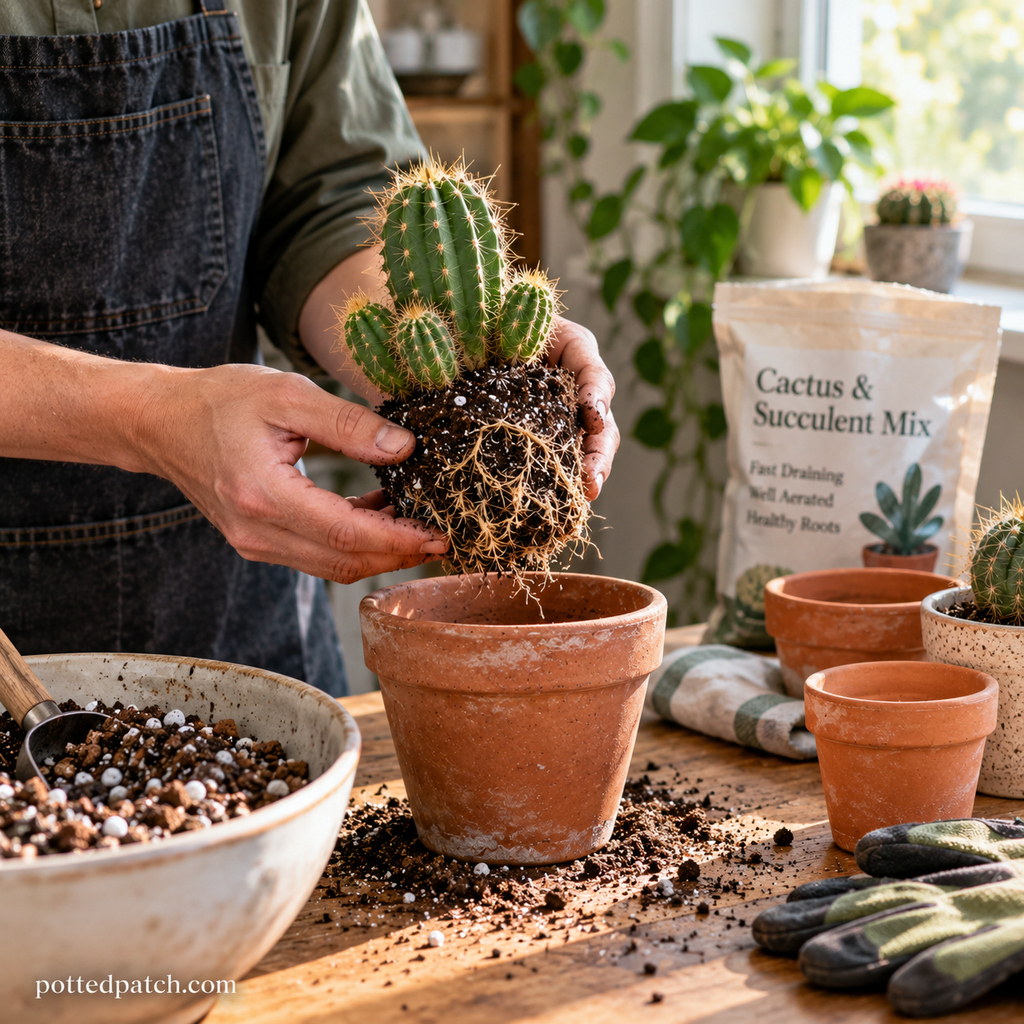
- Choose an appropriately sized pot with drainage.
- Prepare fresh, fast-draining cactus mix.
- Carefully remove the cactus.
- Loosen excess old soil where practical.
- Inspect the roots.
- Remove clearly dead or rotten roots with clean tools if necessary.
- Position the plant at roughly its previous depth.
- Fill around the roots without heavily compacting the mix.
- Let the plant settle before returning to its normal routine.
Handling is often the hardest part.
For spiny species, folded newspaper, appropriate plant-handling tongs, or protective gloves can help. Don’t assume thick gloves make you completely spine-proof; some spines penetrate surprisingly well.
For more detail on the relationship between container size, drainage, soil, and root health, see the Complete Guide to Plant Pots, Soil, and Repotting (Indoor Plants).
Encouraging Healthy New Cactus Growth
If a cactus isn’t growing well, fertilizer isn’t the first thing I reach for.
I check:
- Light
- Season
- Roots
- Soil
- Pot size
- Watering
- Temperature
For desert cacti, the shape of new growth is particularly informative.
Healthy new growth should generally resemble the plant’s normal form. If new growth becomes progressively thinner or stretched, more fertilizer won’t solve the problem—light is a much more likely limitation.
Fertilizing a Cactus
Cacti aren’t heavy feeders.
During active growth, an appropriate cactus/succulent fertilizer or suitably diluted houseplant fertilizer can be used according to its instructions.
I wouldn’t increase fertilizer concentration because a cactus seems slow.
Slow growth can be perfectly normal, and excess fertilizer can stress roots rather than speed up healthy development.
I also avoid trying to fertilize a badly stressed, dehydrated, freshly repotted, or rotting cactus back to health.
Fix the underlying condition first.
Getting a Cactus to Flower
Flowering requirements vary substantially by species.
Factors can include:
- Plant maturity
- Strong enough light
- Seasonal temperature changes
- Winter rest
- Appropriate watering
- Nutrition
- Overall plant health
This is another area where patience matters.
A perfectly healthy young cactus may simply not be mature enough to bloom.
Some species also benefit from a cooler, drier winter rest. Keeping those plants warm, wet, and actively growing throughout winter can interfere with the seasonal conditions that encourage future flowering.
Year-Round Cactus Care
Indoor cactus care shouldn’t remain identical throughout the year.
Spring
As daylight increases, many cacti begin moving into more active growth.
This is when I start paying closer attention to:
- Faster soil drying
- New growth
- Repotting needs
- Fertilizing
- Increasing sunlight
- Pest activity
If the cactus has spent winter in softer light, increase intense sun gradually.
Summer
Warm temperatures and strong light can make pots dry considerably faster.
Check the soil more frequently, but don’t interpret summer as permission to keep it constantly moist.
If moving plants outdoors, acclimate them.
Indoor glass filters and changes sunlight, so even a cactus sitting in a sunny window can be shocked by sudden exposure to outdoor midday sun.
Fall
As daylight shortens, growth and water use may begin slowing.
This is when I start watching how long pots remain wet rather than automatically maintaining summer watering frequency.
Winter
Winter is where I’ve found calendar-based watering becomes particularly risky.
A cactus in weaker light and cooler conditions may use dramatically less moisture than it did several months earlier.
For many desert cacti:
- Keep light as strong as practical
- Let soil remain dry longer
- Reduce watering as growth slows
- Reduce or stop fertilizer
- Avoid cold, wet roots
- Protect from freezing windows and drafts
However, don’t force a “dormant” watering schedule on a cactus kept warm under strong grow lights. Its growing conditions may not resemble a naturally cool, low-light winter.
Observe the plant rather than the month.
Common Cactus Care Mistakes
Most indoor cactus failures I’ve seen or would investigate first come back to a handful of issues.
Watering Because the Calendar Says So
Check the soil instead.
Giving Frequent Tiny Sips
When a desert cactus genuinely needs water, water the root zone properly and then allow it to dry.
Using Dense Houseplant Soil
Soil that stays wet and compacted can deprive roots of oxygen.
Using an Oversized Pot
More soil means more moisture around a relatively small root system.
Assuming a Dark Shelf Is Fine Because Cacti Grow Slowly
A cactus can remain alive while gradually becoming etiolated.
Survival isn’t the same as healthy growth.
Moving It Straight Into Intense Sun
Even sun-loving cacti need acclimation after lower-light conditions.
Misting Desert Cacti
Routine misting doesn’t meaningfully water the roots and generally isn’t necessary for desert species.
Trying to Fix Stress With Fertilizer
Root rot, weak light, and incorrect watering aren’t nutrient deficiencies.
Treating Every Cactus Like a Desert Cactus
Epiphytic cacti are the major exception worth remembering.
Reading Common Cactus Problems
Cacti can hide root problems for longer than you might expect.
That’s why I look at several clues together rather than diagnosing from color alone.
Soft or Mushy Tissue
Softness deserves attention, especially when it appears around the base and is associated with:
- Wet soil
- Darkened tissue
- Yellowing
- Bad-smelling soil
- Collapsing stems
Those signs can indicate rot.
If the plant is soft but its soil has been extremely dry, severe dehydration may also be involved. Check before assuming it needs more water.
Root Rot
Healthy roots should generally feel firm.
Rotten roots may become dark, mushy, or easy to pull apart.
If rot is limited, damaged material may be removable with sanitized tools. If rot has traveled far into the plant, an unaffected healthy section may sometimes need to be saved as a cutting.
Simply moving badly rotted tissue into dry soil doesn’t necessarily stop the decay.
Yellowing
Possible causes include:
- Excess moisture
- Root damage
- Weak light
- Sudden environmental change
- Pest activity
- Nutrient problems
- Natural aging
Check moisture, roots, texture, and recent changes rather than diagnosing from yellow color alone.
Brown Tissue: Rot or Corking?
Not all brown cactus tissue is decay.
Older cacti can develop corking, particularly near their lower portions. Corking is typically dry, firm, woody-looking, and gradual.
Rot behaves differently.
Rot is more likely to be soft, wet, dark, or rapidly spreading.
Learning that difference can prevent you from cutting into perfectly healthy mature tissue because it looks brown.
Skinny Growth at the Top
Thin new growth is a classic sign of insufficient light.
Improve the light for future growth, but do it gradually. A light-starved cactus can still sunburn if suddenly placed in intense sun.
Leaning
A cactus may lean toward its light source.
Rotation can help growth stay balanced, but it doesn’t compensate for insufficient light.
If a cactus becomes suddenly unstable, also inspect the base, roots, and soil. Root damage or rot can cause physical instability.
For symptoms that aren’t clear after checking the soil, roots, and light, work through the Complete Guide to Indoor Plant Problems (Diagnosis & Fixes).
Cactus Pests to Watch For
Cacti can develop many of the same pests as other indoor plants.
Watch for:
- Mealybugs
- Scale
- Spider mites
- Root mealybugs
- Fungus gnats when soil remains persistently damp
Mealybugs often hide around areoles, joints, crevices, or roots and can look like small cottony deposits.
Scale can be trickier because a cactus naturally has bumps, scars, spines, and unusual textures. I find close inspection more useful than trying to judge the plant from several feet away.
With spider mites, watch for fine webbing, stippling, and discolored patches.
New plants are worth inspecting carefully before placing them among an established collection.
Propagating Cacti
Propagation depends on the cactus.
Common methods include:
- Stem cuttings
- Pads
- Offsets
- Seeds
Stem Cuttings
For species that propagate readily from stem cuttings, make a clean cut and allow the cut surface to dry and callus before planting it in an appropriate medium.
Don’t keep an unrooted cutting constantly wet. It doesn’t yet have an established root system capable of using moisture like a mature plant.
Pads
Some Opuntia species can be propagated from pads.
Allow the wound to callus before placing the healed end into fast-draining medium.
Be especially careful with Opuntia. The tiny barbed glochids can detach easily and become lodged in skin.
Offsets
Some cacti produce pups around their base.
Once sufficiently developed, these can often be separated and potted individually. An offset that already has its own roots usually has an easier start than an unrooted cutting.
A Practical Indoor Cactus Routine
Cacti generally don’t need daily attention.
Regularly:
- Check new growth for stretching
- Inspect the base for softness or discoloration
- Look for pests around areoles and crevices
- Make sure the pot isn’t sitting in water
Before watering:
- Check deeper than the soil surface
- Consider how long the pot has actually been drying
- Account for the season and current light
Periodically:
- Check drainage
- Inspect for compacted soil
- Look for crowded roots
- Reevaluate the plant’s window as seasonal sunlight changes
- Rotate when useful for balanced growth
I find the most valuable habit is noticing changes from the plant’s normal pattern.
If a pot that normally dries predictably suddenly remains damp for much longer, ask what changed. Maybe winter arrived. Maybe the cactus was moved. Maybe roots are unhealthy.
Likewise, if the newest growth suddenly becomes thinner than everything below it, that’s useful information about the current environment.
Final Thoughts
Cactus care becomes much easier when you stop thinking of these plants as decorations that need almost nothing and start looking at how their adaptations affect indoor care.
A desert cactus stores water efficiently, so its roots don’t need continuously moist soil. But those roots still need real water when the plant is dry. Its stems can tolerate strong light, but a plant accustomed to weaker indoor conditions still needs time to acclimate to intense sun.
Season matters too.
The same cactus beside the same window can dry very differently in July than it does in December. That’s why I rely on the condition of the soil, the shape of new growth, and the plant’s recent environment more than a fixed watering calendar.
If you remember only a few things, make them these: provide enough light for compact growth, use fast-draining soil and a draining pot, let desert cactus soil dry between waterings, avoid oversized containers, and pay close attention when the plant becomes soft or unstable.
Those habits solve—or prevent—a surprisingly large percentage of indoor cactus problems.