
Snake plants have earned a reputation as some of the toughest houseplants around. They tolerate missed waterings, don’t demand constant attention, and can adapt to lighting conditions that would frustrate many other indoor plants.
That toughness can also lead to one of the biggest mistakes people make with them: assuming they can handle absolutely anything.
A snake plant sitting in wet, heavy soil can develop root rot surprisingly quickly. One kept in a very dark corner may survive, but barely grow. And watering on the same schedule as your tropical houseplants can create more problems than it solves.
The good news is that snake plant care really can be simple.
Give the plant suitable light, let its soil dry well between waterings, and use a potting mix that doesn’t stay soggy. Those three things take care of much of the work.
This complete guide covers everything you need to know about growing a healthy snake plant indoors, including watering, light, soil, fertilizing, repotting, propagation, pests, and common problems.
Snake Plant Care at a Glance
If you just brought home a snake plant, start with these basics:
- Light: Bright, indirect light is ideal, but snake plants tolerate lower light
- Water: Allow the soil to dry substantially before watering again
- Soil: Loose, fast-draining potting mix
- Humidity: Normal household humidity is usually fine
- Temperature: Warm, stable indoor conditions
- Fertilizer: Light feeding during active growth
- Pruning: Remove damaged or dying leaves when necessary
- Repotting: When roots or rhizomes become crowded
- Propagation: Division, leaf cuttings, or rhizome separation
- Growth rate: Slow to moderate indoors
The most important thing to remember is that snake plants store water in their thick leaves and underground structures. They generally handle being a little too dry much better than staying wet for too long.
What Is a Snake Plant?
Snake plant is the common name used for a group of distinctive succulent-like plants known for their stiff, upright foliage.
Many people know the classic plant as Sansevieria trifasciata. Botanically, snake plants are now generally classified within the Dracaena genus, so you may also see the name Dracaena trifasciata.
Don’t worry if a plant tag or older care guide still says Sansevieria. Both names are commonly encountered.
Snake plants come in a surprising variety of shapes and colors.
Depending on the variety, leaves may be:
- Tall and sword-shaped
- Short and arranged in a compact rosette
- Cylindrical
- Deep green
- Silver-green
- Banded with darker markings
- Edged with yellow or cream
Their basic care is similar, although individual varieties may grow at different rates and sizes.
How Much Light Does a Snake Plant Need?
Snake plants are famous for tolerating low light, but that doesn’t mean low light is ideal.
Bright, indirect light generally produces stronger growth.
A snake plant receiving adequate light may:
- Produce new leaves more frequently
- Develop stronger growth
- Maintain better coloration
- Use water more efficiently
- Produce new shoots or pups more readily
In lower light, the plant may remain healthy but grow considerably more slowly.
Can Snake Plants Grow in Low Light?
Yes.
That’s one reason they’re popular in offices, bedrooms, hallways, and apartments.
But there’s a limit.
A dark corner several feet from a small window isn’t necessarily a good long-term environment simply because a snake plant can tolerate it better than other plants.
If your snake plant hasn’t produced noticeable growth for a very long time, inadequate light is worth considering.
Can Snake Plants Take Direct Sun?
Snake plants can tolerate some direct sunlight, particularly when gradually acclimated.
However, a plant accustomed to indoor shade can be damaged if suddenly placed in intense afternoon sun.
Sun stress may cause:
- Bleached areas
- Pale patches
- Brown spots
- Crispy sections
Increase exposure gradually.
A brighter location can be beneficial, but sudden changes are unnecessary.
Where Should You Put a Snake Plant?
Choose a location with as much suitable natural light as practical.
A spot near a bright window is excellent, provided the plant isn’t suddenly exposed to intense sunlight it isn’t accustomed to.
Snake plants also work well in areas where other plants struggle with slightly lower light.
Avoid placing them directly beside:
- Cold exterior doors
- Drafty windows
- Air-conditioning vents
- Heating vents
- Radiators
Snake plants prefer warm, relatively stable conditions.
How Often Should You Water a Snake Plant?
This is where most snake plant problems begin.
Snake plants don’t need frequent watering.
Allow the potting mix to dry substantially before watering again. In many indoor environments, letting the soil dry throughout much or all of the container is safer than keeping it consistently moist.
When it’s time to water:
- Check that the soil has dried sufficiently.
- Water slowly across the surface.
- Thoroughly moisten the root ball.
- Allow excess water to drain from the bottom.
- Empty standing water from the saucer or decorative pot.
- Wait for the soil to dry again before repeating.
Don’t give the plant tiny sips of water every few days.
A thorough watering followed by an appropriate drying period is generally better.
How Often Is That in Days or Weeks?
There isn’t one correct number.
A snake plant might dry relatively quickly in bright summer conditions but take much longer during winter.
Water use depends on:
- Light
- Temperature
- Pot size
- Plant size
- Soil type
- Container material
- Root density
- Season
A snake plant in a terracotta pot beside a bright window may dry considerably faster than one in a glazed ceramic pot in lower light.
Use the calendar to remind yourself to check the plant—not to automatically water it.
Signs of an Overwatered Snake Plant
Because snake plants store water, chronically wet soil can become a serious problem.
Signs of excessive moisture may include:
- Yellow leaves
- Soft or mushy leaves
- Leaves collapsing near the base
- Drooping foliage
- Brown, water-soaked areas
- Soft roots
- Unpleasant smells from the soil
- A mushy rhizome
If a leaf becomes soft at the base and begins falling over, check the root system and soil conditions.
Adding more water will usually make the situation worse.
What Does Snake Plant Root Rot Look Like?
Healthy snake plant roots and rhizomes should feel firm.
Rotten tissue may become:
- Brown or black
- Soft
- Mushy
- Slimy
- Fragile
- Unpleasant smelling
The rhizomes—the thicker underground structures connecting parts of the plant—should also be inspected.
Soft, rotting rhizomes need attention.
How to Save a Snake Plant With Root Rot
If you catch the problem before the entire plant has deteriorated:
- Remove the plant from its pot.
- Gently remove wet soil from the roots.
- Inspect the roots and rhizomes.
- Cut away clearly rotten tissue with clean, sanitized tools.
- Allow excessively wet surfaces to dry appropriately.
- Repot the healthy remaining plant into fresh, fast-draining soil.
- Use a container with drainage holes.
- Adjust your watering routine.
If some sections remain completely healthy, you may also be able to separate or propagate them.
Signs of an Underwatered Snake Plant
Snake plants tolerate drought well, but they’re not completely immune to dehydration.
A plant kept dry for an extremely long time may develop:
- Wrinkled leaves
- Curling foliage
- Dry brown edges
- Leaves folding inward
- Very dry soil
- Slowed or stopped growth
If the soil has become extremely dry, water thoroughly.
Very dry potting mix can sometimes resist absorbing water, so apply moisture slowly enough to reach the entire root ball.
Best Soil for Snake Plants
Snake plants need excellent drainage.
A dense potting mix that stays wet for a long time is one of the easiest ways to create root problems.
A cactus or succulent potting mix can provide a good starting point.
You can also improve drainage and aeration with ingredients such as:
- Perlite
- Pumice
- Coarse mineral amendments
- Fine orchid bark
The ideal mix should absorb water while allowing excess moisture to drain relatively quickly.
A Simple Snake Plant Soil Mix
A practical mixture might include:
- 2 parts cactus or succulent potting mix
- 1 part perlite or pumice
- 1 part fine orchid bark
You don’t have to follow this recipe exactly.
Your environment matters.
If plants dry extremely quickly in your home, you may want slightly more moisture retention. If pots routinely stay wet for long periods, additional aeration may be helpful.
Does a Snake Plant Need Drainage Holes?
Drainage holes are strongly recommended.
They make it much easier to water thoroughly while allowing excess moisture to escape.
If you want to use a decorative planter without drainage, keep the snake plant in a nursery pot inside it.
When watering:
- Remove the nursery pot.
- Water thoroughly.
- Allow it to drain completely.
- Empty any water from the decorative container.
- Return the plant.
Never leave the nursery pot standing in accumulated water.
What Is the Best Pot for a Snake Plant?
Container size and material can both affect watering.
Terracotta pots are popular for snake plants because the porous material allows moisture to evaporate through the container walls.
Plastic and glazed ceramic pots can work perfectly well too, but they may retain moisture longer.
Whatever material you choose, prioritize drainage.
Choosing the Right Pot Size
Avoid placing a small snake plant in a huge pot.
An oversized container holds more soil than the root system needs, and that soil can stay wet for a long time.
When repotting, choose a container only moderately larger than the existing root system.
Snake plants also don’t mind being somewhat snug in their pots.
Temperature Requirements for Snake Plants
Snake plants generally prefer warm household temperatures.
They’re not particularly demanding as long as they’re protected from cold conditions and sudden temperature swings.
Avoid locations directly exposed to:
- Cold drafts
- Frost
- Cold window glass
- Air conditioners
- Exterior doors during winter
A warm, stable indoor environment is usually all they need.
How Much Humidity Do Snake Plants Need?
Snake plants don’t require tropical levels of humidity.
Normal household humidity is usually suitable.
This makes them particularly convenient in homes where humidity-loving plants struggle.
You generally don’t need to run a humidifier specifically for a snake plant unless you’re addressing other environmental concerns.
Should You Mist a Snake Plant?
There’s usually no reason to mist a snake plant.
Misting doesn’t provide meaningful watering to the roots and isn’t necessary for humidity.
Keeping the foliage unnecessarily wet can also create conditions you don’t need.
If the leaves become dusty, wipe them gently with a soft, damp cloth instead.
How to Fertilize a Snake Plant
Snake plants aren’t heavy feeders.
During periods of active growth, you can use a suitable houseplant or succulent fertilizer according to the product’s directions.
Avoid excessive fertilizer.
Overfertilization can contribute to:
- Root stress
- Salt buildup
- Brown leaf edges
- Damaged growth
Reduce or pause feeding when the plant isn’t actively growing.
Fertilizer also won’t fix problems caused by low light, root rot, or inappropriate watering.
Address those conditions first.
How Fast Do Snake Plants Grow?
Snake plants are generally slow to moderate growers indoors.
Growth rate depends on:
- Variety
- Light
- Temperature
- Root health
- Nutrition
- Season
- Plant maturity
Good light can make a noticeable difference.
A snake plant surviving in a dim corner may produce little visible growth, while the same type in brighter conditions may regularly produce new leaves and pups.
How to Make a Snake Plant Grow Faster
You can’t force a snake plant to grow beyond its natural pace, but you can provide conditions that support healthy growth.
Focus on:
- Bright, appropriate light
- Healthy roots
- Fast-draining soil
- Proper watering
- Warm temperatures
- Light fertilization during active growth
Don’t compensate for slow growth by adding extra fertilizer or water.
That usually creates new problems instead.
What Are Snake Plant Pups?
A healthy snake plant may eventually send up small new plants beside the original growth.
These are commonly called pups.
They develop from underground rhizomes and can gradually make the pot look fuller.
You can leave them attached to the parent plant or separate them once they’ve developed sufficiently.
Leaving pups in place is an easy way to create a dense, mature-looking plant.
How to Prune a Snake Plant
Snake plants don’t require routine pruning in the same way as branching houseplants.
Pruning is mostly used to remove:
- Dead leaves
- Severely damaged leaves
- Rotten foliage
- Leaves that have become permanently bent or broken
Use a clean, sharp tool.
When removing an entire damaged leaf, cut it near the soil line without damaging neighboring growth.
Can You Cut the Top Off a Snake Plant Leaf?
You can trim a damaged tip, but the cut end won’t regrow into its original pointed shape.
The scar will remain visible.
If only a small tip is brown, you can trim it to mimic the natural leaf shape for cosmetic reasons.
If an entire leaf is badly damaged, removing it at the base may look better.
How to Repot a Snake Plant
Snake plants don’t need frequent repotting.
They can remain somewhat snug in their containers and often grow happily that way.
Repotting may be necessary when:
- Rhizomes are crowding the container
- The pot begins bulging or cracking
- Roots emerge extensively through drainage holes
- The plant becomes unstable
- The soil has badly deteriorated
- The root system is severely crowded
To repot:
- Choose a container slightly larger than the current one.
- Prepare fresh, fast-draining potting mix.
- Carefully remove the snake plant.
- Inspect the roots and rhizomes.
- Remove any clearly rotten tissue.
- Position the plant at approximately the same depth.
- Fill around the root system with fresh soil.
- Avoid packing the soil excessively tightly.
- Allow the plant to settle into its new container.
- Resume sensible watering based on soil moisture.
Avoid automatically moving into a dramatically larger pot.
How to Propagate a Snake Plant
Snake plants can be propagated in several ways.
The most common methods are:
- Division
- Rhizome separation
- Leaf cuttings
Division is often the easiest way to create a new plant that maintains the same appearance as the parent.
How to Propagate a Snake Plant by Division
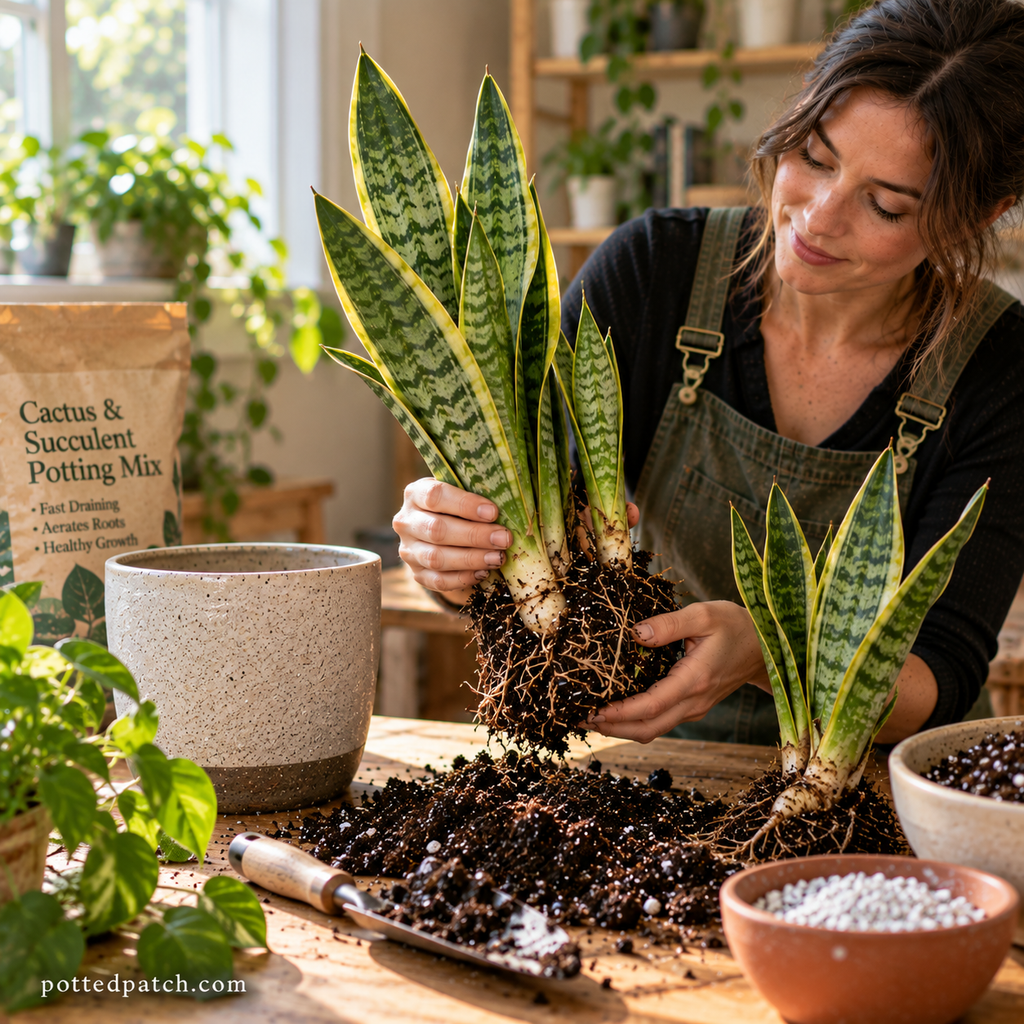
If your plant has multiple established sections or pups, you may be able to divide it.
Here’s a basic approach:
- Remove the plant from its pot.
- Gently expose the root system.
- Identify natural divisions or pups.
- Locate the connecting rhizomes.
- Separate sections carefully using a clean tool when necessary.
- Make sure each division has healthy roots and foliage.
- Pot each section into an appropriately sized container.
- Use fresh, fast-draining soil.
This method works particularly well when you’re repotting an overcrowded plant anyway.
How to Propagate Snake Plant Leaf Cuttings
Snake plants can also be propagated from leaf sections.
To propagate using a leaf:
- Choose a healthy mature leaf.
- Cut it near the base.
- Divide it into sections if desired.
- Keep track of which end originally pointed downward.
- Allow the cut surfaces to dry and callus.
- Place the correct end into an appropriate propagation medium.
- Provide warmth and suitable indirect light.
- Keep conditions appropriate while roots and new growth develop.
Be patient.
Snake plant leaf propagation can take time.
Will Variegated Snake Plant Cuttings Stay Variegated?
Not always.
Some variegated snake plants propagated from leaf cuttings can revert to greener growth and lose the parent plant’s distinctive variegation.
If preserving a particular variegated pattern is important, division is generally the safer propagation method.
Why Are My Snake Plant Leaves Turning Yellow?
Yellow leaves can have several causes, but excessive moisture should be high on your list.
Possible causes include:
- Overwatering
- Poor drainage
- Root rot
- Cold stress
- Severe environmental changes
- Natural aging
Check the soil and the base of the affected leaf.
If the leaf is yellow, soft, and mushy near the soil, investigate the root system.
Why Are My Snake Plant Leaves Curling?
Curling or folding leaves may indicate:
- Prolonged dryness
- Root stress
- Temperature stress
- Pest problems
- Severe environmental changes
Start by checking the soil and roots.
If the soil is bone dry and the foliage looks wrinkled, dehydration may be the cause.
If the soil is wet and the plant is deteriorating, don’t assume it needs additional water.
Why Is My Snake Plant Drooping?
Healthy snake plant leaves are usually relatively upright and firm.
Drooping can result from:
- Overwatering
- Root rot
- Severe underwatering
- Physical damage
- Insufficient light over time
- Cold damage
A leaf that becomes mushy near its base and falls sideways often points toward excess moisture or rot.
A tall leaf that simply bends may have suffered physical damage.
Why Does My Snake Plant Have Brown Tips?
Brown tips can result from several forms of stress, including:
- Prolonged dryness
- Physical damage
- Root stress
- Fertilizer buildup
- Temperature stress
If only a small amount of browning appears and the rest of the plant is healthy, it may be primarily cosmetic.
Watch whether the damage continues spreading.
Why Is My Snake Plant Not Growing?
First, remember that snake plants aren’t especially fast growers.
If growth has completely stalled, consider:
- Low light
- Cold temperatures
- Poor root health
- Seasonal slowdown
- Severe root crowding
- Lack of nutrients during active growth
Lighting is particularly important.
Moving the plant to brighter indirect light may improve future growth, provided the other conditions are healthy.
Why Is My Snake Plant Falling Over?
There are several possibilities.
If the base of the leaf is soft or mushy, check for overwatering and rot.
If the leaf is firm but bent, physical damage may be responsible.
Very tall plants can also become unstable if they’re growing toward a light source.
Check the entire plant before deciding on a treatment.
Common Snake Plant Pests
Snake plants are relatively resilient, but they can still develop common houseplant pests.
Watch for:
- Spider mites
- Mealybugs
- Scale insects
- Thrips
Inspect:
- Leaf surfaces
- Leaf bases
- New growth
- Crevices between leaves
Possible signs include:
- White cottony material
- Sticky residue
- Fine webbing
- Small bumps
- Speckling
- Distorted growth
- Visible insects
What to Do if You Find Pests
Move the affected snake plant away from your other plants.
Depending on the pest, treatment may include:
- Wiping the foliage
- Rinsing affected areas
- Physically removing visible pests
- Using an appropriately labeled horticultural or insecticidal product
Follow product instructions carefully.
Continue inspecting the plant afterward because repeated treatment may be necessary.
How to Clean Snake Plant Leaves
Snake plant leaves can collect dust, especially larger upright varieties.
Cleaning is simple.
Use a soft, damp cloth and gently wipe both sides of each leaf.
Avoid pulling or bending the foliage.
Cleaning also gives you a chance to inspect the plant for pests, discoloration, or soft areas.
There’s no need to use leaf-shine products.
Snake Plant Care During Winter
Winter is when overwatering becomes especially easy.
Shorter days and cooler indoor conditions often mean the plant uses water more slowly.
Soil that dried fairly quickly in summer may remain moist much longer.
During winter:
- Check soil carefully before watering
- Expect watering frequency to decrease
- Provide good light
- Protect the plant from cold drafts
- Keep it away from heating vents
- Reduce fertilizer when growth slows
- Inspect occasionally for pests
Don’t water simply because a certain number of days have passed.
Common Snake Plant Care Mistakes
Snake plants are tough, but several common habits can still cause trouble.
1. Watering Too Frequently
This is one of the biggest problems.
Let the soil dry substantially between waterings.
2. Assuming Low Light Is Ideal
Snake plants tolerate low light. They generally grow better with brighter conditions.
3. Using Dense Potting Soil
Fast drainage helps protect the roots and rhizomes from prolonged wetness.
4. Choosing an Oversized Pot
Extra soil holds extra moisture.
Move up gradually when repotting.
5. Misting Unnecessarily
Snake plants don’t require misting to stay healthy.
6. Fertilizing to Force Growth
Extra fertilizer won’t compensate for inadequate light or unhealthy roots.
7. Repotting Too Often
Snake plants can remain somewhat snug in their containers.
8. Watering More When Leaves Droop
Always check the soil first.
Drooping can result from both excessive and insufficient moisture.
Snake Plant Care FAQ
Are Snake Plants Easy to Care For?
Yes. Snake plants are among the more forgiving indoor plants.
Their ability to tolerate periods of dryness and a range of lighting conditions makes them particularly suitable for beginners.
How Often Should I Water a Snake Plant?
There’s no fixed schedule.
Allow the potting mix to dry substantially before watering thoroughly again. Your plant may need water much less frequently during winter or in lower light.
Can a Snake Plant Live in Low Light?
Yes, but growth will generally be slower.
Bright, indirect light typically supports stronger growth and more frequent new shoots.
Does a Snake Plant Need Direct Sunlight?
No.
Bright indirect light works well. Some direct sunlight can be tolerated when the plant is gradually acclimated.
Do Snake Plants Like Small Pots?
Snake plants tolerate somewhat snug containers and don’t need a lot of unused soil around their roots.
Repot when the root system or rhizomes genuinely need additional space.
Should I Bottom-Water a Snake Plant?
You can bottom-water a snake plant, but it isn’t necessary.
The important part is thoroughly moistening the root zone when the plant actually needs water and then allowing excess moisture to drain.
How Do I Make My Snake Plant Fuller?
Allow pups to remain attached to the parent plant.
As new shoots emerge from underground rhizomes, the container will naturally become fuller over time.
Why Isn’t My Snake Plant Producing Pups?
Several factors can influence new growth, including light, plant maturity, temperature, root health, and season.
Providing good light and proper overall care is more useful than trying to force pup production with extra water or fertilizer.
Are Snake Plants Toxic to Pets?
Snake plants can cause gastrointestinal upset if eaten by cats or dogs.
Keep the plant somewhere pets that like to chew foliage can’t easily reach it.
If you believe your pet has eaten part of a snake plant or develops concerning symptoms, contact your veterinarian or an appropriate animal poison-control service.
Final Thoughts on Snake Plant Care
Snake plant care is easiest when you resist the urge to do too much.
Give your plant good light, use fast-draining soil, and allow the potting mix to dry substantially before watering again. Keep it warm, use fertilizer modestly, and don’t rush to repot it every year.
Most importantly, check the plant before reacting.
A drooping leaf doesn’t automatically mean it needs water. Slow growth doesn’t automatically mean it needs fertilizer. And a snake plant surviving in a dark corner doesn’t necessarily mean it’s getting enough light to thrive.
Pay attention to the soil, roots, leaves, and new growth.
Once you get those fundamentals right, snake plants require surprisingly little day-to-day attention—and that’s exactly what makes them such reliable indoor plants.