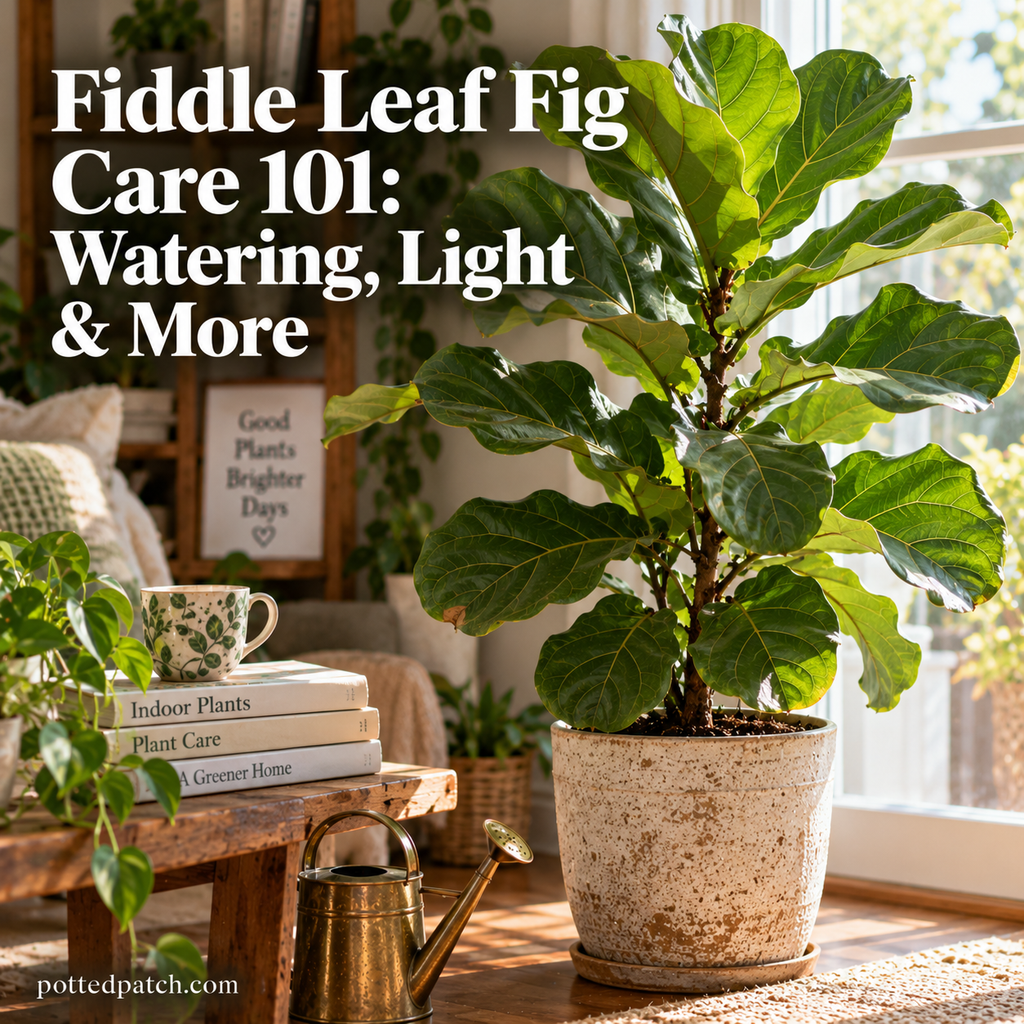
Few houseplants make a statement quite like a fiddle leaf fig.
With its large, violin-shaped leaves and upright growth, a healthy fiddle leaf fig can transform an empty corner into one of the most noticeable parts of a room. Unfortunately, it also has a reputation for being a little dramatic.
Move it suddenly and it may drop leaves. Keep the soil wet for too long and brown spots can appear. Put it in a dark corner and new growth may slow to a crawl.
The good news? Fiddle leaf fig care isn’t nearly as mysterious as it sometimes seems.
Most problems come back to a few basics: light, watering, drainage, and consistency. Once those are working together, caring for a fiddle leaf fig becomes much more predictable.
This guide covers everything you need to know about growing a fiddle leaf fig indoors, including watering, light, soil, humidity, fertilizer, pruning, repotting, propagation, pests, and common problems.
What Is a Fiddle Leaf Fig?
The fiddle leaf fig, Ficus lyrata, is a tropical plant native to western Africa.
In its natural environment, it can grow into a large tree. Indoors, it remains much smaller but can still become an impressive floor plant with proper care.
Its most recognizable feature is its foliage.
The leaves are large, leathery, and shaped somewhat like a violin or fiddle, which explains the common name. Their prominent veins and slightly wavy edges give the plant its distinctive appearance.
Fiddle leaf figs are usually sold in one of two general forms:
- A bushier plant with foliage growing along several stems
- A tree-like form with a bare trunk and leafy canopy
Both have similar basic care requirements.
Are Fiddle Leaf Figs Hard to Care For?
They’re not the easiest houseplants, but they’re also not impossible.
Fiddle leaf figs tend to react strongly when their environment changes. That can make them seem more difficult than plants that quietly tolerate almost anything.
The biggest challenges are usually:
- Providing enough light
- Watering at the right time
- Maintaining good drainage
- Avoiding sudden environmental changes
- Diagnosing brown spots correctly
- Preventing root problems
Once you’ve found a location where your plant is growing well, consistency becomes one of your best tools.
How Much Light Does a Fiddle Leaf Fig Need?
Fiddle leaf figs like plenty of light.
Bright, indirect light is a good starting point, and established plants can often tolerate some direct sunlight when properly acclimated.
A location close to a bright window is usually much better than a dark corner across the room.
What Happens When a Fiddle Leaf Fig Doesn’t Get Enough Light?
Insufficient light can cause:
- Slow growth
- Smaller new leaves
- Long spaces between leaves
- Leaning toward the window
- Lower leaf loss
- Soil staying wet for too long
That last problem can lead to a frustrating cycle.
The plant receives too little light, so it uses water slowly. The soil remains wet. The roots become stressed, and leaves begin developing problems.
You may assume the plant needs a different watering schedule when what it really needs is more light.
Can Fiddle Leaf Figs Handle Direct Sun?
Yes, but acclimation matters.
A fiddle leaf fig that has been growing under weaker indoor light can burn if it’s suddenly moved into several hours of intense direct sunlight.
Increase sun exposure gradually.
Watch for:
- Bleached patches
- Pale areas
- Dry tan spots
- Crispy sections
Gentle morning sunlight is typically easier for an indoor plant to adjust to than intense afternoon sun.
Where Should You Put a Fiddle Leaf Fig?
Choose the brightest appropriate location available.
Depending on your home, that might be:
- Near a large east-facing window
- Close to a bright south-facing window
- Near a west-facing window with protection from harsh afternoon sun
- In a bright room with large windows
- Under supplemental grow lights
Avoid placing your fiddle leaf fig several feet into a dark room simply because it looks good there.
Plants experience light very differently from our eyes. A room that seems bright to you may provide surprisingly little usable light in the corner.
Should You Rotate a Fiddle Leaf Fig?
Rotating the pot occasionally can encourage more balanced growth when light comes primarily from one direction.
Make small rotations rather than constantly moving the plant around the house.
Fiddle leaf figs appreciate consistency.
If the plant has clearly oriented itself toward a window, rotating it a quarter turn periodically can help keep the canopy more even.
How Often Should You Water a Fiddle Leaf Fig?
Don’t water your fiddle leaf fig according to a rigid calendar.
Check the soil.
Allow the upper portion of the potting mix to dry before watering again. The exact depth and timing depend on the size of the plant, pot, soil, light, temperature, and season.
A plant beside a bright summer window may dry considerably faster than the same plant during winter.
How to Tell When a Fiddle Leaf Fig Needs Water
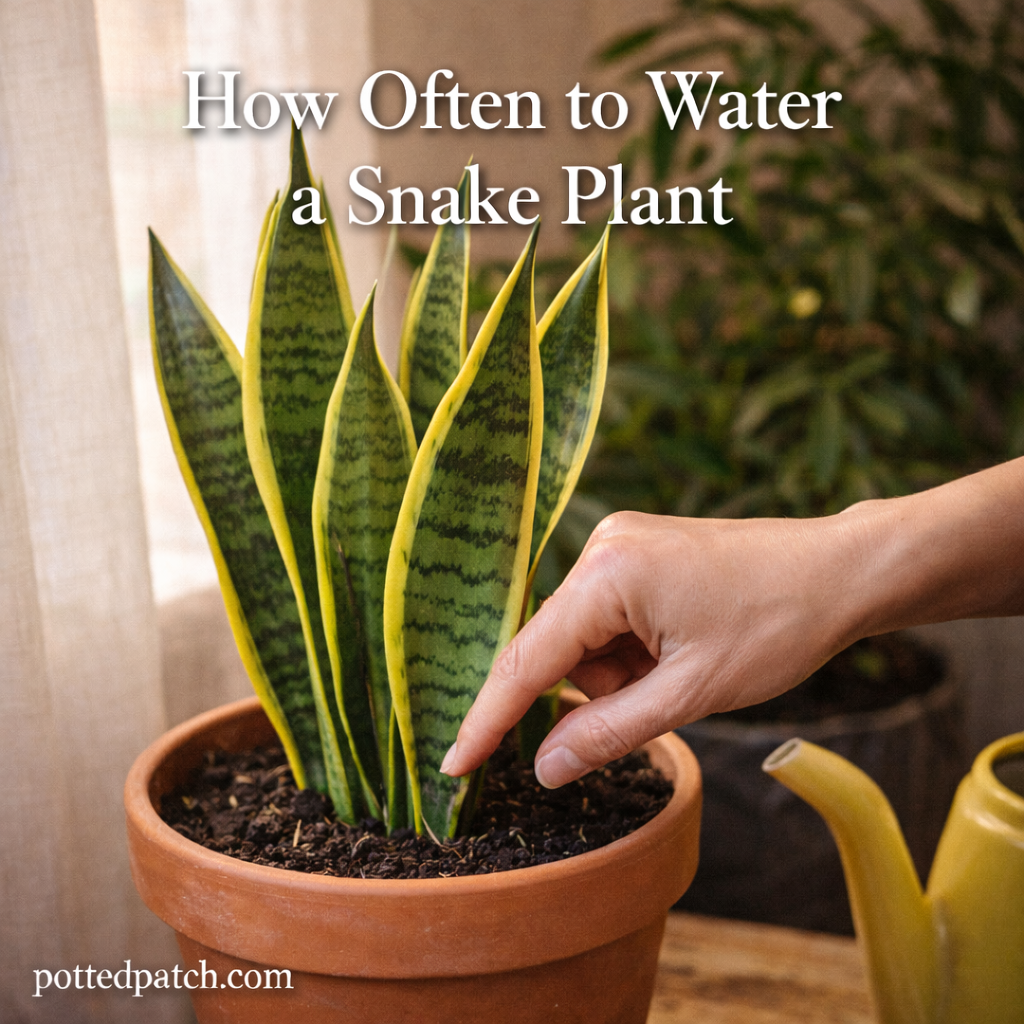
Use your finger to check the soil several inches below the surface.
Other useful clues include:
- The pot feeling lighter
- The upper soil becoming dry
- Slight loss of leaf firmness
- Soil beginning to pull away from the container
Don’t wait for severe wilting as your normal watering signal.
Repeated extreme dehydration can stress the plant and contribute to leaf damage.
How to Water a Fiddle Leaf Fig Properly
When it’s time to water:
- Water slowly across the soil surface.
- Continue until the entire root zone is moistened.
- Allow excess water to drain from the bottom.
- Empty standing water from the saucer or decorative pot.
- Return the plant to its normal location.
- Check the soil again before the next watering.
Thorough watering followed by appropriate drying is better than giving the plant small amounts every few days.
Signs of an Overwatered Fiddle Leaf Fig
Fiddle leaf figs don’t like sitting in saturated soil.
Possible signs of excessive moisture include:
- Yellowing leaves
- Dark brown spots
- Lower leaf drop
- Drooping despite wet soil
- Persistently damp potting mix
- Soft or dark roots
- An unpleasant smell from the soil
Remember, overwatering isn’t simply about the amount of water you pour into the pot.
The real issue is how long the roots remain wet.
Poor drainage, low light, compacted soil, oversized pots, and cool temperatures can all cause soil to stay wet too long.
Signs of an Underwatered Fiddle Leaf Fig
A plant that becomes too dry may develop:
- Drooping leaves
- Crispy brown edges
- Dry brown patches
- Curling leaves
- Extremely dry soil
- Leaf drop
The location of the damage can provide clues.
Dry, crispy browning around leaf edges is often associated with dehydration or dry conditions, while soft or spreading dark spots can indicate a different problem.
Don’t diagnose based on color alone.
Does Water Quality Matter?
Fiddle leaf figs can usually adapt to ordinary household water, although water quality varies considerably between locations.
If you notice repeated mineral buildup on the soil or pot, filtered or suitable rainwater may be worth trying.
However, changing water sources shouldn’t be your first reaction to every brown leaf.
Light, watering, roots, temperature, and drainage are usually more important factors to investigate first.
The Best Soil for a Fiddle Leaf Fig
Fiddle leaf figs prefer potting soil that retains some moisture while still draining and allowing air around the roots.
Dense soil that stays saturated for long periods increases the risk of root problems.
A suitable mix might include:
- Quality indoor potting soil
- Perlite or pumice
- Fine orchid bark
- Coco coir or another moisture-retentive component
There’s no single perfect recipe.
The goal is a loose, well-aerated mixture that doesn’t become compacted and waterlogged.
Choosing the Right Pot
A drainage hole is one of the most important features of a fiddle leaf fig container.
Without drainage, managing soil moisture becomes much harder.
Decorative pots without drainage can still be used as outer cachepots. Keep the plant in a draining inner pot and remove excess water after watering.
What Size Pot Does a Fiddle Leaf Fig Need?
Choose a pot that’s only slightly larger than the root system when repotting.
Don’t move a small fiddle leaf fig directly into an enormous container.
The extra soil can hold water for much longer than the roots need, increasing the risk of overwatering.
Terracotta vs. Plastic Pots
Both can work.
Unglazed terracotta allows moisture to evaporate through the sides of the container and usually dries faster.
Plastic and glazed ceramic retain moisture longer.
The best choice depends on your growing environment and watering habits.
Temperature Requirements
Fiddle leaf figs prefer warm, stable indoor temperatures.
Typical household temperatures are usually comfortable.
Avoid:
- Cold drafts
- Heating vents
- Air-conditioning vents
- Freezing windows
- Sudden temperature changes
- Frequently opened exterior doors during cold weather
A plant can experience stress from a nearby draft even when the room temperature itself seems perfectly comfortable.
Does a Fiddle Leaf Fig Need High Humidity?
Fiddle leaf figs appreciate moderate humidity but usually don’t require greenhouse-like conditions.
Extremely dry air can contribute to crispy leaf edges and may encourage certain pests.
If your home becomes very dry during winter, a humidifier can help.
Should You Mist a Fiddle Leaf Fig?
Routine misting isn’t necessary.
Misting temporarily wets the leaves without substantially changing room humidity for long.
If humidity is consistently low, improving the surrounding environment is more effective.
Keeping foliage constantly damp without good airflow can also create unnecessary problems.
How to Fertilize a Fiddle Leaf Fig
Fiddle leaf figs can benefit from regular but moderate feeding during active growth.
Use an appropriate houseplant fertilizer according to the product directions.
Avoid assuming that extra fertilizer will make the plant grow dramatically faster.
Too much fertilizer can damage roots and cause mineral buildup.
When Should You Fertilize?
Spring and summer are commonly the most active growing periods indoors.
Feed during active growth and reduce or stop fertilizing when growth slows.
A plant growing under strong supplemental lighting year-round may behave differently.
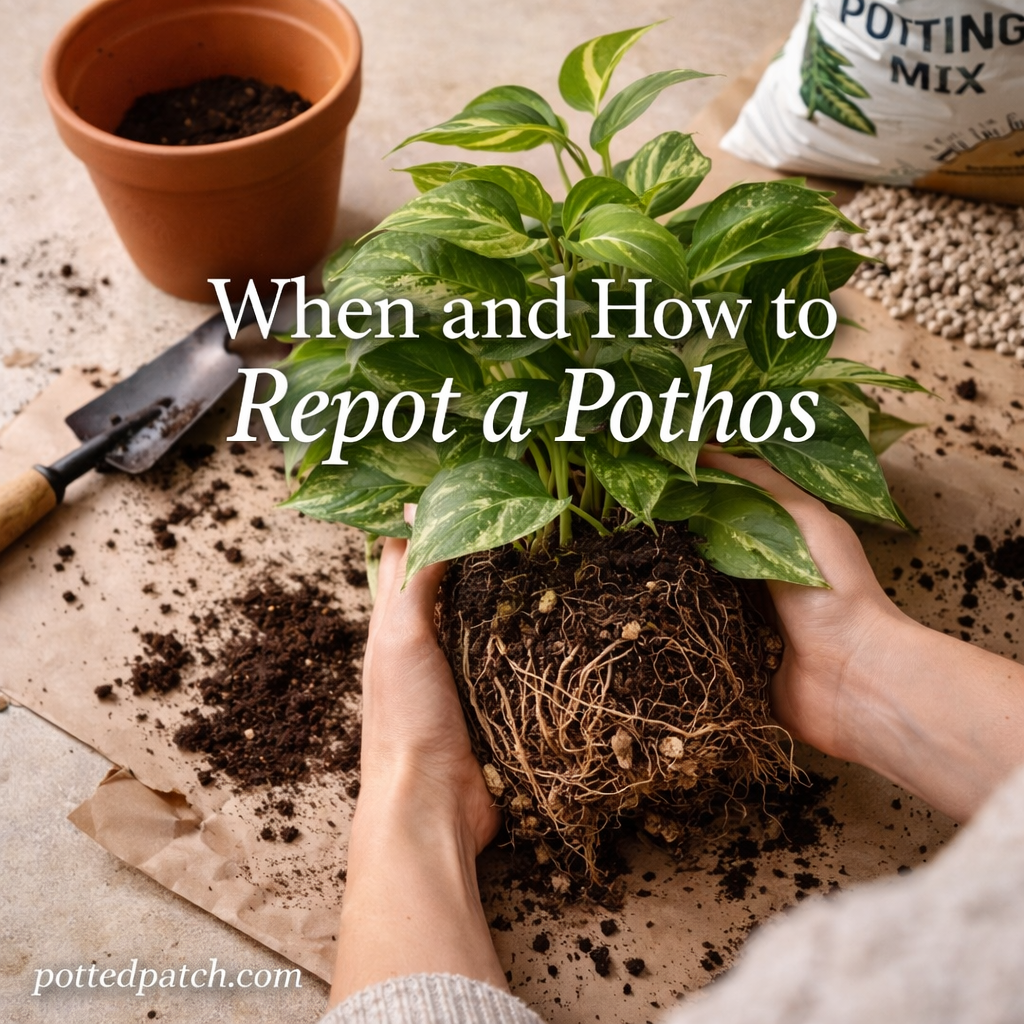
How to Repot a Fiddle Leaf Fig
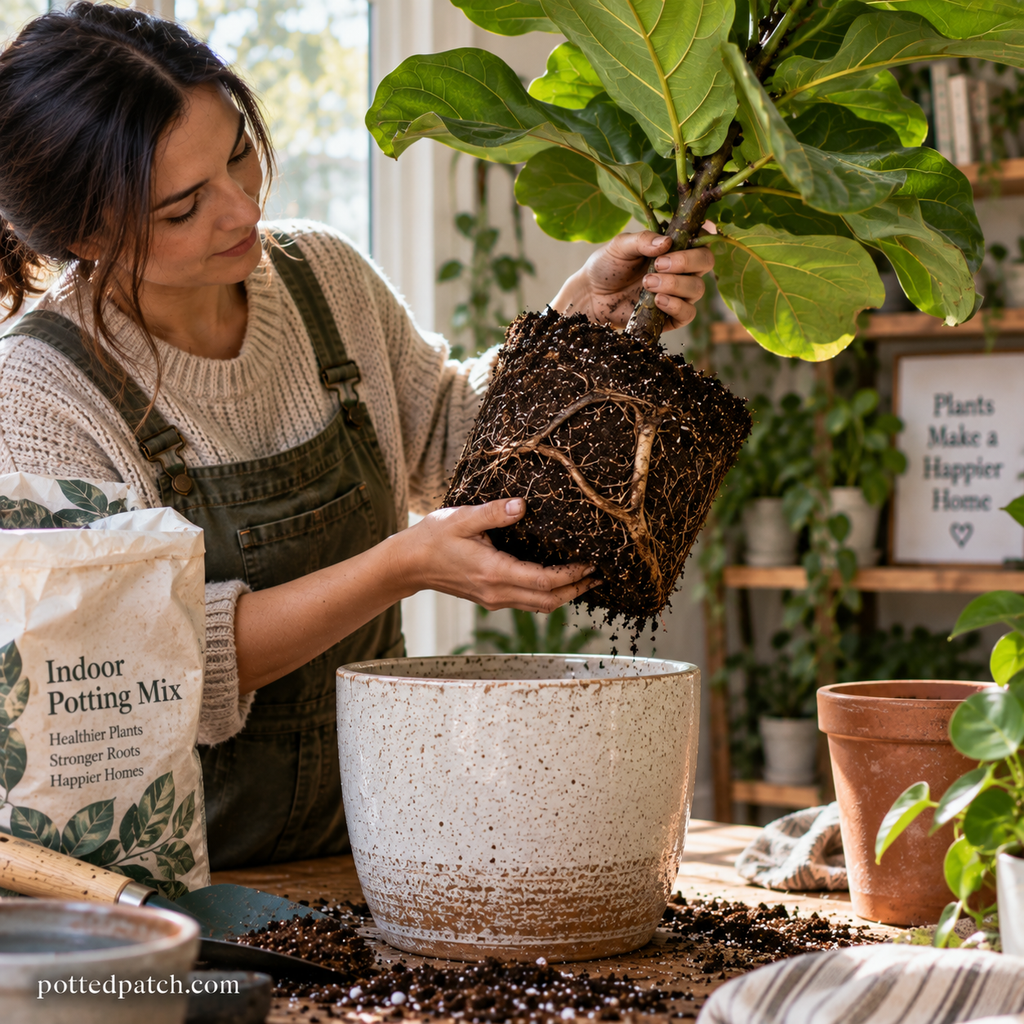
Fiddle leaf figs don’t need to be repotted every year automatically.
Consider repotting when:
- Roots densely fill the container
- Roots emerge heavily from drainage holes
- The plant dries unusually quickly
- Water runs through immediately
- Soil has become compacted
- Growth slows despite good conditions
- The plant becomes unstable
- You suspect root problems
Spring is often a convenient time.
How to Repot a Fiddle Leaf Fig Step by Step
- Choose a pot slightly larger than the current container.
- Prepare fresh, well-draining potting mix.
- Carefully remove the plant.
- Loosen some of the old soil when necessary.
- Inspect the roots.
- Trim clearly dead or rotten roots with sanitized tools.
- Position the plant at approximately its previous depth.
- Fill around the roots with fresh soil.
- Water thoroughly.
- Allow excess water to drain.
Large fiddle leaf figs can be heavy.
Having another person help stabilize the trunk while removing the pot can make repotting much easier.
Fiddle Leaf Fig Root Rot
Root rot is one of the more serious problems you can encounter.
It typically develops when roots remain in overly wet, poorly aerated conditions.
Possible signs include:
- Dark spreading leaf spots
- Yellowing
- Persistent drooping
- Lower leaf loss
- Soft, dark roots
- Unpleasant-smelling soil
- Declining growth
Healthy roots should generally feel firm.
Rotten roots may be brown or black, soft, mushy, or easily broken apart.
What to Do About Root Rot
If you suspect serious root rot:
- Remove the plant from its pot.
- Gently remove excess wet soil.
- Inspect the root system.
- Cut away severely rotten roots using sanitized tools.
- Repot into fresh, well-aerated soil.
- Use a pot with adequate drainage.
- Correct the conditions that caused the problem.
Simply replacing the soil isn’t enough if you continue watering too frequently or return the plant to very low light.
How to Prune a Fiddle Leaf Fig
Pruning can help control height and encourage a more attractive shape.
You might prune to:
- Control an overly tall plant
- Remove damaged growth
- Encourage branching
- Improve an uneven canopy
- Take propagation cuttings
Use clean, sharp pruning shears.
Fiddle leaf figs produce a milky latex sap when cut, so avoid contact with your eyes and skin and clean your tools afterward.
Where Should You Cut a Fiddle Leaf Fig?
When shortening a stem, make your cut just above a node where a leaf or branch emerges.
New growth may develop from nodes below the pruning point.
Think about the final shape before making the cut.
Once you’ve removed several feet from the top of a plant, you can’t put it back.
How to Encourage a Fiddle Leaf Fig to Branch
Pruning the growing tip can encourage branching below the cut.
Results aren’t always perfectly predictable, but healthy plants often respond by activating new growth points.
Timing matters.
Spring or early summer, when the plant is actively growing, is generally a better time for substantial pruning than the middle of a low-light winter.
Strong light also helps support the new growth.
How to Propagate a Fiddle Leaf Fig
Fiddle leaf figs can be propagated from stem cuttings.
The cutting needs a node.
A single detached leaf may remain alive and even produce roots, but without the necessary stem tissue and growth point, it generally won’t develop into a complete new tree.
Propagating Fiddle Leaf Fig From a Stem Cutting
- Select a healthy stem with at least one node.
- Make a clean cut with sanitized pruning shears.
- Remove lower leaves if necessary.
- Place the cutting in water or a suitable propagation medium.
- Keep it in bright, indirect light.
- Maintain warm, stable conditions.
- Wait for a healthy root system to develop.
- Transfer the cutting to potting soil when appropriate.
Propagation takes patience.
Avoid constantly pulling a cutting from its medium to see whether roots have formed.
Why Does My Fiddle Leaf Fig Have Brown Spots?
Brown spots are probably the most confusing fiddle leaf fig problem because several different conditions can produce them.
Possible causes include:
- Root problems
- Overwatering
- Underwatering
- Sunburn
- Physical damage
- Temperature stress
- Pest damage
- Leaf disease
Look at the texture, location, and progression of the spots.
Dark Brown Spots
Dark spots that spread across leaves, particularly when accompanied by wet soil or yellowing, can point toward root stress or excessive moisture.
Check the soil and roots.
Crispy Brown Edges
Dry, crispy browning around the outer edges of leaves is more commonly associated with dehydration, dry air, or inconsistent watering.
Pale or Tan Patches
Pale, bleached, or dry tan patches on areas exposed to strong sunlight may indicate sunburn.
This often appears after a plant is suddenly moved into more intense direct sun.
Why Are My Fiddle Leaf Fig Leaves Turning Yellow?
Yellow leaves may be caused by:
- Overwatering
- Poor drainage
- Root problems
- Insufficient light
- Nutrient issues
- Natural aging
One old lower leaf turning yellow isn’t necessarily a crisis.
Several leaves yellowing quickly deserves investigation.
Start with soil moisture and light.
Why Is My Fiddle Leaf Fig Dropping Leaves?
Leaf drop can happen for many reasons.
Common causes include:
- Sudden relocation
- Overwatering
- Underwatering
- Root damage
- Cold drafts
- Insufficient light
- Repotting stress
- Pest problems
Think about what changed recently.
Did you move the plant?
Did temperatures drop?
Did you repot it?
Has the soil remained wet much longer than usual?
The timing often provides useful clues.
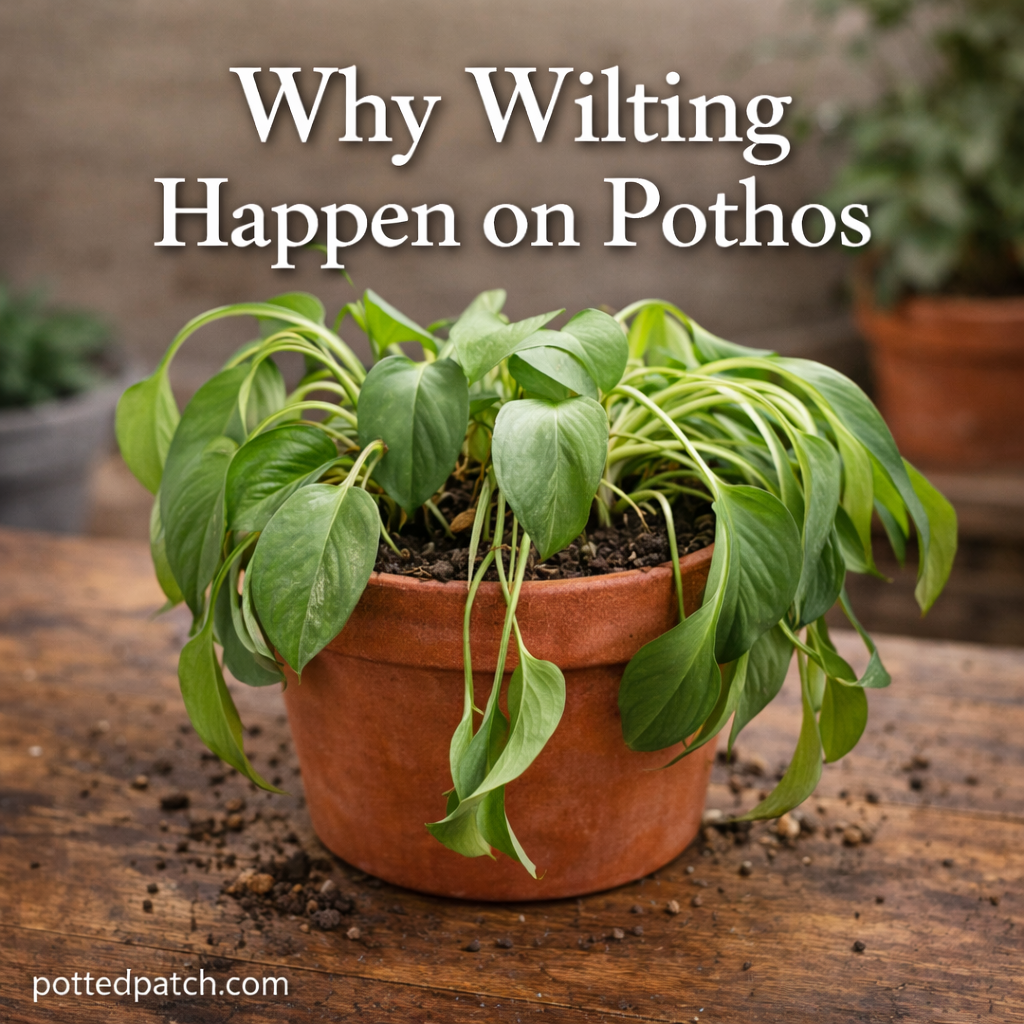
Why Is My Fiddle Leaf Fig Drooping?
Drooping doesn’t automatically mean the plant needs water.
Check the soil first.
If it’s very dry, dehydration is possible.
If it’s soaking wet, damaged roots may be unable to supply the leaves with water effectively.
Other causes include temperature stress and recent repotting.
Why Are My Fiddle Leaf Fig Leaves Curling?
Curling may result from:
- Dry soil
- Low humidity
- Temperature stress
- Excessive sunlight
- Root problems
- Pest activity
Inspect both the environment and the plant.
Look underneath leaves for pests and check soil moisture before making changes.
Why Is My Fiddle Leaf Fig Not Growing?
Growth can slow because of:
- Insufficient light
- Cool temperatures
- Winter dormancy or seasonal slowdown
- Root problems
- Lack of nutrients
- Severe root binding
- Recent environmental stress
If the plant looks healthy but isn’t growing during winter, it may simply be responding to shorter days.
A lack of growth isn’t always a sign of trouble.
Why Is My Fiddle Leaf Fig Leaning?
Plants naturally grow toward their light source.
A fiddle leaf fig receiving strong light from one side may gradually lean toward the window.
Rotate the pot periodically to encourage more even growth.
A severe or sudden lean can also result from an unstable root system or a top-heavy plant, so check the base if necessary.
Common Fiddle Leaf Fig Pests
Fiddle leaf figs can attract several common houseplant pests.
Watch for:
- Spider mites
- Scale
- Mealybugs
- Thrips
- Fungus gnats
Spider Mites
Spider mites may cause:
- Fine webbing
- Pale stippling
- Faded foliage
- Tiny moving dots on leaf undersides
They can spread quickly, especially in warm, dry conditions.
Scale
Scale insects can look like small brown or tan bumps attached to stems or leaves.
Check around leaf veins and stems carefully.
Mealybugs
Mealybugs appear as small white, cottony clusters.
They often hide in leaf joints and protected areas.
How to Prevent Pest Problems
Regular inspection is one of the easiest ways to prevent a small infestation from becoming a major one.
Good habits include:
- Inspecting plants before purchasing
- Separating new plants temporarily
- Checking leaf undersides
- Cleaning foliage
- Removing dead plant material
- Inspecting neighboring plants when pests appear
- Maintaining healthy growing conditions
Large fiddle leaf fig leaves make inspection relatively easy, so take advantage of it.
How to Clean Fiddle Leaf Fig Leaves
Those enormous leaves collect dust.
Wipe them occasionally with a soft damp cloth.
Support the underside of each leaf with one hand while gently wiping with the other.
Avoid aggressive rubbing.
Clean foliage looks better, makes pest inspection easier, and keeps dust from building up on the leaf surface.
You generally don’t need commercial leaf-shine products.
Fiddle Leaf Fig Care Throughout the Year
Indoor growing conditions change with the seasons.
Your care routine should change too.
Spring
Increasing daylight often triggers stronger growth.
Spring is a good time to:
- Repot when necessary
- Begin fertilizing
- Prune
- Take propagation cuttings
- Increase watering as growth accelerates
- Inspect for pests
Summer
Warm temperatures and strong light can increase water use.
Check the soil more frequently.
Protect plants from sudden exposure to intense direct sunlight and keep them away from strong air-conditioning vents.
Fall
Growth often begins slowing as daylight decreases.
Soil may take longer to dry.
Reduce fertilizer and adjust watering accordingly.
Winter
Fiddle leaf figs often use considerably less water during winter.
Keep the plant in the brightest appropriate location and avoid cold drafts.
Indoor heating may also lower humidity.
Fiddle Leaf Fig Care Checklist for Beginners
If you’re growing your first fiddle leaf fig, focus on these basics:
- Give it plenty of bright, indirect light.
- Acclimate gradually to direct sunlight.
- Check the soil before watering.
- Water thoroughly when needed.
- Allow the upper soil to dry between waterings.
- Use loose, well-draining potting mix.
- Choose a pot with drainage holes.
- Avoid oversized containers.
- Keep temperatures relatively stable.
- Fertilize moderately during active growth.
- Clean and inspect the large leaves.
- Rotate occasionally for balanced growth.
- Avoid constantly moving the plant.
Most importantly, don’t react to every imperfect leaf by changing five things at once.
Consistency matters.
Frequently Asked Questions About Fiddle Leaf Fig Care
Are Fiddle Leaf Figs Good for Beginners?
They can be, provided you have enough light and are willing to monitor soil moisture.
They’re less forgiving than some beginner houseplants, but their care isn’t unusually complicated once the basics are established.
How Often Should I Water a Fiddle Leaf Fig?
There’s no fixed schedule.
Check the soil and water when the upper portion has dried appropriately.
Watering frequency changes with light, temperature, season, pot size, and soil.
Does a Fiddle Leaf Fig Need Direct Sun?
Not necessarily.
Bright indirect light is a good baseline.
Some direct sun can be beneficial when the plant is gradually acclimated.
Can a Fiddle Leaf Fig Grow in Low Light?
It may survive for some time, but low light usually leads to slower growth and increases the risk of soil remaining wet too long.
A brighter location is generally better.
Does a Fiddle Leaf Fig Like to Be Root-Bound?
It can tolerate being somewhat snug in its container, but severe root binding can eventually interfere with water uptake and growth.
Repot when the root system clearly needs more room.
Should I Cut Brown Leaves Off My Fiddle Leaf Fig?
You can remove severely damaged leaves for appearance or plant management.
Avoid removing large numbers of otherwise functional leaves at once.
A partially damaged leaf can still contribute to photosynthesis.
Can Brown Spots Turn Green Again?
No.
Once leaf tissue has become permanently damaged, it won’t return to healthy green tissue.
Focus on preventing new damage.
How Fast Does a Fiddle Leaf Fig Grow?
Growth varies according to light, temperature, nutrition, root health, and plant maturity.
Under strong indoor conditions, healthy plants can produce noticeable growth during spring and summer.
Why Did My Fiddle Leaf Fig Stop Growing?
Seasonal changes are a common reason.
If the plant otherwise looks healthy, slower winter growth may be normal.
If growth remains stalled during the active season, investigate light, roots, nutrition, and overall plant health.
Can You Grow a Fiddle Leaf Fig From One Leaf?
A leaf may produce roots, but a complete new fiddle leaf fig generally requires a stem cutting containing a node and viable growth point.
For propagation, use an appropriate stem section rather than a detached leaf alone.
Is Fiddle Leaf Fig Toxic to Pets?
Fiddle leaf figs contain irritating sap and can cause problems if chewed or eaten by pets.
Keep the plant out of reach of cats, dogs, and other animals likely to chew foliage.
If you suspect a pet has eaten part of the plant or is showing unusual symptoms, contact your veterinarian or an appropriate animal poison-control service.
Final Thoughts on Fiddle Leaf Fig Care
Fiddle leaf figs aren’t impossible plants. They’re plants that notice when their environment isn’t working.
And in a way, that’s useful.
Drooping leaves tell you to check moisture. Leaning growth tells you to look at the light. Repeated brown spots tell you to investigate watering, roots, sun exposure, or environmental stress.
The biggest mistake is responding to every symptom by immediately watering.
Check first.
Give your fiddle leaf fig a bright location, well-draining soil, a properly sized pot, and enough time for the upper soil to dry between thorough waterings. Keep its environment reasonably stable and adjust your routine as the seasons change.
Don’t worry about maintaining a plant with absolutely flawless leaves.
A healthy fiddle leaf fig may still carry an old brown spot or damaged edge from months ago. What matters more is what happens next.
If the roots are healthy and the plant continues producing strong new leaves, you’re moving in the right direction.