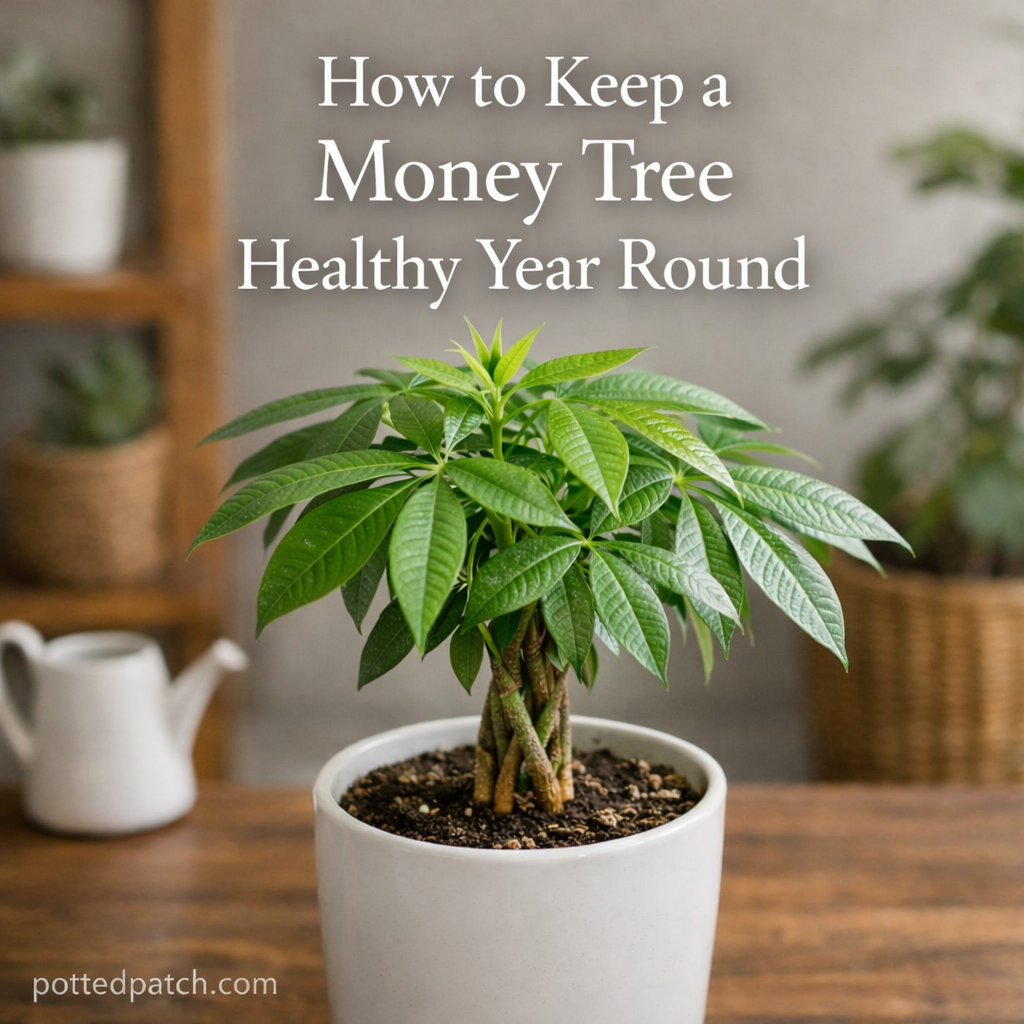

Money trees are popular indoor plants for a good reason. With their glossy green leaves, distinctive trunks, and relatively forgiving nature, they can add a tropical feel to a room without demanding constant attention.
The money tree (Pachira aquatica) is often sold with several young trunks braided together, giving it the familiar appearance seen in homes and offices. While money trees have a reputation for being easy houseplants, they still have a few preferences—especially when it comes to watering, drainage, and light.
If your money tree is dropping leaves, turning yellow, or simply not growing the way you expected, a few adjustments to its environment may be all it needs.
This guide covers everything you need to know about money tree care, including watering, light, soil, humidity, fertilizing, pruning, repotting, propagation, and common problems.
Money Tree Care at a Glance
Before getting into the details, here’s a quick overview of what a money tree generally needs indoors:
- Light: Bright, indirect light
- Water: Water thoroughly after the upper portion of the soil begins to dry
- Soil: Loose, well-draining potting mix
- Humidity: Average to moderately humid indoor conditions
- Temperature: Warm, stable household temperatures
- Fertilizer: Light feeding during active growth
- Pruning: As needed to control shape and encourage branching
- Repotting: When roots become crowded or the soil needs refreshing
Money trees tolerate occasional mistakes better than many tropical houseplants, but consistently wet soil is one problem they don’t handle particularly well.
Understanding the Money Tree
Pachira aquatica is a tropical plant native to parts of Central and South America, where it can grow much larger than the compact specimens commonly kept as houseplants.
Indoors, its size is considerably easier to manage. Regular pruning, container size, and indoor growing conditions naturally limit its growth.
One important thing to understand is that the braided trunk isn’t how money trees naturally grow. Growers typically braid several flexible young plants together while their stems are still easy to manipulate.
As those trunks mature, they become thicker and more rigid.
This means a braided money tree may actually contain several individual plants sharing the same pot.
How Much Light Does a Money Tree Need?
Money trees generally perform best in bright, indirect light.
A location near a bright window can work very well, particularly when the plant receives plenty of ambient light without being exposed to intense direct sun for hours at a time.
Too little light can result in:
- Slow or weak growth
- Long, stretched stems
- Smaller new leaves
- Gradual leaf loss
- Soil that stays wet for too long
Intense direct sunlight can create a different set of problems. Leaves that aren’t accustomed to strong sun may develop pale, bleached, or scorched areas.
Finding the Right Location
Instead of focusing only on which direction a window faces, pay attention to the actual conditions around your plant.
Buildings, trees, curtains, window size, and seasonal changes can dramatically affect how much light reaches a room.
A money tree positioned several feet from a window may receive much less usable light than you realize.
If your plant begins leaning strongly toward the window, rotate the pot periodically so growth remains more balanced.
Can Money Trees Grow in Low Light?
Money trees can tolerate somewhat lower light conditions, but “tolerate” doesn’t necessarily mean “thrive.”
Growth usually slows as available light decreases. The plant also uses water more slowly, which increases the risk of overwatering if you continue watering on the same schedule.
For long-term health, give your money tree the brightest indirect light you can reasonably provide.
How Often Should You Water a Money Tree?
Watering is where many money tree problems begin.
Rather than watering every Tuesday or following another rigid schedule, check the soil first.
Allow the upper portion of the potting mix to dry before watering again. You can test it by inserting a finger into the soil or using a wooden skewer to get a better idea of moisture deeper in the pot.
When it’s time to water:
- Take the plant to a sink or another area where excess water can drain safely.
- Water the soil thoroughly and evenly.
- Continue until excess water begins draining from the bottom of the pot.
- Allow the container to finish draining.
- Empty any water collected inside the saucer or decorative outer pot.
The goal is to thoroughly moisten the root ball and then allow it to partially dry—not to constantly keep the soil damp.
Why a Fixed Watering Schedule Can Cause Problems
Your money tree doesn’t use the same amount of water throughout the year.
Water consumption changes according to:
- Light levels
- Temperature
- Humidity
- Plant size
- Pot size
- Soil composition
- Season
- Rate of new growth
A plant that needs water fairly frequently during bright summer weather may take considerably longer to dry during winter.
Treat the calendar as a reminder to check your money tree rather than an automatic reminder to water it.
Signs Your Money Tree Is Overwatered
Overwatering isn’t simply giving a plant a large amount of water at once. The bigger issue is soil remaining saturated for too long.
Roots need both moisture and oxygen. When the spaces in the soil stay filled with water, root health can decline.
Possible signs include:
- Yellowing leaves
- Repeated leaf drop
- Soft or unhealthy roots
- A sour or unpleasant smell from the soil
- Persistently wet potting mix
- Softening near the base of a trunk
If you suspect overwatering, don’t simply add less water each time. First determine why the soil is staying wet.
The pot may be too large, the soil may be compacted, drainage may be inadequate, or the plant may not be receiving enough light.
What Healthy and Unhealthy Roots Look Like
If you need to inspect the roots, healthy money tree roots should generally feel firm rather than soft and mushy.
Damaged or rotting roots may appear dark, soft, slimy, or fragile and can sometimes have an unpleasant odor.
Remove clearly dead or rotting material with clean pruning tools and correct the underlying drainage or watering problem before repotting.
Can a Money Tree Be Underwatered?
Yes. Although overwatering gets more attention, money trees shouldn’t be allowed to remain completely dry for extended periods.
An underwatered money tree may develop:
- Drooping leaves
- Dry, crispy leaf edges
- Rapidly drying soil
- Leaf drop
- Soil pulling away from the sides of the pot
If the soil has become extremely dry, water may run directly through gaps around the root ball without actually soaking it.
Water slowly and thoroughly so the potting mix has time to absorb moisture.
Best Soil for a Money Tree
Money trees prefer a potting mix that holds enough moisture for the roots while still allowing excess water to drain efficiently.
A dense mix that remains soggy for long periods can make watering much more difficult.
A practical indoor mixture can contain quality houseplant potting soil combined with drainage-enhancing ingredients such as:
- Perlite
- Pumice
- Fine orchid bark
- Other coarse, airy potting amendments
You don’t need an overly complicated recipe. What matters most is creating a loose root environment that drains reliably while retaining some moisture.
Does a Money Tree Need a Drainage Hole?
A drainage hole is strongly recommended.
It allows excess water to escape and makes thorough watering much safer.
If you like decorative pots without drainage, place the money tree inside a slightly smaller nursery pot with drainage holes. Remove the inner pot when watering, let it drain completely, and then return it to the decorative container.
Never allow the inner pot to sit in accumulated water.
Choosing the Right Pot Size
Bigger isn’t always better.
Moving a relatively small money tree into an oversized container creates a large volume of soil around the root system. That extra soil can stay wet much longer than the roots need.
When repotting, choose a container only moderately larger than the existing root system.
The pot should provide enough room for continued root growth without surrounding the plant with excessive amounts of unused, wet soil.
Temperature Requirements for Money Trees
Money trees appreciate the same general temperatures that make most homes comfortable.
Stable conditions are more important than chasing one exact number.
Keep your plant away from sudden temperature extremes, including:
- Cold drafts
- Frequently opened exterior doors during cold weather
- Heating vents
- Air-conditioning vents
- Extremely hot windows
Rapid environmental changes can sometimes trigger leaf drop even when nothing is seriously wrong with the plant.
How Much Humidity Does a Money Tree Need?
As tropical plants, money trees appreciate moderate humidity. Fortunately, they can usually adapt to typical household conditions.
If your home becomes particularly dry, especially when heating systems are running, you may notice dry leaf edges or tips.
A humidifier can help when indoor air is consistently dry.
Grouping plants together may create a slightly more humid microclimate as well, although it won’t transform a very dry room into a humid one.
Should You Mist a Money Tree?
Misting provides only a temporary increase in moisture around the leaves and isn’t a substitute for maintaining appropriate room humidity.
It’s generally unnecessary for a healthy money tree.
Instead, focus on good watering habits, adequate light, reasonable humidity, and airflow around the foliage.
How to Fertilize a Money Tree
Money trees growing indoors don’t require heavy feeding.
A balanced houseplant fertilizer can be used during periods of active growth according to the product’s directions. Avoid assuming that more fertilizer will produce faster growth.
Too much fertilizer can cause salts to accumulate in the potting mix and potentially damage roots.
Reduce or pause fertilizing when growth slows significantly, particularly during darker parts of the year.
Also avoid fertilizing a severely stressed plant in an attempt to revive it. Identify and correct the underlying problem first.
How to Prune a Money Tree
Pruning helps control height and encourages a fuller, more balanced shape.
Money trees can become somewhat leggy indoors, especially when they’re stretching toward available light.
To prune:
- Inspect the plant and decide which stems are making it look unbalanced.
- Use clean, sharp pruning shears.
- Make a clean cut just above a node or branching point when appropriate.
- Remove damaged or dead growth.
- Avoid unnecessarily removing large amounts of healthy foliage at once.
New growth can develop below pruning points, helping create a bushier appearance over time.
Should You Cut the Braided Trunk?
Routine shaping should focus primarily on leafy stems and branches rather than cutting into the main braided trunks.
Also inspect braided money trees occasionally for ties, wires, or bands left from production. As trunks expand, restrictive material can potentially damage them.
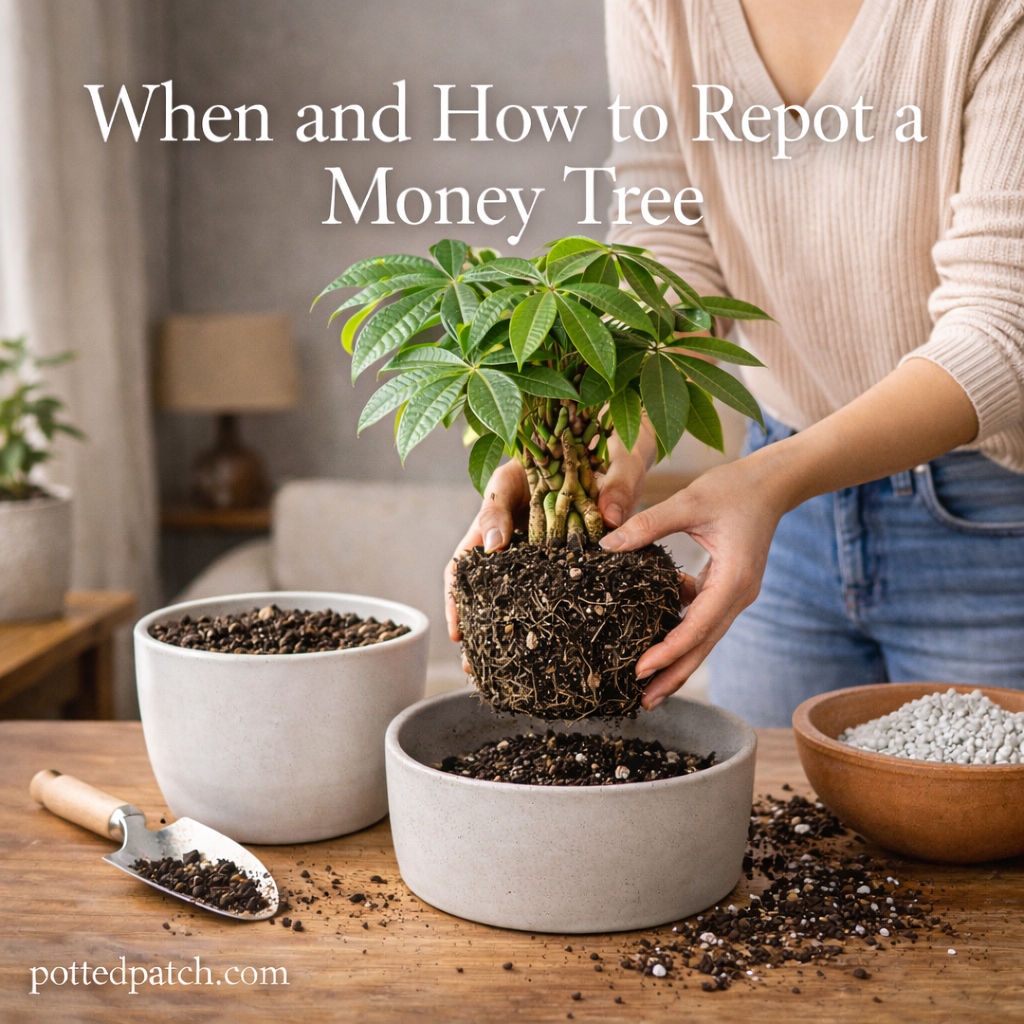
How to Repot a Money Tree
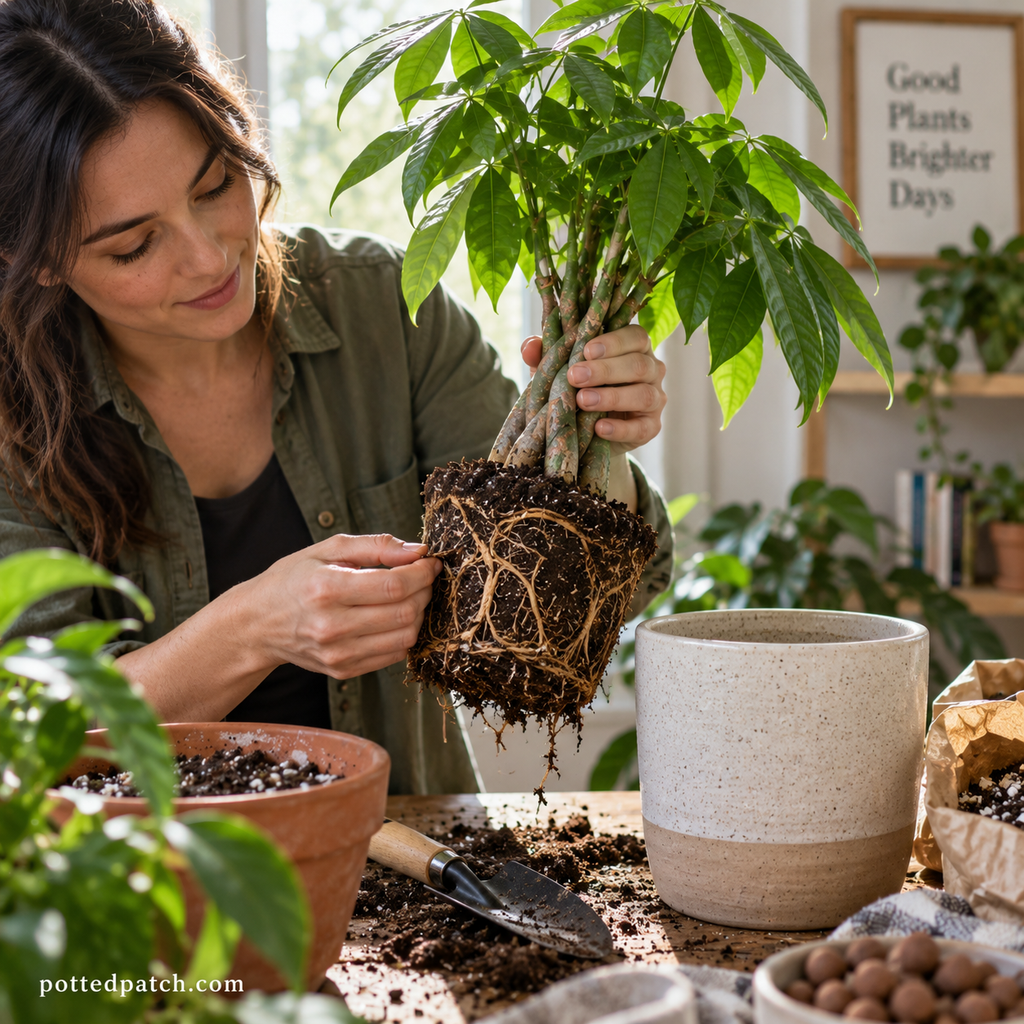
A money tree doesn’t need to be repotted simply because you’ve owned it for a certain amount of time.
Instead, look at the plant and its root system.
Repotting may be appropriate when:
- Roots heavily circle the inside of the container
- Roots emerge extensively through drainage holes
- The plant dries unusually quickly because the pot is packed with roots
- The soil has become compacted or drains poorly
- The plant has outgrown its container
To repot your money tree:
- Choose a slightly larger container with adequate drainage.
- Gently remove the plant from its existing pot.
- Inspect the root system.
- Loosen severely circling roots if necessary.
- Remove obviously dead or rotten roots with clean tools.
- Add fresh, well-draining potting mix.
- Position the plant at approximately the same depth it was previously growing.
- Fill around the root ball without excessively compacting the soil.
- Water thoroughly and allow excess moisture to drain.
Some temporary stress after repotting is possible, so give the plant time to adjust.
How to Propagate a Money Tree
Money trees can be propagated from stem cuttings.
Choose a healthy section of stem containing nodes and make your cut with clean pruning shears.
A simple propagation process is:
- Take a healthy stem cutting.
- Remove leaves from the lower portion of the cutting.
- Keep some healthy foliage toward the top.
- Place the cutting in water or an appropriate propagation medium.
- Keep it in bright, indirect light.
- Maintain warm, stable conditions while roots develop.
Root development takes time, so don’t be concerned if you don’t see dramatic changes immediately.
If propagating in water, refresh the water regularly and monitor the submerged portion of the cutting for signs of decay.
Once a healthy root system develops, the cutting can eventually be transitioned into a small container of well-draining potting mix.
Why Are My Money Tree’s Leaves Turning Yellow?
Yellow leaves are a symptom rather than a diagnosis.
Several different problems can produce similar-looking foliage.
Common possibilities include:
- Soil remaining wet too long
- Poor drainage
- Insufficient light
- Root problems
- Environmental stress
- Normal aging of older leaves
Look at the entire plant before making changes.
If one old lower leaf turns yellow occasionally while the plant continues producing healthy new growth, there may be nothing to fix.
If multiple leaves suddenly yellow while the soil remains constantly wet, watering and root conditions deserve closer attention.
Why Is My Money Tree Dropping Leaves?
Money trees sometimes respond to environmental changes by dropping leaves.
Potential triggers include:
- Overwatering
- Severe underwatering
- Sudden changes in light
- Cold drafts
- Temperature fluctuations
- Recent relocation
- Repotting stress
- Pest problems
Consider what changed shortly before the leaf drop started.
A recently purchased plant, for example, has gone through major changes in lighting, humidity, temperature, transportation, and handling. Some adjustment can occur after bringing it home.
Why Are Money Tree Leaves Turning Brown?
Brown tips and edges can result from several factors, including inconsistent watering, very dry conditions, root stress, or accumulated fertilizer salts.
Large brown or bleached patches on leaves receiving strong direct sunlight may instead indicate sun damage.
Avoid diagnosing the plant from leaf color alone.
Check the soil moisture, roots, light exposure, watering history, and location before deciding what needs to change.
Common Money Tree Pests
Money trees can occasionally attract common houseplant pests.
Watch for:
- Spider mites
- Mealybugs
- Scale insects
- Aphids
Inspect both sides of the leaves, stems, and areas where leaves connect to stems.
Pest symptoms may include sticky residue, fine webbing, unusual bumps, white cottony material, distorted growth, or clusters of tiny insects.
What to Do if You Find Pests
Move the affected plant away from your other houseplants while you identify and address the infestation.
Depending on the pest, treatment may include physically removing insects, rinsing the foliage, or using an appropriately labeled horticultural or insecticidal product.
Follow product directions carefully, and continue checking the plant afterward. Many pest problems require repeated monitoring because eggs or previously unnoticed insects can remain on the plant.
It’s also a good idea to inspect nearby houseplants.
Should You Clean Money Tree Leaves?
Those broad green leaves eventually collect dust.
Gently wiping them with a soft, damp cloth can keep the foliage clean and make pest inspections easier.
Support each leaf with one hand while wiping gently with the other.
There’s usually no need for commercial leaf-shine products. Clean leaves are attractive enough on their own.
How to Keep a Money Tree Growing Evenly
Indoor plants naturally grow toward their strongest source of light.
If one side of your money tree receives considerably more light than the other, the canopy may eventually become uneven.
Rotate the pot periodically to expose different sides of the plant to the window.
You can also prune excessively long branches to maintain a compact shape.
If the plant repeatedly becomes thin or stretched despite pruning, however, the underlying issue may be insufficient light.
Money Tree Care During Winter
Indoor growing conditions often change considerably during winter.
Days become shorter, sunlight may become weaker, and household heating can reduce humidity.
Most importantly, the soil may take longer to dry.
Continue checking the potting mix rather than following the watering frequency that worked during summer.
You may also need to move the plant closer to a bright window as seasonal light levels decrease.
Keep it away from cold window drafts and direct blasts of heated air.
Common Money Tree Care Mistakes
Most money tree problems come down to a handful of recurring issues.
1. Watering on a Schedule
Check the soil instead. Your plant’s water needs will change throughout the year.
2. Using a Pot That’s Too Large
Oversized pots can hold excessive moisture around a relatively small root system.
3. Letting the Plant Sit in Water
Always empty saucers and decorative pots after watering.
4. Keeping It Too Far From a Window
A room can look bright to us while still providing relatively little usable light to a plant.
5. Fertilizing a Struggling Plant
Fertilizer isn’t medicine. Determine whether watering, light, roots, pests, or environmental conditions are causing the problem first.
6. Making Too Many Changes at Once
Moving the plant, repotting it, changing its watering routine, fertilizing it, and pruning it all at once can create additional stress.
Correct the most likely problem and give the plant time to respond.
Money Tree Care FAQ
Are Money Trees Easy to Care For?
Money trees are generally considered approachable indoor plants. They can tolerate some variation in household conditions, but good drainage and sensible watering are particularly important for keeping them healthy.
Where Should I Put My Money Tree?
Choose a location with plenty of bright, indirect light and relatively stable temperatures. Avoid areas exposed to harsh direct sunlight, cold drafts, or strong heating and air-conditioning vents.
How Do I Know When My Money Tree Needs Water?
Check the potting mix rather than relying on a fixed schedule. Once the upper portion has dried sufficiently, water thoroughly and allow the excess to drain.
Does a Money Tree Need Direct Sunlight?
It doesn’t require intense direct sunlight. Bright, indirect light is generally a safer choice indoors.
Money trees can sometimes tolerate gentler direct sun, particularly when gradually acclimated, but sudden exposure to intense sunlight may scorch foliage.
How Can I Make My Money Tree Bushier?
Provide adequate light and prune long or leggy stems strategically. Pruning above suitable nodes can encourage branching and help produce a fuller canopy.
Why Isn’t My Money Tree Growing?
Growth can slow because of low light, cool temperatures, root problems, nutrient limitations, or normal seasonal changes.
Start by evaluating light and root health before adding more fertilizer.
Do Money Trees Like to Be Root-Bound?
A slightly snug container isn’t necessarily a problem, but a severely root-bound money tree can eventually struggle to absorb water and nutrients efficiently.
Repot when the root system has clearly outgrown its container rather than routinely moving it into larger pots.
How Big Can a Money Tree Get Indoors?
Indoor size varies significantly depending on growing conditions, container size, pruning, and the age of the plant.
Regular pruning makes it possible to maintain a money tree at a manageable size for your space.
Final Thoughts on Money Tree Care
A healthy money tree doesn’t require a complicated routine.
Give it plenty of bright, indirect light, use a well-draining potting mix, and let the soil partially dry between thorough waterings. Keep temperatures relatively stable, provide reasonable humidity, and fertilize modestly when the plant is actively growing.
Most importantly, pay attention to the plant rather than following rigid schedules.
Changes in its leaves, growth, soil, and water use can tell you a great deal about what it needs. Once you learn those signals, money tree care becomes much easier—and your plant has a much better chance of staying green, full, and healthy for years.