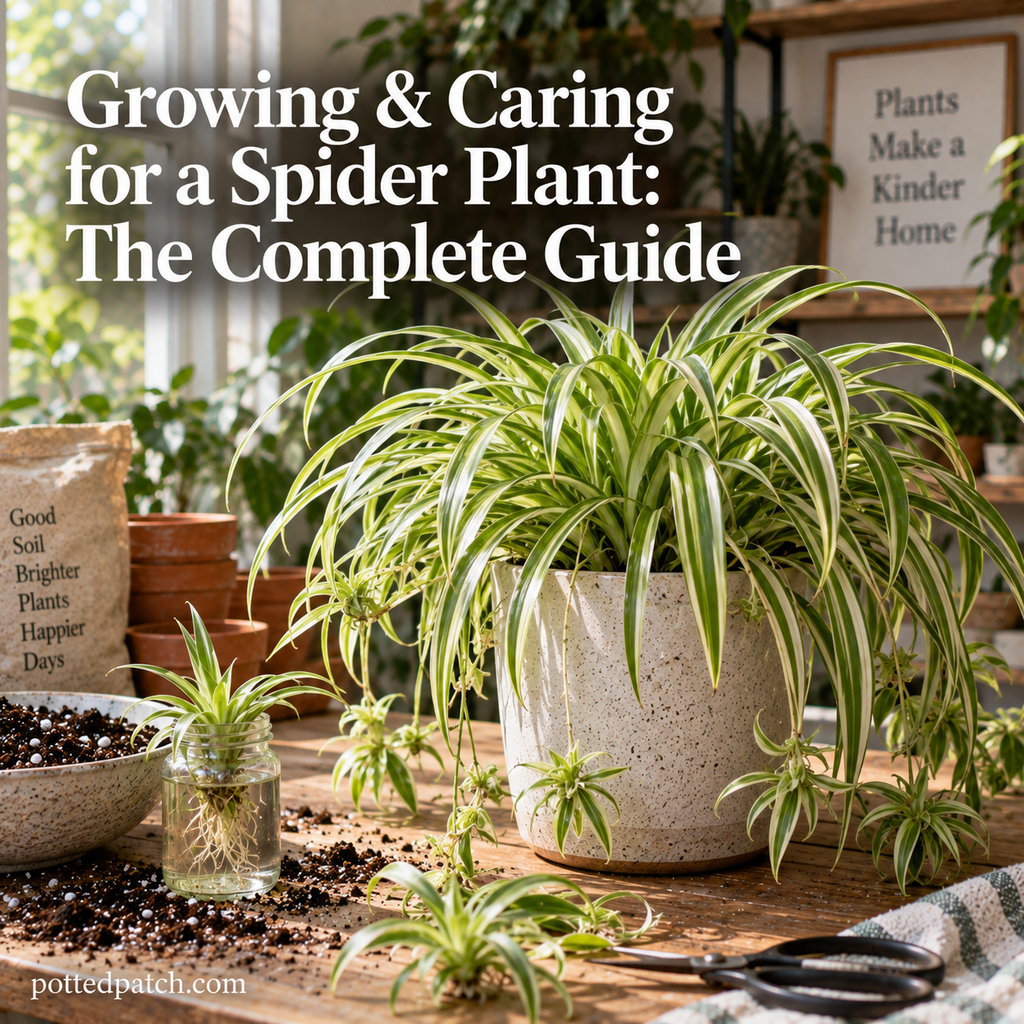
Spider plants are the kind of houseplant that can make almost anyone feel successful. They grow quickly under the right conditions, tolerate the occasional missed watering, and produce cascading plantlets that can turn one plant into an entire collection.
They’re forgiving, but they’re not completely maintenance-free.
Brown leaf tips, pale foliage, soggy soil, and a plant that refuses to produce spiderettes are all common frustrations. Fortunately, most spider plant problems can be traced back to a handful of things: light, watering, soil, root health, or the plant’s growing environment.
Whether you’ve just brought home your first spider plant or you’re trying to revive an older one, this complete guide covers what you need to know about growing and caring for spider plants indoors.
About the Spider Plant
The spider plant, Chlorophytum comosum, is a popular houseplant originally native to parts of Africa.
Its long, narrow leaves grow outward from the center, eventually forming an arching fountain of foliage. Depending on the variety, the leaves may be solid green or striped with white or cream.
Mature plants can also produce long stems with small flowers and baby plants. These young plants are commonly called spiderettes, pups, or plantlets.
That cascading growth makes spider plants especially attractive in:
- Hanging baskets
- Plant stands
- Shelves
- Elevated pots
- Window displays
They’re also relatively adaptable, making them a practical choice for beginners.
Spider Plant Care at a Glance
For a quick overview, most indoor spider plants do well with:
- Light: Bright, indirect light
- Water: When the upper portion of the soil begins to dry
- Soil: Loose, well-draining indoor potting mix
- Temperature: Approximately 60–80°F (16–27°C)
- Humidity: Average household humidity
- Fertilizer: Light feeding during active growth
- Repotting: When roots become heavily crowded
- Propagation: Spiderettes, division, or rooted plantlets
- Difficulty: Beginner-friendly
Spider plants are adaptable enough to tolerate less-than-perfect conditions, but they’ll usually grow fuller and produce more plantlets when their basic needs are consistently met.
How Much Light Does a Spider Plant Need?
Spider plants grow best in bright, indirect light.
A location near an east-facing window can work particularly well because the plant receives good natural light without being exposed to intense afternoon sun.
Bright rooms with south- or west-facing windows can also work. You may simply need to position the plant farther from the glass or filter strong sunlight with a sheer curtain.
Can Spider Plants Grow in Low Light?
Spider plants can tolerate lower-light conditions, but growth may slow considerably.
In insufficient light, you may notice:
- Slower growth
- Smaller leaves
- Less pronounced variegation
- Fewer spiderettes
- Weak or stretched growth
- Soil taking longer to dry
A spider plant sitting in a dim corner may survive, but it probably won’t look as full or vigorous as one receiving brighter light.
Can Spider Plants Take Direct Sun?
Some gentle morning sunlight is usually tolerated.
Intense direct sunlight, particularly during the hottest part of the afternoon, may scorch the leaves.
Sun damage can appear as:
- Bleached patches
- Brown areas
- Crispy sections
- Faded foliage
If you’re moving a plant into stronger sunlight, increase the exposure gradually rather than making a sudden change.
How Often Should You Water a Spider Plant?
Spider plants appreciate consistent moisture but shouldn’t sit in constantly soggy soil.
Rather than watering according to a strict schedule, check the potting mix.
When the upper inch or two feels dry, it’s usually time to investigate whether the plant needs water.
When watering:
- Water the soil thoroughly.
- Continue until excess water drains from the bottom of the pot.
- Allow the container to drain.
- Empty standing water from the saucer or decorative pot.
- Wait until the upper soil begins drying before watering again.
How quickly this happens depends on your particular growing conditions.
Why a Fixed Watering Schedule Doesn’t Work
Your spider plant doesn’t use the same amount of water every week of the year.
Watering frequency changes with:
- Light
- Temperature
- Humidity
- Pot size
- Soil composition
- Plant size
- Season
- Container material
A large spider plant in a warm, bright room may dry relatively quickly. The same plant in a cooler, darker location may remain moist much longer.
Check the plant instead of the calendar.
Signs of an Overwatered Spider Plant
Spider plants tolerate occasional watering mistakes, but consistently saturated soil can eventually damage the roots.
Possible signs of overwatering include:
- Yellow leaves
- Drooping despite wet soil
- Soft or darkened growth near the base
- Soil remaining wet for unusually long periods
- An unpleasant smell from the pot
- Brown or black roots
- Declining growth
If the plant is drooping while the soil is wet, don’t immediately give it more water.
Check the root zone first.
What Spider Plant Root Rot Looks Like
Healthy spider plant roots are typically firm and often pale or cream-colored. Mature plants can also develop thick, fleshy roots that store water.
Rotten roots may appear:
- Brown or black
- Soft
- Mushy
- Slimy
- Fragile
- Unpleasant smelling
If you discover significant rot, remove badly damaged roots with clean pruning tools and repot the healthy portion of the plant in fresh, well-draining soil.
Signs of an Underwatered Spider Plant
Spider plants can tolerate some dryness, partly because of their thickened roots, but prolonged drought will eventually show.
Signs may include:
- Drooping leaves
- Folding or curling foliage
- Crispy brown tips
- Dry soil
- Pale or dull-looking leaves
- A pot that feels unusually light
If the soil has become extremely dry, water thoroughly.
Potting mix that has dried excessively can sometimes pull away from the container and repel water. In that situation, apply water slowly enough for the soil to absorb it rather than letting everything immediately run down the sides.
Why Does My Spider Plant Have Brown Tips?
Brown leaf tips are probably the most familiar spider plant problem.
Unfortunately, there isn’t one single cause.
Possible reasons include:
- Inconsistent watering
- Prolonged dryness
- Fertilizer buildup
- Mineral or salt accumulation
- Very dry indoor conditions
- Root stress
- Physical damage
Some spider plants can also be sensitive to minerals or chemicals present in certain water supplies.
Should You Use Filtered Water for Spider Plants?
If your plant repeatedly develops brown tips despite otherwise good care, experimenting with rainwater, distilled water, or suitable filtered water may be worthwhile.
Before blaming the water, however, check the basics.
Make sure you’re not:
- Allowing the plant to become severely dehydrated
- Overfertilizing
- Keeping the roots constantly wet
- Exposing the foliage to excessive heat
- Letting fertilizer salts accumulate in the soil
Brown tips are cosmetic once they occur, but correcting the underlying problem can improve future growth.
Should You Cut Brown Tips Off?
You can trim brown tips for appearance if you want.
Use clean scissors and follow the natural shape of the leaf rather than cutting straight across it.
Leave a tiny amount of brown tissue instead of cutting deeply into healthy green foliage.
Trimming won’t fix the cause, so continue investigating if new leaves develop the same problem.
Best Soil for Spider Plants
Spider plants aren’t particularly demanding about soil, but they do best in a mixture that holds some moisture while still draining well.
A quality indoor potting mix is usually a good starting point.
You can improve aeration with materials such as:
- Perlite
- Pumice
- Fine orchid bark
The final mixture shouldn’t become dense and waterlogged after every watering.
How to Tell if the Soil Is Too Dense
Pay attention to how the pot behaves after watering.
Potential warning signs include:
- Water sitting on the soil surface
- Soil staying wet for a very long time
- A compacted or muddy texture
- Poor root growth
- Persistent fungus gnat problems
- Roots beginning to rot
If the potting mix has become heavily compacted, repotting into a fresher, airier mixture may help.
Choosing the Right Pot for a Spider Plant
Spider plants develop surprisingly substantial root systems.
Choose a container that gives the roots enough space without being dramatically oversized.
A pot that’s too large contains more unused soil, which can remain wet longer than necessary.
Do Spider Plant Pots Need Drainage Holes?
Drainage holes are strongly recommended.
They allow excess water to escape and make thorough watering much safer.
If you’re using a decorative pot without drainage, keep the spider plant in a nursery pot inside it. Remove the nursery pot when watering and let it drain before putting it back.
Are Hanging Baskets Good for Spider Plants?
Yes.
Spider plants are particularly well suited to hanging baskets because mature plants produce long stems covered with flowers and dangling plantlets.
Just make sure a hanging plant isn’t so difficult to reach that you stop checking its soil regularly.
Temperature and Humidity for Spider Plants
Spider plants adapt well to normal household conditions.
Temperatures around 60–80°F (16–27°C) are generally suitable.
Protect the plant from:
- Freezing temperatures
- Cold drafts
- Heating vents
- Air-conditioning vents
- Sudden temperature changes
Do Spider Plants Need High Humidity?
Average household humidity is usually sufficient.
If your home is exceptionally dry, slightly higher humidity may help keep the foliage looking its best, but you don’t need greenhouse-like conditions.
Proper watering, healthy roots, and adequate light generally matter more than achieving a precise humidity percentage.
Should You Mist a Spider Plant?
Misting isn’t necessary for healthy growth.
It may temporarily wet the leaves, but it doesn’t provide the consistent humidity increase people sometimes expect.
If your indoor air is extremely dry and humidity is genuinely a concern, a humidifier is more effective.
Otherwise, concentrate on watering the soil properly.
How to Fertilize a Spider Plant
Spider plants can grow relatively quickly under good conditions, but they don’t need heavy feeding.
During active growth, use a balanced houseplant fertilizer according to the product’s instructions.
Avoid overfertilizing.
Too much fertilizer can contribute to:
- Brown leaf tips
- Salt buildup
- Root damage
- White crust on the soil
- Weak or abnormal growth
More fertilizer doesn’t automatically mean more spiderettes.
Good light and healthy roots are equally important.
How to Get a Spider Plant to Produce Babies
The little plants dangling from long stems are one of the biggest attractions of growing spider plants.
A mature plant is more likely to produce spiderettes when it has suitable growing conditions.
To encourage them:
- Provide bright, indirect light
- Avoid excessively large pots
- Water appropriately
- Fertilize moderately during active growth
- Keep the plant healthy
- Give younger plants time to mature
Don’t panic if a newly purchased or recently propagated spider plant doesn’t immediately produce babies.
It may simply need time.
What Are Spider Plant Spiderettes?
Spiderettes are small plantlets that form along flowering stems produced by mature spider plants.
They eventually develop their own leaves and small root structures, making them easy to propagate.
A healthy mother plant can sometimes produce many spiderettes at once.
How to Propagate a Spider Plant
Spider plant propagation is simple, especially once the mother plant begins producing mature spiderettes.
You can root them in soil or water.
How to Propagate Spider Plants in Soil
Rooting directly in soil reduces the need to transition water-grown roots into potting mix later.
To propagate in soil:
- Choose a healthy spiderette with visible root nubs.
- Prepare a small container with fresh potting mix.
- Position the base of the spiderette against the soil.
- Gently secure it in place.
- Keep the soil lightly moist while roots establish.
- Once the plantlet is securely rooted, cut the connecting stem from the mother plant if you haven’t already.
You can even leave the spiderette attached to the mother plant while it begins rooting.
How to Propagate Spider Plants in Water
Water propagation lets you watch the roots develop.
To try it:
- Cut a healthy spiderette from the mother plant.
- Place the base in a small container of clean water.
- Keep the foliage above the water.
- Put the container in bright, indirect light.
- Refresh the water as needed.
- Transfer the plantlet to soil once a healthy root system develops.
Don’t leave a rooted spiderette in water indefinitely if your goal is to grow it as a conventional potted plant.
Propagating Spider Plants by Division
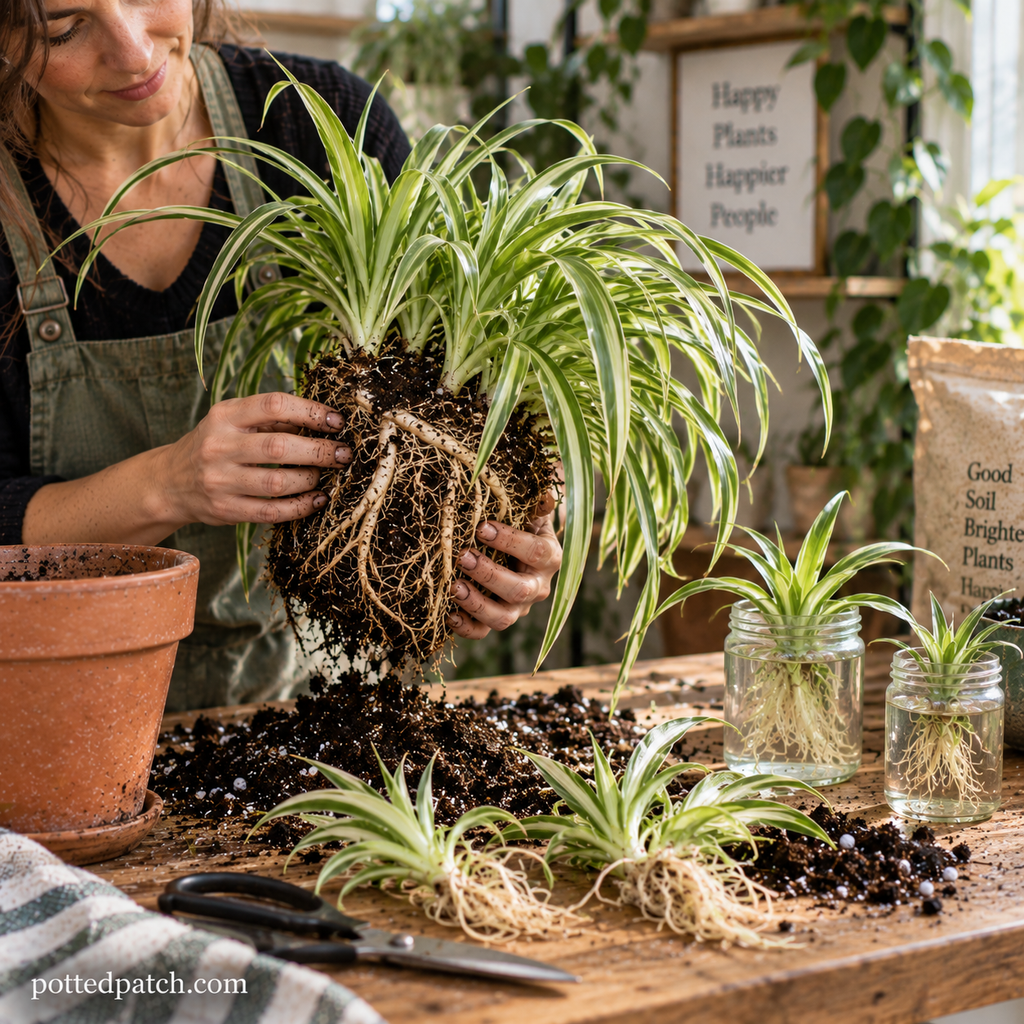
Large spider plants can also be divided.
Remove the plant from its pot and carefully separate the root mass into sections, making sure each division has healthy foliage and roots.
Pot the divisions separately in appropriately sized containers.
Division is especially useful when an older spider plant has become very large or crowded.
When Should You Repot a Spider Plant?
Spider plants can tolerate somewhat crowded roots, so they don’t need a new pot every few months.
Consider repotting when:
- Roots are heavily circling the pot
- Thick roots are pushing the plant upward
- Roots are emerging extensively from drainage holes
- The container is becoming distorted or cracked
- Water runs through unusually quickly
- The plant dries out extremely fast
- Growth has slowed despite good care
Depending on growth, repotting may be needed every year or two, but let the plant tell you when it’s ready.
How to Repot a Spider Plant
- Choose a container slightly larger than the existing pot.
- Prepare fresh, well-draining potting mix.
- Carefully remove the plant.
- Gently loosen the outer roots if they’re tightly circling.
- Inspect for damaged or rotten roots.
- Position the plant at roughly its previous depth.
- Fill around the roots with fresh soil.
- Gently settle the mixture without heavily compacting it.
Avoid jumping from a small pot to a huge one.
A modest increase in size is usually enough.
How to Prune a Spider Plant
Spider plants don’t require complicated pruning.
Most trimming involves removing:
- Dead leaves
- Completely yellow foliage
- Brown tips
- Damaged leaves
- Old flower stems
- Unwanted spiderettes
Use clean scissors or pruning shears.
Where Should You Cut Spider Plant Leaves?
If an entire leaf is dead or badly damaged, cut it near the base of the plant without damaging surrounding healthy growth.
For brown tips, trim only the damaged portion.
If you’re removing spiderettes, cut the thin connecting stem rather than damaging the plantlet itself.
Common Spider Plant Pests
Spider plants can occasionally attract common houseplant pests.
Watch for:
- Spider mites
- Mealybugs
- Scale
- Aphids
Despite the name, spider mites aren’t uniquely associated with spider plants.
Signs of a Pest Problem
Look for:
- Fine webbing
- Sticky residue
- Cotton-like clusters
- Small bumps attached to leaves
- Speckled or stippled foliage
- Distorted new growth
- Visible insects
Inspect both sides of the leaves and the center of the plant.
If you find pests, move the affected plant away from your other houseplants when practical and identify the pest before choosing a treatment.
Why Is My Spider Plant Turning Yellow?
Yellow leaves can have several causes.
Possibilities include:
- Overwatering
- Poor drainage
- Root rot
- Insufficient light
- Nutrient problems
- Natural aging
- Environmental stress
Start by checking the soil.
If several leaves are yellowing while the soil remains wet, investigate the roots and drainage before adding more water.
Why Is My Spider Plant Pale?
Pale growth may result from inadequate light, nutrient issues, root stress, or other environmental conditions.
Variegated varieties naturally contain lighter portions, so distinguish normal coloration from an overall loss of healthy color.
If the entire plant appears washed out, review its light exposure and root health.
Why Is My Spider Plant Drooping?
Drooping doesn’t automatically mean “water me.”
A spider plant may droop because of:
- Dry soil
- Saturated soil
- Root damage
- Heat stress
- Sudden environmental changes
Feel the soil first.
Dry soil and limp foliage may point toward thirst. Wet soil combined with declining leaves deserves a closer look at the roots.
Why Are My Spider Plant Leaves Curling?
Curling or folding leaves can occur when the plant is dehydrated or stressed.
Check:
- Soil moisture
- Temperature
- Root condition
- Light exposure
Avoid treating symptoms individually without considering the plant’s overall environment.
Spider Plant Care in Spring and Summer
Spring and summer often bring faster growth because days are longer and indoor light becomes stronger.
During these seasons:
- Check soil moisture more frequently
- Provide plenty of bright indirect light
- Fertilize appropriately during active growth
- Watch for spiderettes
- Repot if necessary
- Propagate mature plantlets
If you move your plant closer to a sunny window or outdoors for summer, introduce stronger sunlight gradually.
Spider Plant Care in Fall and Winter
Growth may slow as daylight decreases.
Your plant may also use water more slowly.
During fall and winter:
- Check the soil before watering
- Reduce watering frequency if drying takes longer
- Keep the plant away from cold drafts
- Maximize available natural light
- Reduce fertilizer when growth slows
- Watch for pests that can spread among indoor plants
One of the easiest winter mistakes is continuing a summer watering schedule when the soil is no longer drying at the same rate.
Can Spider Plants Grow Outdoors?
Spider plants can spend time outdoors when temperatures are suitable.
A protected patio, porch, or shaded outdoor location can provide excellent growing conditions.
However, don’t move an indoor spider plant directly into intense outdoor sunlight.
Acclimate it gradually.
Also remember to inspect outdoor plants for pests before bringing them back inside.
Are Spider Plants Safe for Cats and Dogs?
Spider plants are generally considered non-toxic to cats and dogs.
That makes them a popular choice for households with pets.
Still, “non-toxic” doesn’t mean you should encourage pets to eat large amounts of the plant. Chewing plant material can potentially cause digestive upset, and repeated nibbling certainly won’t improve the appearance of your spider plant.
Hanging baskets can help keep tempting leaves and spiderettes away from curious pets.
Where Should You Put a Spider Plant Indoors?
Look for a location with good indirect light and enough room for the foliage to arch naturally.
Good options may include:
- Near an east-facing window
- A few feet from a bright south-facing window
- Hanging near a bright window
- On an elevated plant stand
- On a well-lit shelf
- In a bright bathroom
Remember that a mature plant may eventually produce long stems carrying spiderettes.
Give it enough space to show them off.
Common Spider Plant Care Mistakes to Avoid
Spider plants are forgiving, but avoiding a few common mistakes makes growing them much easier.
Try not to:
- Water automatically on a fixed schedule
- Keep the soil constantly soggy
- Use a container without drainage
- Grow the plant indefinitely in extremely low light
- Suddenly expose it to intense direct sunlight
- Repot into an unnecessarily huge container
- Apply excessive fertilizer
- Ignore recurring brown tips
- Assume every drooping leaf means the plant needs water
- Remove spiderettes before deciding whether you want to propagate them
Most spider plant problems become manageable once you identify what’s happening around the roots.
Frequently Asked Questions About Spider Plant Care
Are Spider Plants Easy to Grow?
Yes. Spider plants are generally considered beginner-friendly because they adapt to normal household conditions and tolerate occasional care mistakes.
Proper watering and adequate light make them even easier to maintain.
How Often Should I Water a Spider Plant?
Water when the upper portion of the potting mix has begun to dry.
The actual interval varies depending on the plant, season, light, temperature, pot size, and soil.
Why Does My Spider Plant Keep Getting Brown Tips?
Brown tips can result from inconsistent watering, fertilizer or mineral buildup, very dry conditions, or root stress.
If your overall care seems appropriate, experimenting with the water source may also be worthwhile.
Should I Cut the Babies Off My Spider Plant?
You don’t have to.
Spiderettes can remain attached and create the classic cascading appearance spider plants are known for.
Remove them if you want to propagate new plants, reduce the size of the display, or tidy the mother plant.
Why Isn’t My Spider Plant Making Babies?
The plant may be too young, receiving insufficient light, recently repotted, or simply not ready.
Give it good light and consistent care rather than trying to force plantlet production with excessive fertilizer.
Do Spider Plants Like Small Pots?
Spider plants can tolerate somewhat crowded roots, but they shouldn’t be kept severely root-bound indefinitely.
Move to a slightly larger container when the roots have clearly filled the existing pot.
Can Spider Plants Grow in Water Permanently?
Spider plant cuttings root readily in water, but plants intended for long-term soil culture should eventually be transferred into potting mix.
Growing plants hydroponically long-term requires different care than simply leaving a propagation cutting in a glass of water.
Should I Mist My Spider Plant?
Misting isn’t required.
If your home has extremely dry air, increasing overall humidity is more effective than occasionally spraying the leaves.
How Long Do Spider Plants Live?
With suitable care, spider plants can live for many years.
They can also continuously produce plantlets, allowing a single original plant to create multiple generations of new plants.
A Simple Spider Plant Care Routine
Spider plant care doesn’t need to become another household chore with a complicated schedule.
A simple routine works well:
- Keep the plant in bright, indirect light.
- Check the soil regularly rather than watering automatically.
- Water thoroughly when the upper soil has dried.
- Allow excess water to drain.
- Check foliage for brown tips, yellowing, or pests.
- Fertilize lightly during active growth.
- Remove dead or badly damaged foliage when needed.
- Repot when the roots genuinely become crowded.
- Propagate mature spiderettes if you want more plants.
- Adjust watering and light as the seasons change.
After a while, you’ll become familiar with how quickly your particular plant dries and grows.
Final Thoughts
Spider plants have remained popular for good reason. They’re attractive, adaptable, easy to propagate, and forgiving enough for people who don’t want a houseplant that demands attention every day.
For the best results, give your spider plant bright indirect light, a well-draining potting mix, and a container with drainage. Water thoroughly when the upper soil begins to dry, but don’t leave the roots sitting in constantly wet soil.
Pay attention to brown tips, too. They’re common and usually aren’t an emergency, but recurring damage can tell you something about watering, fertilizer buildup, water quality, or the plant’s environment.
Once your spider plant matures, the real fun begins. Those long stems and dangling spiderettes aren’t just decorative—they’re an easy way to propagate new plants for other rooms, friends, or your growing indoor collection.
Give it the basics, make small adjustments when conditions change, and a spider plant can remain a lively part of your home for years.