
Snake plants have a reputation for being nearly indestructible. They tolerate missed waterings, handle ordinary household humidity, and can adapt to less-than-perfect lighting.
But “low maintenance” doesn’t mean “no maintenance.”
A snake plant can still develop yellow leaves, brown tips, curling foliage, soft stems, root rot, pest problems, or frustratingly slow growth. And because several of these symptoms can have more than one cause, fixing the plant isn’t always as simple as watering it more—or less.
The best approach is to look at the entire growing environment.
Check the soil. Think about when you last watered. Look at the roots when necessary. Consider the amount of light the plant receives and whether anything recently changed.
This troubleshooting guide covers the most common snake plant problems, what may be causing them, and practical steps you can take to help your plant recover.
Start Here: Check These Things First
Before treating an individual leaf, spend a few minutes inspecting the whole plant.
Check:
- Soil moisture
- Drainage
- Roots and rhizomes
- Light
- Temperature
- Pests
- Recent changes
These clues can quickly narrow down the problem.
Check the Soil
Push your finger several inches into the potting mix or use another reliable method to check moisture deeper in the container.
Is the soil:
- Wet?
- Slightly moist?
- Mostly dry?
- Completely dry?
Snake plants store water in their thick leaves and underground rhizomes, so they generally don’t need constantly moist soil.
If the potting mix stays wet for a long time, that’s worth investigating.
Check the Drainage
Make sure excess water can actually leave the container.
Drainage holes are particularly important for snake plants because prolonged moisture around the roots and rhizomes can lead to rot.
If the nursery pot sits inside a decorative outer pot, check for standing water after watering.
Check the Light
Snake plants are famous for tolerating lower light, but they still need light to grow.
A plant kept in very dim conditions may:
- Grow extremely slowly
- Produce weaker growth
- Use water slowly
- Stay wet longer after watering
At the other extreme, a snake plant moved suddenly into intense direct sunlight may develop scorched foliage.
Why Are My Snake Plant Leaves Turning Yellow?
Yellow leaves are one of the most common warning signs.
Potential causes include:
- Overwatering
- Poor drainage
- Root or rhizome rot
- Insufficient light
- Temperature stress
- Natural aging
The soil is the first place to investigate.
Yellow Leaves and Wet Soil
If multiple leaves are turning yellow while the soil remains wet, excessive moisture should be high on your list of possible causes.
Don’t water again until you’ve evaluated the situation.
Check whether:
- The pot has drainage holes
- Water is trapped inside a decorative container
- The soil is dense and compacted
- The pot is too large
- The plant is receiving enough light
- Roots or rhizomes have begun to rot
Yellowing combined with soft leaves or an unpleasant smell from the soil deserves prompt attention.
One Older Leaf Turning Yellow
A single older outer leaf gradually yellowing isn’t necessarily an emergency.
Leaves age.
If the rest of the plant is firm, healthy, and producing normal growth, you may simply be seeing natural decline.
Rapid yellowing across several leaves is more concerning.
Why Are My Snake Plant Leaves Drooping?
Healthy snake plant leaves are usually relatively upright and firm.
When they begin falling outward or losing rigidity, something may have changed.
Possible causes include:
- Overwatering
- Root rot
- Severe underwatering
- Insufficient light
- Physical damage
- Natural growth habit
Drooping With Wet Soil
This combination can indicate root stress.
When roots remain in saturated soil for too long, they may begin to deteriorate.
Check the roots and rhizomes if the plant continues declining.
Drooping With Extremely Dry Soil
Snake plants tolerate drought well, but they aren’t completely immune to dehydration.
If the soil has remained bone dry for an extended period, leaves may begin losing firmness.
Water thoroughly and allow excess water to drain.
Don’t respond by keeping the soil continuously moist afterward.
Why Are My Snake Plant Leaves Soft or Mushy?
Soft, mushy leaves are more concerning than simple leaning.
They often point toward excessive moisture or rot.
Look for:
- Wet soil
- Yellowing
- Soft leaf bases
- Brown or black tissue
- An unpleasant smell
- Mushy rhizomes
If the base of a leaf has become soft and rotten, remove the plant from the pot and inspect below the soil.
Waiting for the soil surface to dry may not be enough if rot is already established.
Snake Plant Root Rot: Signs to Look For
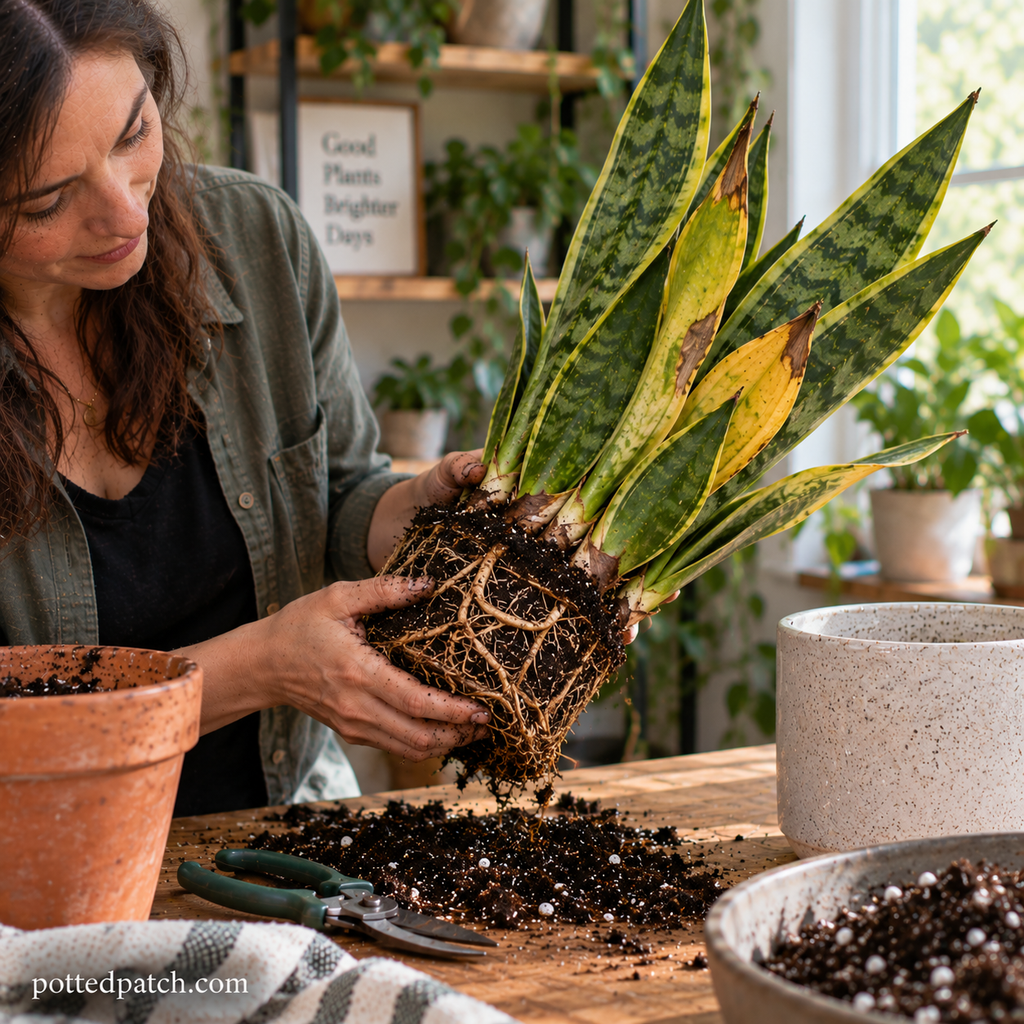
Root and rhizome rot is one of the most serious snake plant problems.
It typically develops when underground plant tissue remains excessively wet and poorly aerated.
Possible signs include:
- Yellow leaves
- Drooping
- Soft leaves
- Mushy leaf bases
- Persistent wet soil
- Unpleasant smell
- Dark, soft roots
- Mushy rhizomes
Healthy vs. Rotten Snake Plant Roots
Healthy roots and rhizomes should generally feel firm.
Rotten tissue may be:
- Soft
- Mushy
- Slimy
- Darkened
- Fragile
- Unpleasant smelling
Don’t rely only on color.
Firmness and texture are important clues when determining whether tissue is healthy.
How to Fix Snake Plant Root Rot
If you’ve confirmed rot, remove the damaged material before it spreads farther.
- Take the snake plant out of its pot.
- Gently remove soil around the roots and rhizomes.
- Identify soft or clearly rotten tissue.
- Cut away damaged roots and rhizomes with clean tools.
- Remove leaves whose bases are severely rotted.
- Clean the container or use a fresh one.
- Repot the remaining healthy plant in fresh, well-draining soil.
- Use a container with adequate drainage.
- Adjust your watering habits.
Don’t move a plant with a reduced root system into a dramatically oversized container.
A large amount of unused soil can stay wet for longer.
Can a Snake Plant Recover From Root Rot?
Sometimes.
Recovery depends on how much healthy tissue remains.
If healthy leaves or rhizome sections survive, the plant may recover.
You may also be able to propagate healthy portions as a backup.
Why Are My Snake Plant Leaves Turning Brown?
Brown foliage can develop for several reasons.
Possible causes include:
- Severe dehydration
- Sunburn
- Cold damage
- Fertilizer buildup
- Root problems
- Physical damage
- Natural aging
Look at the pattern.
Dry brown areas on the side facing a sunny window suggest something different from soft brown tissue beginning near the soil.
Why Does My Snake Plant Have Brown Tips?
Brown tips are usually less serious than mushy leaf bases.
Potential causes include:
- Prolonged dryness
- Inconsistent watering
- Fertilizer buildup
- Mineral accumulation
- Physical damage
- Environmental stress
Snake plant tips are also easily damaged when bumped against walls, furniture, or people.
Should You Cut Brown Tips Off a Snake Plant?
You can, but consider whether it’s necessary.
Once you cut the natural tip off a snake plant leaf, that leaf won’t regrow a pointed tip.
If you choose to trim it, use clean scissors and remove as little healthy tissue as possible.
For minor cosmetic damage, leaving the leaf alone is often perfectly reasonable.
Why Are My Snake Plant Leaves Curling?
Curling or folding can occur when the plant is under stress.
Possible causes include:
- Severe underwatering
- Root damage
- Excessive heat
- Pest activity
- Environmental stress
Check soil moisture first.
If the soil has been extremely dry for a long time, the plant may need water.
If the soil is wet, don’t assume curling means thirst.
Inspect the roots instead.
Why Are My Snake Plant Leaves Wrinkled?
Wrinkled foliage often suggests the leaves have lost some of their stored moisture.
Prolonged underwatering is one possibility.
But damaged roots can also prevent a plant from taking up water properly.
That means wrinkling doesn’t always mean “water immediately.”
Check both the soil and root health.
Wrinkled Leaves and Dry Soil
If the potting mix is completely dry and the plant hasn’t been watered for a long time, give it a thorough watering.
Allow the excess to drain.
Wrinkled Leaves and Wet Soil
If the soil is wet but the leaves still look dehydrated, inspect the roots.
A damaged root system may be unable to supply the foliage properly.
Why Is My Snake Plant Not Growing?
Snake plants aren’t particularly fast growers indoors.
Periods of little visible growth can be completely normal.
Growth may slow because of:
- Low light
- Cooler temperatures
- Seasonal changes
- Root problems
- Nutrient limitations
- Recent repotting
- Plant maturity
Does Low Light Stop Snake Plant Growth?
Very low light can dramatically slow growth.
Snake plants tolerate dim conditions better than many houseplants, but “tolerates low light” doesn’t mean “grows best in darkness.”
Moving the plant to brighter indirect light may encourage stronger growth.
Why Isn’t My Snake Plant Making New Pups?
New shoots, often called pups, emerge from underground rhizomes.
A plant may produce fewer pups if it is:
- Young
- Growing slowly
- Receiving little light
- Experiencing root stress
- Growing during a slower season
Healthy plants sometimes simply need time.
Why Is My Snake Plant Leaning?
A leaning snake plant isn’t always unhealthy.
Possible explanations include:
- Uneven light
- Top-heavy leaves
- Crowded growth
- Loose soil
- Root damage
- Natural leaf orientation
If the plant leans toward a window, it may be responding to the direction of the available light.
Occasional rotation can encourage more balanced growth.
When Leaning Is a Warning Sign
Investigate further if leaning leaves are also:
- Soft
- Yellow
- Mushy near the base
- Easily detached
Those symptoms may indicate rot rather than normal growth.
Why Are Snake Plant Leaves Falling Over?
Leaves can fall outward as they become large, but sudden collapse deserves attention.
Check the base of the affected leaf.
If it’s firm, the issue may be physical damage, orientation, or the weight of the leaf.
If it’s soft or mushy, investigate for rot.
A leaf that has been permanently bent or creased may not stand upright again.
Why Are My Snake Plant Leaves Splitting?
Snake plant leaves can develop splits from physical and environmental stress.
Possible causes include:
- Accidental damage
- Pets
- Rough handling
- Leaves rubbing against objects
- Severe dehydration
- Environmental fluctuations
A split leaf won’t fuse back together.
If the damage is minor, leave it in place.
The leaf can still contribute to photosynthesis.
Why Does My Snake Plant Have White Spots?
White marks can have several explanations.
They may be:
- Mineral residue
- Dust
- Mealybugs
- Scale
- Other surface deposits
Try gently wiping the area with a damp cloth.
If the mark doesn’t wipe away or appears to be an insect attached to the plant, inspect more closely.
Common Snake Plant Pests
Snake plants aren’t especially pest-prone, but infestations can occur.
Watch for:
- Spider mites
- Mealybugs
- Scale
- Thrips
Inspect plants regularly, particularly when you bring a new plant into your home.
Mealybugs on Snake Plants
Mealybugs often appear as white cotton-like clusters.
Check:
- Leaf bases
- Crevices
- New growth
- Areas where leaves overlap
Sticky residue may also be present.
Spider Mites on Snake Plants
Spider mites are tiny and can be difficult to see.
Possible signs include:
- Fine webbing
- Pale speckling
- Dull leaves
- Yellowing
- Tiny moving pests
Inspect the foliage closely.
Scale on Snake Plants
Scale can resemble small brown, tan, or pale bumps attached to the leaves.
Because the insects don’t always look like typical pests, they can be overlooked.
Unexplained sticky residue may provide another clue.
Thrips on Snake Plants
Thrips can cause:
- Silvery scarring
- Speckled damage
- Distorted new growth
- Tiny dark marks
- Declining foliage
Inspect both sides of the leaves and areas around new growth.
What to Do if Your Snake Plant Has Pests
If you find pests:
- Separate the affected plant from nearby houseplants when practical.
- Identify the pest.
- Inspect the entire plant.
- Physically remove pests when practical.
- Remove severely damaged material if necessary.
- Use an appropriately labeled pest treatment when needed.
- Follow the product instructions.
- Continue inspecting the plant over the following weeks.
Check neighboring plants as well.
An infestation may have spread before you noticed it.
Why Is My Snake Plant Soil Staying Wet?
For a drought-tolerant plant, persistently wet soil is an important warning sign.
Possible causes include:
- Low light
- Dense potting mix
- Poor drainage
- Oversized pot
- Cool temperatures
- Frequent watering
Snake plants generally benefit from a loose, well-draining mixture that doesn’t remain saturated.
What Soil Is Best for a Struggling Snake Plant?
A well-draining succulent or cactus-style mix can work, or you can improve a quality potting mix with additional drainage materials.
Common amendments include:
- Perlite
- Pumice
- Coarse mineral components
- Fine orchid bark
The exact recipe matters less than the result.
Water should move through the mixture while enough moisture remains available to the roots.
Why Does Water Run Straight Through the Pot?
Sometimes extremely dry potting mix becomes difficult to rehydrate.
Water may run around the root ball and immediately leave the drainage holes.
This can also happen when:
- Soil has pulled away from the pot
- Roots heavily fill the container
- Potting mix has degraded
- Water channels have formed
Water slowly and check whether the root ball is actually becoming moist.
If the plant is severely root-bound, consider repotting.
Is My Snake Plant Root-Bound?
Snake plants can tolerate somewhat crowded conditions.
However, rhizomes eventually fill the available space.
Signs that repotting may be necessary include:
- Rhizomes crowding the container
- Roots emerging heavily from drainage holes
- The pot becoming distorted
- A ceramic pot cracking
- The plant becoming unstable
- Water behaving unusually because roots occupy most of the container
Move up only slightly in pot size.
A huge container isn’t necessary.
Why Is My Snake Plant Struggling After Repotting?
Temporary stress after repotting isn’t unusual.
The roots may have been disturbed, especially if the plant was heavily root-bound.
After repotting:
- Provide appropriate indirect light
- Avoid excessive watering
- Keep temperatures stable
- Avoid heavy fertilizer
- Give the plant time to adjust
Don’t assume a temporarily drooping plant needs daily watering.
Snake Plant Problems After Propagation
Snake plant propagation can take time.
A cutting may remain unchanged for weeks or even months while developing roots and underground growth.
That doesn’t automatically mean it has failed.
Signs a Cutting May Be Rotting
Watch for:
- Soft tissue
- Mushiness
- Blackened areas
- An unpleasant smell
- Damage spreading upward
Healthy cuttings should remain reasonably firm.
Why Isn’t My Snake Plant Cutting Growing?
Patience may be the answer.
Root development happens before dramatic above-soil growth.
Temperature, light, propagation method, and the condition of the cutting can all affect how quickly new growth appears.
Can a Damaged Snake Plant Leaf Heal?
Damaged tissue won’t return to its original condition.
A split won’t reconnect, a brown patch won’t become green again, and a cut tip won’t regrow its original pointed shape.
However, damaged leaves can remain functional.
When Should You Remove a Damaged Leaf?
Consider removing a leaf if it is:
- Completely yellow
- Completely brown
- Rotten at the base
- Severely damaged
- Heavily infested with pests
Minor cosmetic damage can usually be left alone.
Snake Plant Problems in Winter
Winter can be a particularly risky time for overwatering.
Lower light and cooler temperatures often mean the plant uses water much more slowly.
During winter:
- Check soil carefully before watering
- Keep the plant away from cold drafts
- Maximize available light
- Reduce watering frequency when necessary
- Avoid letting the pot sit in water
- Watch for pest problems
Don’t water simply because a certain number of days have passed.
How to Prevent Common Snake Plant Problems
Snake plants become much easier to manage when you focus on a few fundamentals.
Aim to:
- Provide good indirect light when possible.
- Use loose, well-draining soil.
- Choose a pot with drainage holes.
- Allow the soil to dry substantially between waterings.
- Water thoroughly when the plant actually needs it.
- Empty standing water from decorative containers.
- Avoid dramatically oversized pots.
- Protect the plant from cold temperatures.
- Fertilize moderately during active growth.
- Inspect foliage periodically for pests.
Most importantly, don’t overcare for your snake plant.
Constant watering and intervention often create more problems than occasional neglect.
Frequently Asked Questions About Snake Plant Problems
What Is the Most Common Problem With Snake Plants?
Excess moisture is one of the biggest problems.
Snake plants store water and don’t need constantly moist soil. Poor drainage and frequent watering can eventually contribute to root and rhizome rot.
How Do I Know if My Snake Plant Is Overwatered?
Possible signs include yellow leaves, soft foliage, mushy leaf bases, wet soil, drooping, and rotting roots or rhizomes.
Check the soil and roots before watering again.
How Do I Know if My Snake Plant Is Underwatered?
A severely dehydrated snake plant may develop wrinkled, curling, or less rigid leaves while the soil is extremely dry.
Check soil conditions before assuming water is the solution.
Why Is My Snake Plant Drooping Even Though I Water It?
If the soil remains wet, the roots may be stressed or damaged.
Adding more water can make the situation worse.
Inspect the root system if symptoms continue.
Should I Remove Yellow Snake Plant Leaves?
A completely yellow leaf won’t become green again.
You can remove it near the base using clean tools.
If several leaves are yellowing, determine the cause before focusing on pruning.
Can I Save a Snake Plant With Root Rot?
Sometimes.
Remove rotten roots and rhizomes, preserve healthy tissue, and repot appropriately.
Healthy leaves or rhizome sections may also be propagated when necessary.
Why Isn’t My Snake Plant Growing?
Snake plants naturally grow relatively slowly.
Low light, cooler temperatures, seasonal changes, root problems, or recent stress can slow them further.
Do Snake Plants Really Like Low Light?
They tolerate it, but they generally grow better with stronger indirect light.
Very dim conditions can lead to extremely slow growth and soil that stays wet longer.
Should I Mist a Snake Plant?
Routine misting isn’t necessary.
Snake plants generally tolerate normal household humidity well. Proper soil moisture and healthy roots are much more important.
Quick Snake Plant Troubleshooting Checklist
When your snake plant looks unhealthy, work through these steps:
- Check the soil moisture.
- Make sure the pot drains properly.
- Inspect the base of soft or yellow leaves.
- Check roots and rhizomes if rot is suspected.
- Evaluate the plant’s light.
- Look closely for pests.
- Think about recent watering, repotting, or temperature changes.
- Correct the most likely underlying problem.
- Give the plant time before making more major changes.
Avoid changing everything at once.
A snake plant that has been repotted, heavily pruned, relocated, fertilized, and repeatedly watered in the same week may end up more stressed than when you started.
Final Thoughts
Snake plants are tough, but they aren’t immune to problems.
When something looks wrong, start below the surface.
Check the soil before watering. Make sure excess water can escape. If leaves are becoming soft, yellow, or mushy, inspect the roots and rhizomes rather than assuming the plant needs another drink.
Light matters too. Snake plants may survive in dim corners, but brighter indirect light generally supports stronger growth and helps the soil dry at a healthier rate.
And don’t worry about every scar, split, or brown tip. Older leaves develop imperfections, and physical damage happens.
The more important question is whether the plant continues producing firm, healthy growth.
Once you learn to distinguish between normal imperfections and signs of root, watering, light, or pest problems, snake plant troubleshooting becomes much simpler.
Give it good drainage, sensible watering, adequate light, and enough time to respond. In many cases, that’s exactly what a struggling snake plant needs.