
Dracaena is an adaptable indoor plant, but I’ve found that its reputation for being “easy” can hide the two things that cause most trouble: keeping the roots wet for too long and assuming low-light tolerance means light doesn’t matter. This guide covers the practical side of Dracaena care—watering, light, soil, repotting, new growth, seasonal changes, pruning, and what I check when the leaves start looking different.
Dracaena Indoor Care Basics
Dracaena includes a wide range of houseplants, from tall cane-forming plants to compact varieties with striped, lime-green, cream, or red-edged foliage.
Common types include:
- Dracaena marginata
- Dracaena fragrans
- Dracaena ‘Lemon Lime’
- Dracaena ‘Janet Craig’
- Dracaena ‘Warneckii’
- Dracaena reflexa
Their appearances vary, but the commonly grown indoor varieties share similar basic needs.
As a starting point:
- Light: Bright to moderate indirect light
- Water: Let the upper soil dry before watering again
- Soil: Loose, well-draining potting mix
- Pot: Container with working drainage holes
- Temperature: Warm, stable indoor conditions
- Humidity: Average household humidity is usually adequate
- Fertilizer: Moderate feeding during active growth
- Repotting: When the roots, soil, or plant stability justify it
Dracaenas can tolerate an occasional missed watering better than constantly wet roots. That’s one reason they’re relatively forgiving.
But forgiving isn’t the same as indestructible.
I’ve found the most useful approach is to watch how quickly the pot dries and how the newest leaves are developing rather than trying to follow the same routine throughout the year.
For broader principles that apply to other houseplants as well, see the Complete Indoor Plant Care Guide (Beginner to Advanced).
Light: Low-Light Tolerant Doesn’t Mean No Light
Most Dracaenas perform best in bright, indirect light.
Many darker green varieties can tolerate moderate or lower light, but I’ve learned to make a distinction between a plant surviving in a location and actually growing well there.
A Dracaena kept too far from useful natural light may remain alive while producing very little new growth.
Signs a Dracaena May Need More Light
Watch for:
- Very slow growth
- Smaller new leaves
- Leggy growth
- Leaning toward a window
- Reduced variegation
- Soil remaining wet much longer than expected
That last clue is one I pay particular attention to.
Lower light usually means slower growth and reduced water use. If a Dracaena is moved from a bright location into a dimmer room, the pot may suddenly take much longer to dry.
Continuing the old watering frequency can then create a root problem that looks like a watering issue but actually began with a change in light.
Variegated Dracaenas
Variegated varieties generally benefit from brighter indirect light.
Their cream, yellow, white, or lime-colored areas contain less chlorophyll than solid green tissue, so a very dim location can result in weaker growth or less impressive coloration.
If that happens, move the plant gradually toward brighter indirect light rather than immediately exposing it to intense sun.
Can Dracaena Take Direct Sun?
Some gentle direct sunlight may be tolerated, particularly when the plant has been acclimated to it.
Strong direct sun can scorch foliage.
Look for:
- Bleached patches
- Pale areas
- Dry brown spots
- Damage concentrated on the window-facing side
I’ve found seasonal changes matter here too. A window that provides mild sun during winter can become considerably more intense during summer.
For help evaluating actual room and window conditions, see the Where to Place Indoor Plants (Room-by-Room Guide).
Watering: Let the Upper Soil Dry
Dracaenas generally prefer some drying between waterings.
I don’t try to keep the soil continuously moist, and I don’t water because a certain number of days has passed.
Instead, I check the soil.
When the upper portion has dried and the pot feels noticeably lighter, I start considering whether the plant is ready for water.
How I Water Dracaena
When watering:
- Water slowly across the soil surface.
- Thoroughly moisten the root zone.
- Let excess water drain through the bottom.
- Allow the pot to finish draining.
- Empty standing water from the saucer or decorative outer pot.
- Let the upper soil dry before watering again.
A thorough watering isn’t the same thing as overwatering.
This is an important distinction.
You can run plenty of water through an appropriately sized pot with good drainage and then let it drain. The problem begins when the roots remain wet and poorly aerated for too long.
Why I Don’t Use a Fixed Watering Schedule
Drying time changes with:
- Light
- Temperature
- Season
- Pot size
- Pot material
- Soil composition
- Root density
- Plant size
A Dracaena beside a bright window during summer may use moisture considerably faster than the same plant during December.
That’s why I use a schedule to check plants, not automatically water them.
What an Underwatered Dracaena Looks Like
Possible signs include:
- Drooping
- Curling
- Dry brown edges
- Crispy tips
- Very dry soil
- Leaves losing firmness
If the potting mix becomes extremely dry, water slowly.
I’ve seen very dry mixes pull away from the pot so that water runs around the root ball and straight through the drainage hole. Water coming out the bottom doesn’t necessarily mean the root ball actually absorbed enough moisture.
What an Overwatered Dracaena Looks Like
Watch for:
- Several yellowing leaves
- Drooping despite damp soil
- Persistently wet potting mix
- Soft stems
- Leaf loss
- Dark or mushy roots
- Unpleasant-smelling soil
The combination of drooping + wet soil is especially important.
A dry Dracaena can droop because it needs water. A Dracaena with damaged roots can also droop because those roots can no longer function properly.
That’s why I always check the soil before reaching for the watering can.
Does Water Quality Matter?
Dracaenas can sometimes develop brown leaf tips when substances accumulate in their soil or irrigation water.
If brown tips repeatedly appear despite otherwise appropriate care, experimenting with filtered, distilled, or suitable collected rainwater can be reasonable.
But I don’t automatically blame tap water.
Brown tips can also be associated with:
- Dry air
- Inconsistent watering
- Fertilizer buildup
- Root stress
- Severe drying
- Excessive heat
One brown tip doesn’t tell me enough.
I look at whether the damage is appearing repeatedly on new leaves, how the soil is behaving, and whether anything in the plant’s environment recently changed.
Soil: Drainage Without Drying Immediately
Dracaena prefers loose soil that drains well but still retains some useful moisture.
A standard indoor potting mix can work as a base.
Depending on its texture, materials such as these can improve structure:
- Perlite
- Pumice
- Fine orchid bark
- Coco coir
I don’t think Dracaena needs an elaborate soil recipe.
I’m more interested in what happens after watering.
Does excess water drain? Does the soil remain loose? Does the center of the pot stay saturated for an unusually long time?
Dense soil combined with low light and an oversized pot is a setup I would be particularly cautious about.
Pot Size Matters
Choose a container that matches the root system.
I’ve found “give it plenty of room to grow” can be poor advice when it results in moving a plant into a pot several sizes too large.
The unused soil surrounding a relatively small root ball holds additional water and can dramatically increase drying time.
When repotting, moving up modestly is usually enough.
Terracotta vs. Plastic
Either can work.
Terracotta allows moisture to evaporate through its porous sides, so it generally dries faster.
Plastic and glazed ceramic retain moisture longer.
I don’t consider one material universally better. If a Dracaena in terracotta is drying frustratingly fast, that tells me something. If another in glazed ceramic remains wet for two weeks, that tells me something too.
The container is part of the watering system.
Repotting a Dracaena
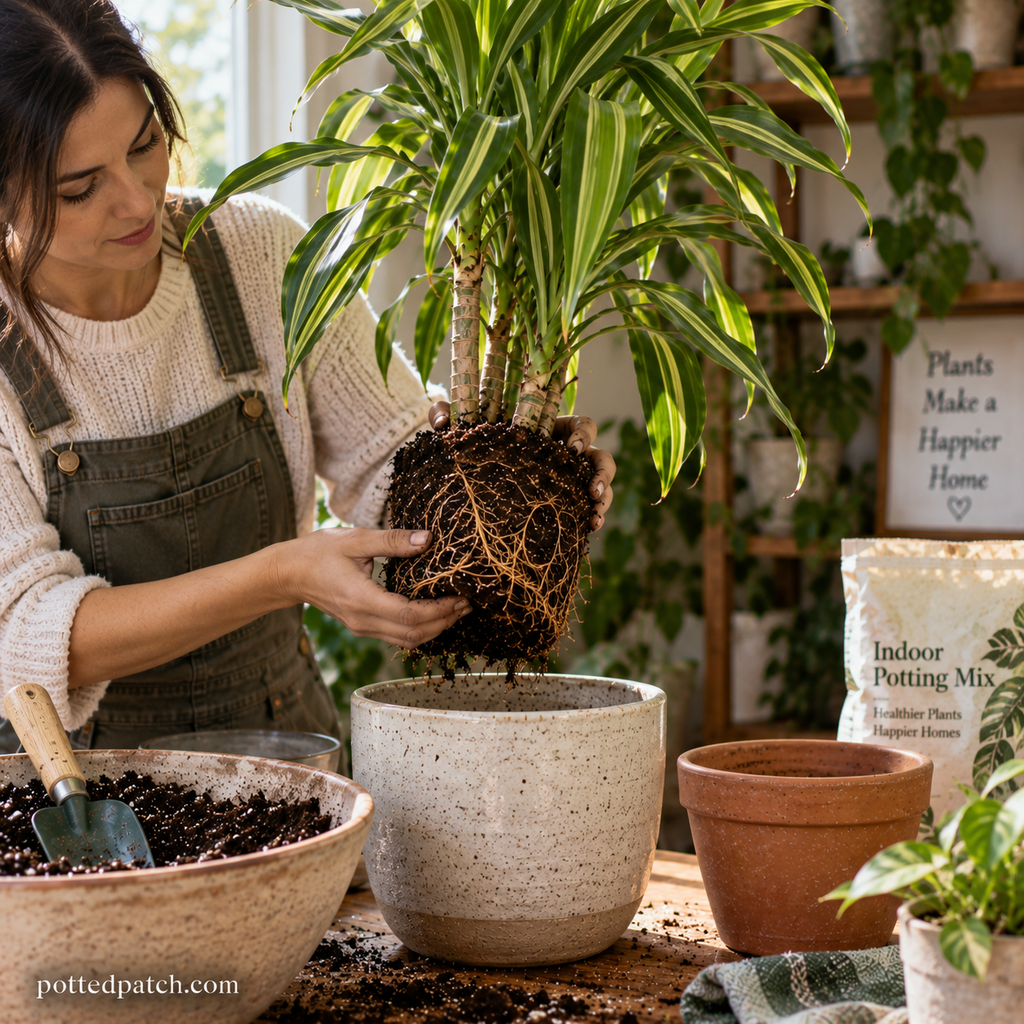
Dracaenas don’t need annual repotting.
They can remain somewhat snug for quite a while, and I prefer not to disturb a healthy root system without a reason.
Consider repotting when:
- Roots densely fill the container
- Many roots emerge through drainage holes
- The plant dries unusually quickly
- Water immediately runs through a root-packed pot
- Soil has badly compacted
- The plant becomes unstable
- Growth has stalled despite appropriate care
- Root problems need investigation
Spring is convenient because many indoor Dracaenas begin growing more actively as daylight increases.
Repotting is a useful opportunity to inspect the Dracaena’s roots for overcrowding, damage, or early rot before placing the plant into fresh soil.
How to Repot Dracaena Step by Step
- Choose a pot only slightly larger than the existing container.
- Prepare fresh, well-draining potting mix.
- Carefully remove the plant.
- Loosen excess old soil where practical.
- Inspect the roots.
- Remove clearly dead or rotten roots with clean tools when necessary.
- Position the plant at approximately its previous depth.
- Fill around the roots without heavily compacting the mix.
- Water appropriately and allow excess water to drain.
After repotting, I give the plant time to adjust.
Some temporary stress doesn’t mean you need to immediately add fertilizer, water repeatedly, or move it to another location.
Changing several things at once also makes it harder to know what the plant is responding to.
Encouraging New Dracaena Growth
When growth slows, fertilizer isn’t the first thing I reach for.
I check:
- Light
- Season
- Root health
- Soil moisture
- Pot size
- Temperature
A Dracaena sitting in insufficient light isn’t going to develop strong growth simply because it receives more fertilizer.
Likewise, a plant with damaged roots needs its root conditions corrected first.
Use New Leaves as Your Report Card
Old damaged foliage doesn’t repair itself.
A brown tip will remain brown. A scorched patch won’t turn green again.
That’s why I’ve found new growth more useful for judging whether a care adjustment worked.
If the newest leaves are becoming larger, stronger, and appropriately colored, the current conditions are probably moving in the right direction.
Fertilizing Dracaena
Dracaenas aren’t heavy feeders.
During active growth, an appropriate houseplant fertilizer can be used according to its directions.
I avoid trying to force rapid growth by increasing the concentration.
Excess fertilizer can contribute to salt accumulation, root stress, and brown tips—the exact symptoms that sometimes lead people to add even more fertilizer.
When growth slows during fall and winter, feeding can usually be reduced or paused.
Pruning Can Create New Growth Too
One of the more useful things about Dracaena is how well many varieties respond to pruning.
If a cane becomes too tall or bare, it can be cut back with clean pruning shears.
New shoots can develop below the cut.
This makes pruning useful for:
- Controlling height
- Encouraging branching
- Correcting a leggy shape
- Removing damaged growth
- Rejuvenating an older plant
- Producing propagation material
Before cutting, I think about where I actually want the new branching to begin.
The removed leafy top can often be propagated rather than discarded.
Year-Round Dracaena Care
The plant may stay in the same room all year, but its environment doesn’t.
Spring
Increasing daylight can bring more active growth.
This is when I start watching for:
- Faster drying
- New leaves
- Repotting needs
- Pruning opportunities
- Increasing fertilizer needs
- Pest activity
If the plant begins using water faster, I respond to that change rather than simply deciding spring means it must be watered more.
Summer
Warm, bright conditions can increase water use.
Check the soil more frequently, but continue letting the upper portion dry.
Also watch intense direct sunlight. Seasonal changes can make the same window much harsher than it was several months earlier.
Air-conditioning vents are another thing I watch. A plant can be in a warm room while sitting directly in a stream of cold air.
Fall
As daylight decreases, growth may slow and soil can remain damp longer.
This is where I start becoming more conservative with fertilizer and pay closer attention to drying time.
Winter
Winter is the season when carrying over a summer watering routine can create problems.
Lower natural light often means slower water use.
At the same time, indoor heating may produce dry air and brown tips.
Those are two separate issues.
Dry foliage doesn’t automatically mean wet the soil more often.
Check the root zone first. If the soil is still damp but the room is extremely dry, increasing soil moisture isn’t solving the actual problem.
Temperature and Humidity
Normal warm household conditions suit most Dracaenas.
What I try to avoid are extremes.
Keep the plant away from:
- Cold drafts
- Freezing temperatures
- Heating vents
- Air-conditioning vents
- Very cold windows
- Sudden temperature changes
The location matters more than the thermostat reading.
A room may be 70°F while the leaves beside an exterior door experience repeated blasts of much colder air.
Dracaenas also adapt reasonably well to average household humidity.
If winter air becomes extremely dry, a room humidifier can help. I don’t rely on routine misting because any humidity increase around the leaves is brief.
Common Dracaena Care Mistakes
Watering on a Calendar
Check the soil rather than the date.
Keeping the Soil Constantly Wet
Dracaena roots need air as well as water.
Assuming Every Drooping Plant Is Thirsty
Feel the soil first. Drooping with wet soil can point toward root trouble.
Putting a Small Root Ball in a Huge Pot
Extra soil can stay wet far longer than expected.
Treating Low-Light Tolerance as No-Light Tolerance
A Dracaena can survive in a dim location while barely growing.
Moving It Straight Into Strong Sun
Increase exposure gradually to reduce the chance of scorched foliage.
Fertilizing a Stressed Plant
Fertilizer doesn’t correct rotten roots, insufficient light, or inappropriate watering.
Assuming Every Brown Tip Is Caused by Tap Water
Water quality is one possibility among several.
Panicking Over One Yellow Lower Leaf
Older lower leaves naturally die as many cane-forming Dracaenas mature.
What concerns me more is rapid yellowing across several parts of the plant.
Troubleshooting Common Dracaena Problems
When a Dracaena starts declining, I use the symptom as a clue rather than a diagnosis.
I look at:
soil + roots + light + temperature + recent changes + new growth
The Complete Guide to Indoor Plant Problems (Diagnosis & Fixes) provides a broader troubleshooting process when the cause isn’t obvious.
Brown Leaf Tips
Possible causes include:
- Water quality
- Dry air
- Fertilizer buildup
- Inconsistent watering
- Root stress
- Severe dehydration
- Environmental changes
Brown tips can be trimmed cosmetically with clean scissors, following the natural shape of the leaf.
But trimming doesn’t fix the cause.
If new leaves continue developing the same damage, investigate further.
Yellow Leaves
One older lower leaf gradually turning yellow can be normal.
Several yellow leaves appearing quickly deserve more attention.
Check:
- Soil moisture
- Drainage
- Roots
- Light
- Temperature
- Recent changes
If the soil has remained wet much longer than normal, that’s where I’d begin.
Drooping
Check the potting mix before watering.
If it’s extremely dry, the plant may be thirsty.
If it’s saturated and has been wet for days, I become much more suspicious of root trouble.
Leggy Growth
Insufficient light is a common cause.
Move the plant gradually into brighter indirect light.
For an established Dracaena that’s already become tall and sparse, pruning can help create a more compact shape.
Root Rot
Warning signs can include:
- Persistent yellowing
- Drooping despite wet soil
- Leaf loss
- Soft stems
- Dark, mushy roots
- Unpleasant-smelling soil
- Declining new growth
If you find rotten roots, remove clearly affected tissue with clean tools and repot when necessary.
But don’t stop there.
The important question is why the roots remained wet.
Fresh soil won’t permanently solve the problem if the Dracaena goes back into an oversized pot, insufficient light, and the same watering routine.
Common Dracaena Pests
Watch for:
- Spider mites
- Mealybugs
- Scale
- Thrips
- Fungus gnats
Spider mites are particularly worth checking for when indoor air becomes warm and dry.
Look underneath leaves for fine webbing, pale stippling, faded areas, or tiny moving specks.
Mealybugs often hide around leaf bases and stems and look like small cottony clusters.
Scale can resemble brown or tan bumps attached to the plant, making it easier to overlook.
I like to combine pest inspection with leaf cleaning. Wiping the long leaves with a damp cloth gives me a reason to examine both surfaces instead of waiting until damage is obvious from across the room.
Propagating Dracaena
Dracaena is useful for propagation because pruning material can often become another plant.
Top Cuttings
A leafy top can be cut with a section of healthy stem attached.
Remove foliage that would sit below water or rooting medium and place the cutting in bright indirect light while roots develop.
Rooting takes time, so I don’t expect immediate growth above the soil.
Cane Cuttings
Healthy bare cane can also be divided into sections for propagation.
Keep track of which end originally faced upward.
That sounds trivial until several similar-looking pieces are sitting on the table.
Depending on the method and variety, cane sections can be rooted vertically or horizontally in a suitable propagation medium.
Warmth, appropriate moisture, and patience matter more than constantly disturbing the cutting to check for roots.
A Simple Dracaena Care Routine
I keep routine Dracaena care fairly minimal.
Regularly:
- Check the upper soil
- Look at the newest leaves
- Inspect for pests
- Notice changes in drying time
- Remove completely dead foliage
When watering:
- Water thoroughly
- Let excess water drain
- Empty standing water
- Allow the upper soil to dry again
Seasonally:
- Reevaluate window light
- Adjust watering to actual drying time
- Reduce fertilizer when growth slows
- Check whether the plant needs repotting
- Watch heating and cooling vents
- Consider pruning overly tall canes
The important part isn’t completing a checklist.
It’s noticing when the plant’s normal pattern changes.
A pot that suddenly stays wet twice as long as usual tells me something. So does a new leaf that’s much smaller than the previous ones.
Those changes are often more useful than waiting for a dramatic symptom.
Final Thoughts
Dracaena is forgiving enough that it doesn’t require constant attention, which is exactly why I think observation works better than micromanagement.
Give it useful indirect light, let the upper soil dry between thorough waterings, keep the roots in an aerated mix, and avoid dramatically oversized pots. Then adjust the routine when the environment changes rather than expecting July and January to behave the same way.
If brown tips appear, don’t immediately blame the water. If the plant droops, check the soil before watering. If lower leaves gradually disappear on a cane-forming plant, remember that some leaf loss is part of normal maturation. And if a tall Dracaena becomes awkward or bare, pruning can actually be part of the solution rather than something to fear.
Most importantly, watch the newest growth.
A healthy Dracaena doesn’t need every old leaf to look perfect. Healthy roots, appropriately shaped new leaves, and steady growth tell you much more about whether the current care routine is working.