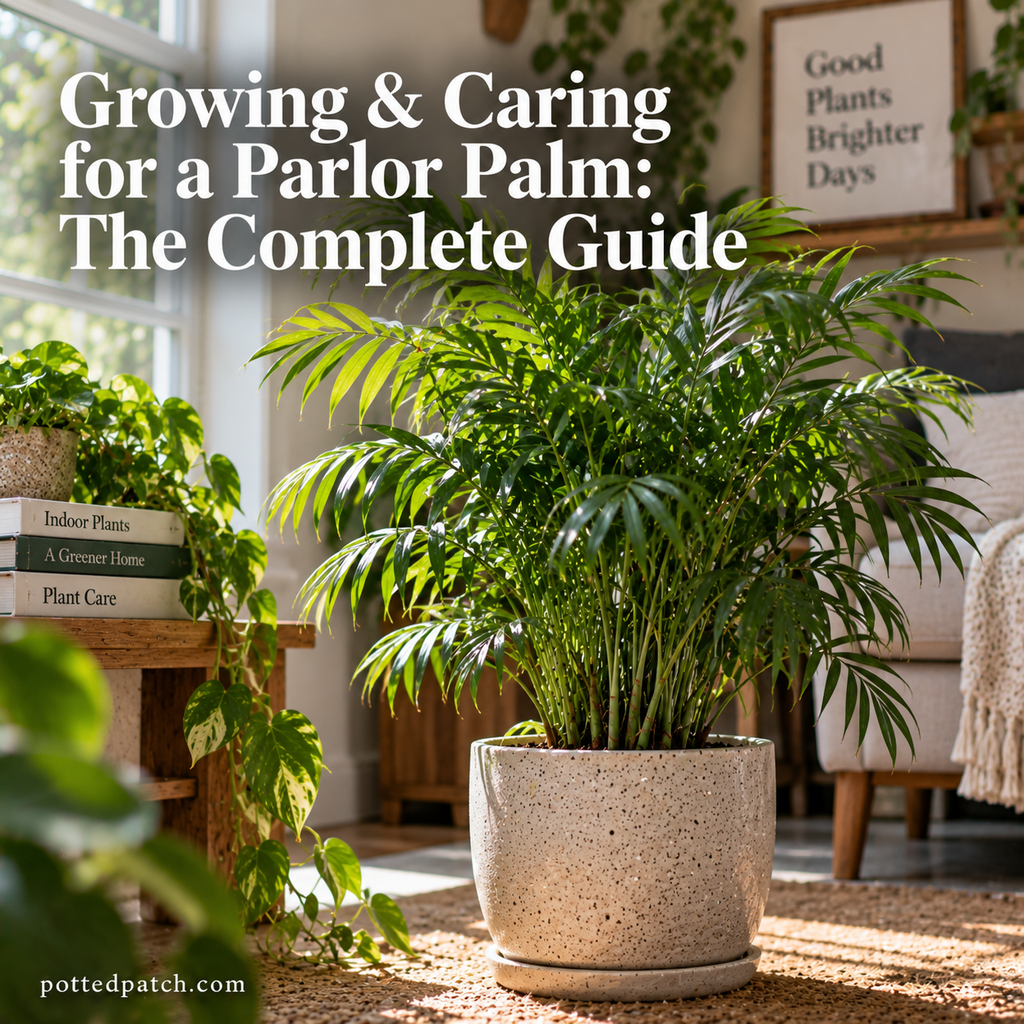
The Parlor Palm has been a popular indoor plant for generations, and it’s easy to understand why. Its soft, arching fronds add a tropical feel to a room without demanding the intense sunlight that many other palms prefer.
It’s also relatively compact, slow-growing, and adaptable to typical household conditions.
That doesn’t mean a Parlor Palm will thrive anywhere. Brown tips, yellow fronds, spider mites, and overly wet soil are some of the problems that can appear when its growing conditions aren’t quite right.
Fortunately, Parlor Palm care is fairly straightforward once you understand what the plant prefers.
This complete guide covers everything from watering and light to soil, humidity, fertilizing, pruning, repotting, pests, and common problems.
Parlor Palm Care at a Glance
Here’s a quick overview of the basic conditions a Parlor Palm prefers indoors:
- Light: Bright, indirect light to moderate indirect light
- Water: Water after the upper portion of the soil begins to dry
- Soil: Loose, well-draining indoor potting mix
- Humidity: Average household humidity or moderately higher
- Temperature: Warm, stable indoor temperatures
- Fertilizer: Light feeding during active growth
- Pruning: Remove fully dead or badly damaged fronds as needed
- Repotting: Infrequently, when the plant becomes genuinely crowded
- Growth rate: Generally slow indoors
One of the advantages of the Parlor Palm is that it doesn’t need constant attention. In fact, doing too much—especially watering too frequently—can cause more problems than leaving it alone.
What Is a Parlor Palm?
The Parlor Palm, Chamaedorea elegans, is a small palm native to parts of Mexico and Central America.
Unlike the towering palms you might picture growing along a tropical beach, this species is naturally suited to growing beneath taller vegetation where sunlight is filtered.
That helps explain why it adapts so well to indoor conditions.
Parlor Palms have slender green stems topped with delicate, feather-like fronds. Several seedlings are commonly planted together in one container to create the dense, full appearance typically seen in garden centers.
Over time, a healthy plant can become a graceful floor plant without quickly overwhelming the room.
How Much Light Does a Parlor Palm Need?
One of the biggest reasons Parlor Palms work well indoors is their ability to tolerate moderate light.
They don’t need hours of intense direct sunlight.
Bright, indirect light is ideal for healthy growth, but they can adapt to somewhat lower light levels better than many other palms.
Signs that your Parlor Palm may need more light include:
- Very slow or stalled growth
- Weak new growth
- Soil remaining wet for long periods
- The plant leaning strongly toward a window
Keep in mind that Parlor Palms are naturally slow-growing, so slow growth alone doesn’t necessarily indicate a problem.
Can Parlor Palms Grow in Low Light?
Yes, within reason.
A Parlor Palm can tolerate lower-light areas, but “low light” shouldn’t mean a windowless room with almost no usable light.
Growth will generally become slower as light levels decrease.
Water use also decreases.
That’s important because a plant that receives less light may need to be watered much less frequently than one growing beside a bright window.
Can Parlor Palms Take Direct Sun?
Parlor Palms are generally better protected from intense direct sunlight.
Strong sun, particularly when the plant hasn’t been acclimated to it, can scorch the delicate foliage.
Sun damage may appear as:
- Bleached areas
- Pale patches
- Crispy brown sections
- Dry-looking fronds
Gentle early morning sunlight may be tolerated in some situations, but bright filtered light is usually the safer choice indoors.
Where Should You Put a Parlor Palm?
Look for a location with good natural light but protection from harsh sun.
A spot near a window with filtered or indirect light can work beautifully.
You should also consider temperature and airflow.
Avoid placing the plant directly beside:
- Heating vents
- Air-conditioning vents
- Cold exterior doors
- Drafty windows
- Radiators
- Other sources of extreme temperature changes
Parlor Palms tend to appreciate stability.
Once you find a location where yours is growing well, there’s usually no reason to keep moving it around.
How Often Should You Water a Parlor Palm?
Don’t water your Parlor Palm according to a strict calendar.
Check the soil instead.
Allow the upper portion of the potting mix to dry somewhat before watering again. You don’t need to let the entire root ball become bone dry, but constantly saturated soil can cause root problems.
When the plant needs water:
- Water slowly and evenly across the soil.
- Continue until excess water begins draining from the bottom.
- Allow the container to drain completely.
- Empty any standing water from the saucer or decorative outer pot.
Then wait until the soil reaches an appropriate level of dryness before watering again.
Why a Watering Schedule Doesn’t Work Well
How quickly the soil dries depends on several factors:
- Light
- Temperature
- Humidity
- Plant size
- Pot size
- Soil composition
- Root density
- Season
A Parlor Palm growing beside a bright window during summer may use water considerably faster than the same plant during a darker winter.
Use the calendar as a reminder to check the soil—not as an automatic signal to water.
Signs of an Overwatered Parlor Palm
Parlor Palms appreciate some moisture, but their roots still need oxygen.
Possible signs of overly wet conditions include:
- Yellowing fronds
- Drooping despite moist soil
- Persistently wet potting mix
- Soft or unhealthy roots
- An unpleasant smell from the soil
- Darkening near the base of stems
- Increasing decline despite regular watering
If the soil stays wet for a very long time, investigate why.
Possible causes include:
- Watering too frequently
- Dense potting soil
- Poor drainage
- An oversized pot
- Insufficient light
Reducing the amount of water you pour into the pot isn’t necessarily the solution. Improving how the root zone drains and dries is more important.
What Does Root Rot Look Like?
If you suspect root rot, carefully inspect the roots.
Healthy roots should generally feel firm.
Rotten roots may appear:
- Dark brown or black
- Soft
- Mushy
- Slimy
- Fragile
- Unpleasant smelling
Remove clearly dead or rotting roots with clean tools.
If the soil has become badly degraded or waterlogged, repotting into fresh, well-draining potting mix may be necessary.
Correct the underlying watering or drainage issue afterward, or the problem can return.
Signs of an Underwatered Parlor Palm
A Parlor Palm can also suffer when kept too dry.
Possible signs include:
- Drooping fronds
- Dry, crispy leaflets
- Brown tips
- Very dry soil
- Soil pulling away from the container
- Fronds becoming increasingly brittle
If the soil has become extremely dry, water may run down the sides of the container instead of soaking into the root ball.
Water slowly so the potting mix has time to absorb moisture.
Best Soil for a Parlor Palm
Parlor Palms grow well in a loose potting mixture that retains some moisture while still draining effectively.
A standard indoor plant mix can work, particularly when amended with materials that improve aeration.
Useful additions include:
- Perlite
- Pumice
- Fine orchid bark
- Coco coir
You don’t need a complicated custom recipe.
The important thing is avoiding dense soil that remains waterlogged for long periods.
A Simple Parlor Palm Soil Mix
A practical starting point is:
- 2 parts indoor potting mix
- 1 part perlite or pumice
- 1 part fine orchid bark
Adjust the mixture according to your environment.
If your soil dries extremely quickly, you may want slightly more moisture-retentive material. If it stays wet for many days, additional aeration may help.
Does a Parlor Palm Need Drainage Holes?
Yes, drainage holes are strongly recommended.
They allow excess water to leave the root zone after a thorough watering.
If you prefer a decorative pot without drainage, keep the palm inside a nursery pot with drainage holes.
Remove the inner pot for watering, allow it to drain completely, and then return it to the decorative container.
Never allow the plant to sit in accumulated water.
Choosing the Right Pot Size
Parlor Palms don’t need oversized containers.
In fact, moving a relatively small root system into a huge pot can create problems because the extra soil holds moisture longer.
When repotting, choose a container only moderately larger than the existing root ball.
Parlor Palms also tend to grow relatively slowly, so they generally don’t need frequent jumps in pot size.
Temperature Requirements for Parlor Palms
Typical indoor temperatures are generally comfortable for Parlor Palms.
They prefer warmth and consistency rather than extreme temperature fluctuations.
Keep them away from:
- Cold drafts
- Heating vents
- Air conditioners
- Frequently opened doors during cold weather
- Very hot windows
Sudden environmental changes can stress the foliage even when the plant was previously healthy.
How Much Humidity Does a Parlor Palm Need?
Parlor Palms appreciate moderate humidity, but they can often adapt to average household conditions.
Extremely dry air can contribute to brown or crispy leaf tips.
This becomes particularly noticeable during winter when indoor heating systems reduce humidity.
If your home is consistently dry, a humidifier can provide a more stable environment.
Grouping plants together may provide a modest local increase in humidity as well.
Should You Mist a Parlor Palm?
Occasional misting isn’t usually harmful under appropriate conditions, but it isn’t an effective long-term solution for dry indoor air.
The moisture evaporates quickly.
If low humidity is causing persistent brown tips, improving the room’s humidity is more useful than repeatedly misting the foliage.
Why Does My Parlor Palm Have Brown Tips?
Brown tips are probably one of the most common complaints with indoor palms.
Possible causes include:
- Inconsistent watering
- Prolonged dryness
- Very dry indoor air
- Fertilizer buildup
- Root stress
- Environmental changes
A small amount of browning doesn’t necessarily mean your palm is dying.
Instead of immediately changing everything about your care routine, look for patterns.
Has the soil been getting extremely dry between waterings? Did the browning begin after winter heating came on? Have you recently increased fertilizer?
Those clues can help identify the cause.
Should You Cut Off Brown Tips?
You can trim brown tips for appearance.
Use clean scissors and follow the natural shape of the leaflet rather than cutting deeply into healthy green tissue.
Remember that trimming doesn’t solve the underlying problem.
If new fronds continue developing brown tips, investigate the plant’s environment.
How to Fertilize a Parlor Palm
Parlor Palms are slow-growing and don’t require heavy feeding.
During active growth, use an appropriate houseplant or palm fertilizer according to the product’s instructions.
Avoid the temptation to fertilize heavily to make the plant grow faster.
Excess fertilizer can lead to salt accumulation and root stress.
Reduce or pause feeding when growth slows significantly.
And don’t fertilize a severely stressed plant as a treatment.
If your palm has root rot, pests, poor lighting, or another serious problem, correct that issue first.
How Fast Does a Parlor Palm Grow?
Don’t expect dramatic growth every month.
Parlor Palms are naturally slow-growing indoors.
A healthy plant may produce only a modest amount of new growth over the course of a year, depending on its environment.
Growth tends to improve when the plant receives:
- Good indirect light
- Appropriate watering
- Healthy roots
- Warm temperatures
- Moderate humidity
- Suitable nutrition
If your plant looks healthy but isn’t growing quickly, there may be nothing wrong.
Patience is part of growing this palm.
How Big Can a Parlor Palm Get Indoors?
Indoor size depends on the plant’s age, variety, container, light, and overall growing conditions.
Over time, a mature Parlor Palm can become a substantial floor plant, but it generally takes years rather than months to reach an impressive size.
This slow growth makes it a practical choice for smaller indoor spaces.
You won’t usually need to prune it constantly just to keep it under control.
How to Prune a Parlor Palm
Parlor Palms don’t require extensive pruning.
Most pruning involves removing fronds that have completely died or become badly damaged.
Use clean, sharp pruning shears.
Cut dead fronds near their base while taking care not to damage neighboring healthy stems.
Should You Cut Yellow Fronds Off?
If a frond has become completely yellow or brown and is clearly declining, it can be removed.
A partially damaged frond still contains green tissue that can contribute to the plant.
There’s usually no need to remove every leaf simply because it has a small cosmetic imperfection.
Can You Cut the Top Off a Parlor Palm?
Avoid cutting healthy growing points simply to control height.
Palms grow differently from many branching houseplants and generally won’t respond to topping the way a pothos or philodendron might.
Focus pruning on dead or damaged foliage rather than trying to reshape the palm through aggressive cutting.
How to Repot a Parlor Palm
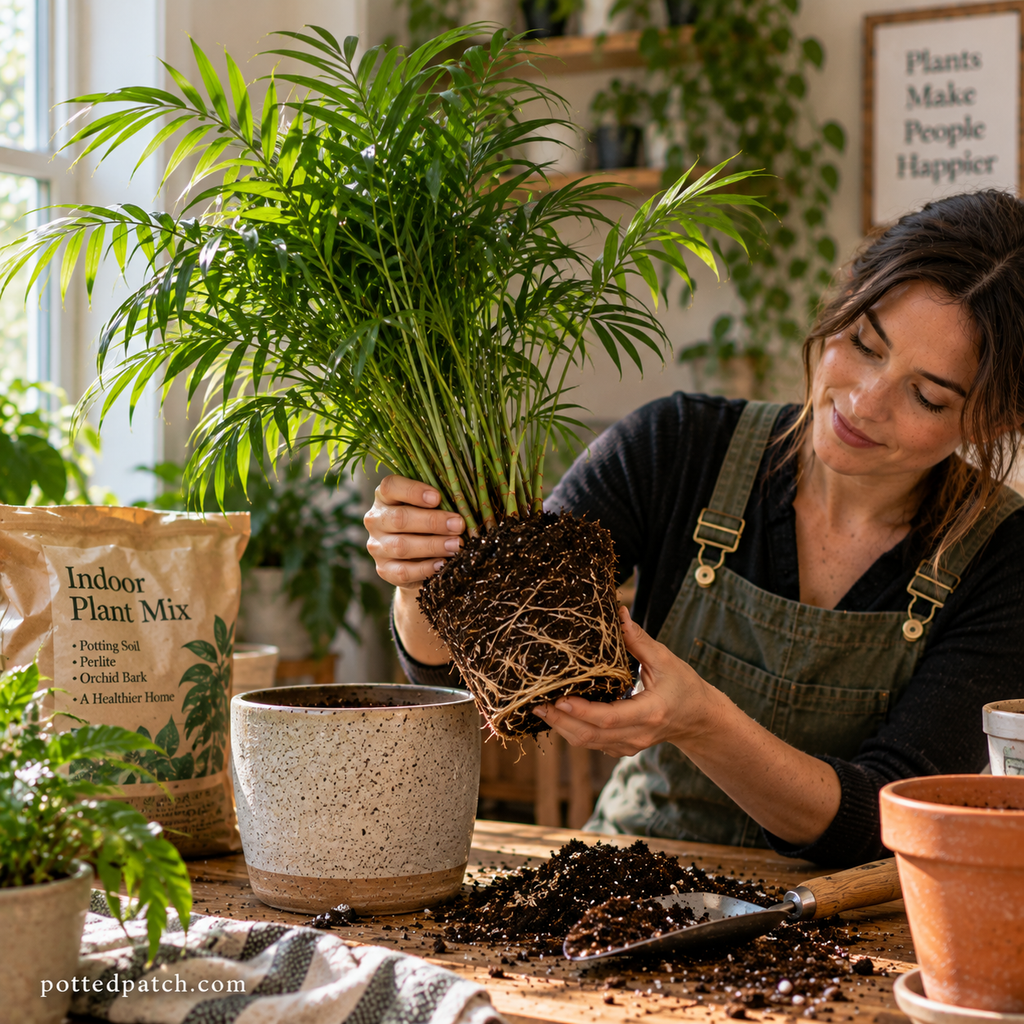
Parlor Palms don’t need frequent repotting.
Their roots can be relatively sensitive to unnecessary disturbance, and their slow growth means they often remain comfortable in the same container for quite some time.
Consider repotting when:
- The plant has become severely root-bound
- Roots extensively emerge through drainage holes
- The soil has badly deteriorated
- Drainage has become poor
- The container is no longer stable enough for the plant
To repot:
- Choose a container slightly larger than the existing one.
- Prepare fresh, well-draining potting mix.
- Carefully remove the palm from its current container.
- Avoid aggressively tearing apart healthy roots.
- Inspect for clearly dead or rotten roots.
- Position the plant at approximately the same depth.
- Fill around the root ball with fresh potting mix.
- Avoid packing the soil tightly.
- Water thoroughly and let excess moisture drain.
Give the plant time to settle afterward.
Some temporary stress following repotting is possible.
Can You Propagate a Parlor Palm?
Parlor Palm propagation isn’t as simple as taking a stem cutting from a pothos.
Commercially, these palms are commonly grown from seed.
Remember that many pots contain multiple individual seedlings planted together to create a fuller appearance.
While it may sometimes be possible to separate individual plants that have their own established root systems, doing so can disturb the roots significantly.
If you attempt division, be gentle and make sure each separated plant has a viable root system.
For most home growers, propagation isn’t an essential part of routine Parlor Palm care.
Why Are My Parlor Palm Leaves Turning Yellow?
Yellowing can have several causes.
Possible explanations include:
- Excessive watering
- Poor drainage
- Root problems
- Prolonged dryness
- Nutrient problems
- Environmental stress
- Natural aging of older fronds
One older frond gradually turning yellow isn’t necessarily concerning.
Several fronds yellowing at once deserves closer investigation.
Check the soil first.
If it’s constantly wet, evaluate drainage and root health before adding more water.
Why Is My Parlor Palm Drooping?
Drooping can occur for several reasons.
Check soil moisture.
Dry soil may indicate that the palm needs water.
Wet soil combined with persistent drooping can point toward root stress or poor drainage.
Other possibilities include:
- Recent repotting
- Sudden temperature changes
- Cold drafts
- Severe environmental stress
Consider what changed shortly before the drooping began.
Why Is My Parlor Palm Turning Brown?
Entire fronds becoming brown can indicate more significant stress than a few brown tips.
Potential causes include:
- Severe underwatering
- Root damage
- Overwatering
- Excessive direct sunlight
- Temperature stress
- Natural death of an older frond
If only one older frond is gradually dying while the rest of the plant remains healthy and new growth continues, it may simply be part of the plant’s natural aging process.
Common Parlor Palm Pests
Spider mites are particularly worth watching for on indoor palms.
Other possible pests include:
- Spider mites
- Mealybugs
- Scale insects
Inspect the foliage regularly, especially the undersides of leaflets.
Signs of pests may include:
- Fine webbing
- Pale speckling
- Sticky residue
- White cottony material
- Small attached bumps
- Gradual loss of healthy leaf color
How to Check a Parlor Palm for Spider Mites
Spider mites can be extremely small.
Look closely at areas where leaflets connect and along the undersides of fronds.
Fine webbing is an obvious warning sign, but you may notice pale stippling or speckling before substantial webbing appears.
If you suspect mites, isolate the palm from your other houseplants while you investigate.
What to Do if You Find Pests
Treatment depends on the pest.
Options may include:
- Rinsing the foliage
- Physically removing visible pests
- Using an appropriately labeled insecticidal or horticultural product
- Removing severely damaged foliage when appropriate
Follow product instructions carefully.
Continue checking the plant afterward because pest control often requires repeated monitoring or treatment.
Also inspect nearby plants.
Should You Clean Parlor Palm Leaves?
Dust can accumulate across the many narrow leaflets.
You can gently wipe larger sections or rinse the foliage carefully when needed.
Avoid aggressively pulling or rubbing the delicate leaflets.
Cleaning the plant also provides a useful opportunity to check for spider mites and other pests.
Parlor Palm Care During Winter
Winter can change your palm’s needs even though it remains indoors.
Shorter days mean less available light, and the soil may take longer to dry.
Indoor heating can simultaneously reduce humidity.
During winter:
- Check soil before watering
- Expect the plant to use water more slowly
- Keep it away from heating vents
- Protect it from cold drafts
- Provide good indirect light
- Monitor humidity
- Reduce fertilizer when growth slows
- Check periodically for spider mites
Avoid following your summer watering schedule automatically.
Common Parlor Palm Care Mistakes
A few recurring mistakes account for many problems.
1. Watering on a Fixed Schedule
Check the soil instead.
Your palm won’t use water at exactly the same rate all year.
2. Keeping the Soil Constantly Wet
Parlor Palms appreciate moisture but still need oxygen around their roots.
3. Putting the Plant in Intense Sun
Bright indirect light is generally a safer choice than harsh direct sunlight.
4. Repotting Too Frequently
These slow-growing palms usually don’t need constant increases in pot size.
5. Overfertilizing
More fertilizer won’t transform a naturally slow-growing palm into a fast-growing plant.
6. Cutting Healthy Fronds Unnecessarily
Minor cosmetic damage isn’t a reason to remove otherwise functional foliage.
7. Ignoring Spider Mites
Regular inspection can help you catch an infestation before it becomes severe.
8. Making Too Many Changes at Once
If your palm begins struggling, avoid immediately moving it, repotting it, fertilizing it, pruning it, and changing its watering routine.
Work out what’s most likely causing the problem first.
Parlor Palm Care FAQ
Are Parlor Palms Easy to Care For?
Yes. Their tolerance of moderate indoor light and slow growth makes Parlor Palms relatively manageable houseplants.
Appropriate watering and protection from extreme conditions are particularly important.
How Often Should I Water a Parlor Palm?
There’s no universal number of days.
Check the soil and water after the upper portion has dried sufficiently. Water thoroughly and allow excess moisture to drain.
Can a Parlor Palm Survive in Low Light?
Parlor Palms tolerate lower light better than many palms, but they still need usable light.
Growth may become extremely slow in dim conditions.
Does a Parlor Palm Need Direct Sunlight?
No.
Bright, indirect light is generally preferable. Intense direct sunlight can damage the foliage, particularly if the plant hasn’t been acclimated to it.
Why Does My Parlor Palm Have Brown Tips?
Common possibilities include dry air, inconsistent watering, prolonged dryness, fertilizer buildup, or root stress.
A small amount of browning is common and doesn’t necessarily indicate a serious problem.
Should I Mist My Parlor Palm?
Misting isn’t necessary.
If your home has very dry air, a humidifier provides a more consistent improvement in humidity.
Does a Parlor Palm Like to Be Root-Bound?
Parlor Palms tolerate somewhat snug containers and don’t require frequent repotting.
However, severe root crowding can eventually create watering and growth problems.
Is a Parlor Palm Toxic to Cats and Dogs?
Parlor Palm, Chamaedorea elegans, is generally considered non-toxic to cats and dogs.
That said, allowing pets to chew heavily on houseplants isn’t ideal. Eating plant material can still cause digestive upset in some animals.
If a pet develops concerning symptoms after chewing any plant, contact your veterinarian for advice.
Final Thoughts on Parlor Palm Care
The Parlor Palm doesn’t need complicated care to look good indoors.
Give it bright to moderate indirect light, use a loose potting mix with good drainage, and water after the upper portion of the soil has begun to dry. Keep temperatures relatively stable, avoid harsh direct sunlight, and provide reasonable humidity.
Then give it time.
This isn’t a plant that will necessarily produce dramatic new growth every few weeks. Its slower pace is part of its appeal.
Pay attention to the condition of the soil, new fronds, brown tips, and signs of pests rather than trying to force faster growth.
With consistent care and a little patience, a Parlor Palm can develop into a graceful, long-lasting indoor plant that brings plenty of greenery to a room without demanding constant attention.