Bringing home your first few houseplants is exciting. Then the questions start.
Should you water them every week? How often should you fertilize? Do the leaves need cleaning? When should you repot? And how can you tell whether a plant is actually healthy?
The good news is that indoor plant care doesn’t need to become a complicated daily routine. In fact, checking plants too often—and reacting to every slightly yellow leaf—can sometimes create more problems than simply giving them consistent conditions and letting them grow.
For beginners, the easiest approach is to develop a simple plant care routine built around observation rather than a rigid schedule.
Instead of deciding that every plant gets watered every Sunday, for example, make Sunday your plant-checking day. Some plants may need water. Others won’t.
This guide walks through a practical daily, weekly, monthly, and seasonal indoor plant care routine that beginners can realistically maintain.
Start With the Right Expectations
Plants grow slowly.
That’s worth remembering when you’re new to indoor gardening because it’s easy to expect immediate results after changing something.
You move a plant closer to a window and check it the next morning. Nothing happened.
You fertilize it and expect a new leaf.
You repot it and wonder why it isn’t suddenly twice as large.
Houseplants operate on a much slower timeline.
Your job isn’t to constantly make them grow. It’s to provide reasonably consistent conditions so they can do that themselves.
A good beginner routine focuses on five basics:
- Light
- Water
- Soil and drainage
- Temperature and humidity
- Occasional maintenance
Get those fundamentals right and most common houseplants become considerably easier to manage.
Your Daily Indoor Plant Care Routine
Here’s the easiest part: you probably don’t need one.
Most established houseplants shouldn’t require daily care.
You certainly don’t need to water every day, and there’s usually no reason to move, mist, fertilize, or otherwise adjust healthy plants daily.
Instead, simply notice them as you move around your home.
Take a Quick Look
A five-second glance can tell you a surprising amount.
Notice whether a plant suddenly looks different.
You might spot:
- A severely drooping plant
- A fallen leaf
- An overturned pot
- Visible pests
- Significant leaf damage
- A plant sitting in standing water
If everything looks normal, leave it alone.
That’s your daily routine.
Your Weekly Indoor Plant Care Routine
A weekly plant check is where most of your routine maintenance happens.
Pick a day that’s convenient for you. Weekends work well for many people, but the actual day doesn’t matter.
The important distinction is this:
You’re scheduling an inspection—not scheduling watering.
Step 1: Check the Soil
Before reaching for your watering can, check the potting mix.
For many common houseplants, you can insert a finger into the upper inch or two of soil to get a basic idea of how much moisture remains.
Some plants prefer drying more deeply between waterings, while others prefer more consistent moisture.
Learn what your individual plants need.
You can also pay attention to the weight of the container. With experience, you’ll notice that a freshly watered pot feels considerably heavier than one containing mostly dry soil.
Step 2: Water the Plants That Need It
Once you’ve determined that a plant actually needs water, water it thoroughly.
Ideally, water should move through the potting mix and excess water should escape through the drainage holes.
Allow the container to drain.
If there’s water remaining in the saucer or decorative outer pot, empty it rather than allowing the plant to sit in standing water for extended periods.
Then leave the plant alone until the soil reaches the appropriate level of dryness again.
Why You Shouldn’t Water Every Plant at Once
Different plants use water at different rates.
Even two identical plants may dry differently if one sits beside a bright window and another is several feet away.
Water usage can change based on:
- Plant species
- Plant size
- Root system
- Pot size
- Pot material
- Soil composition
- Light exposure
- Temperature
- Humidity
- Time of year
That’s why “water every seven days” isn’t a particularly reliable rule.
Your weekly routine should tell you whether a plant needs water—not dictate that it receives water.
Step 3: Look at the Leaves
While checking moisture, spend a few seconds looking at the foliage.
You’re looking for changes rather than perfection.
Real plants develop blemishes. Older leaves eventually yellow and die. Leaves can tear or develop minor brown edges.
One imperfect leaf doesn’t necessarily indicate a serious problem.
Instead, watch for patterns such as:
- Several leaves suddenly yellowing
- Multiple brown or black patches
- Rapid leaf drop
- Significant curling
- Wilting
- Pale new growth
- Distorted leaves
- Unusual sticky residue
- Fine webbing
Changes affecting several leaves deserve more attention than a single damaged leaf.
Step 4: Check for Pests
Plant pests are much easier to manage when you notice them early.
During your weekly check, occasionally look underneath leaves and along stems.
Pay particular attention to:
- Leaf undersides
- New growth
- Stem joints
- Areas where leaves meet stems
- Crevices around emerging foliage
Depending on the pest, you may notice insects, small bumps, cottony material, sticky residue, webbing, or unusual leaf damage.
Don’t panic if you find something.
Move the affected plant away from the rest of your collection while you identify the problem and determine the appropriate treatment.
Step 5: Remove Fallen Plant Material
Pick up leaves that have fallen onto the soil or surrounding surface.
Dead plant material doesn’t need to accumulate inside the pot.
You can also remove completely dead or badly damaged leaves when appropriate using clean scissors or pruning tools.
There’s no need to remove every leaf with a tiny cosmetic imperfection.
A mostly healthy leaf can still benefit the plant.
Step 6: Check the Plant’s Position
Plants can gradually change position without you realizing it.
Maybe someone closed the blinds. Perhaps you moved the plant while cleaning. Or seasonal changes have dramatically altered how much sunlight reaches the room.
Take a quick look at the location.
Ask yourself:
- Is the plant still receiving appropriate light?
- Is it touching a cold window?
- Is a heating or cooling vent blowing directly onto it?
- Has another plant started shading it?
- Is it leaning strongly toward the window?
Small placement adjustments can prevent problems later.
Your Monthly Indoor Plant Care Routine
Once a month, spend a little more time inspecting your collection.
This doesn’t have to become a major project.
For a small collection, it might take 15 or 20 minutes.
Clean Dusty Leaves
Houseplant leaves gradually collect dust.
A significant layer of dust can interfere with light reaching the leaf surface and can also make plants look dull.
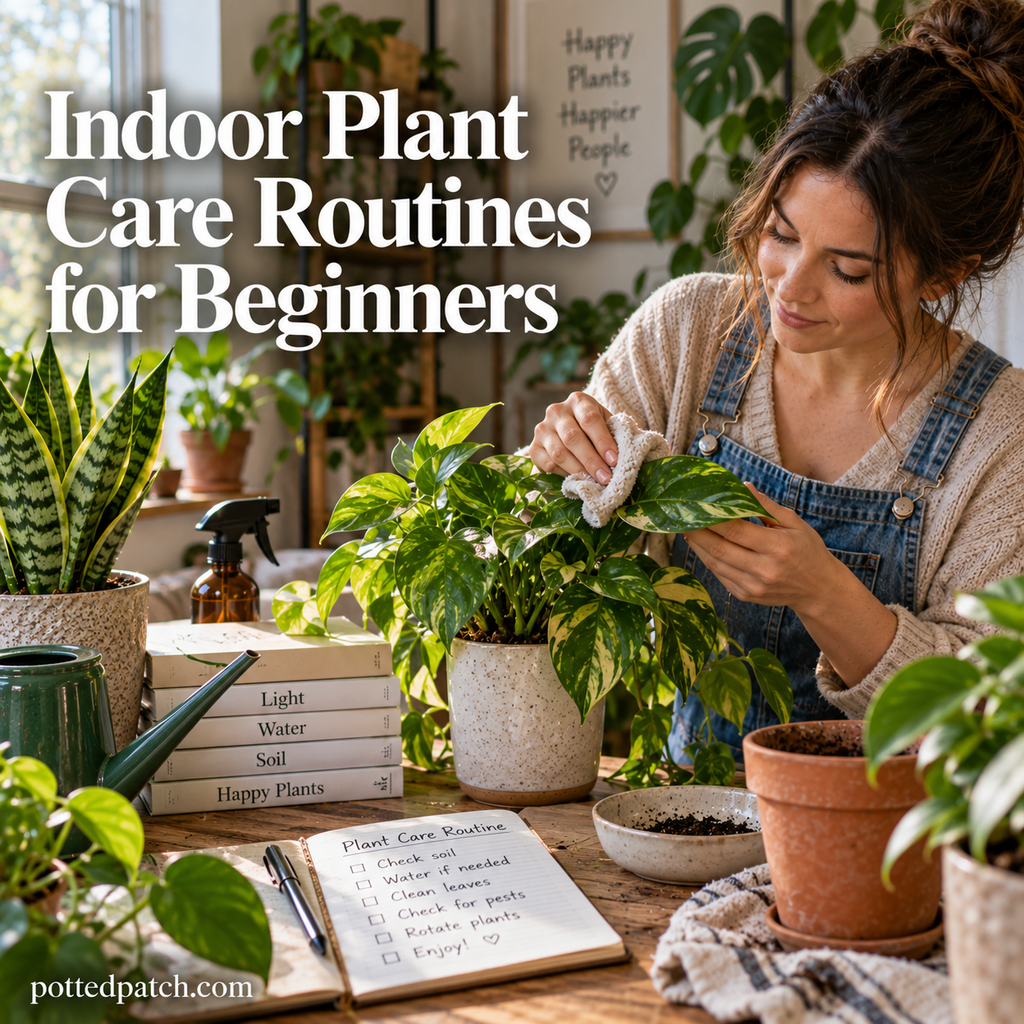
For plants with broad, smooth leaves, gently wipe the foliage with a damp, soft cloth.
Support the leaf with one hand while wiping with the other so you don’t accidentally tear it.
Some smaller plants can be gently rinsed when appropriate, provided the soil and drainage are managed properly afterward.
Avoid aggressive scrubbing or unnecessary leaf-shine products.
Rotate Plants When Appropriate
Plants often grow toward their primary light source.
If you want more balanced growth, occasionally rotate the pot.
You don’t necessarily need to turn every plant constantly. Some plants may prefer being left relatively undisturbed, especially while flowering or adjusting to a new location.
But for many foliage plants, occasional rotation can help prevent strongly one-sided growth.
Inspect Drainage Holes
Take a look underneath your pots.
Roots emerging from drainage holes aren’t automatically an emergency, but they can indicate that it’s worth checking how crowded the root system has become.
Also make sure drainage holes aren’t heavily blocked.
Proper drainage is one of the simplest protections against constantly saturated soil.
Check Pots and Saucers
Look for:
- Cracked containers
- Standing water
- Mineral buildup
- Mold or algae
- Damaged saucers
- Moisture underneath pots
This is particularly important if plants sit on wood furniture, shelving, laminate, or flooring.
A healthy plant isn’t worth damaging the surface underneath it.
Check Supports and Stakes
Climbing plants may need occasional adjustment.
Inspect moss poles, trellises, stakes, and plant ties.
Make sure ties aren’t cutting into growing stems and supports remain stable.
As the plant grows, loosen or reposition ties when necessary.
Your Seasonal Indoor Plant Care Routine
Houseplants experience seasonal changes even when they live indoors.
The temperature inside your home may stay relatively stable, but natural daylight can change dramatically throughout the year.
That affects growth and water use.
Spring Plant Care
Spring is often when many indoor plants begin showing stronger growth as daylight increases.
It’s a useful time to evaluate your collection.
Spring Tasks May Include:
- Inspecting plants after winter
- Repotting plants that genuinely need it
- Refreshing depleted potting mix
- Resuming or adjusting fertilization for actively growing plants
- Pruning unwanted growth
- Propagating healthy cuttings
- Moving plants if seasonal light has changed
Don’t automatically repot every plant simply because it’s spring.
Repot because the plant needs additional root space, the potting mix has significantly deteriorated, there’s a root problem, or another specific reason makes repotting beneficial.
Summer Plant Care
Longer days and warmer conditions can increase plant growth and water use.
Soil may dry more quickly than it did during winter.
Check plants regularly, particularly those near bright windows.
Summer Tasks May Include:
- Checking moisture more frequently
- Watching for excessive direct sunlight
- Monitoring for pests
- Adjusting plants near hot windows
- Fertilizing actively growing plants when appropriate
- Propagating suitable plants
Be careful with dramatic changes in sunlight.
A plant that has spent months receiving indirect light can develop scorched foliage if it’s suddenly moved into intense direct summer sun.
Acclimate plants gradually when increasing their sun exposure.
Fall Plant Care
Fall is a transition period.
As daylight becomes shorter, many indoor plants begin growing more slowly.
That can mean they use water more slowly as well.
Start paying attention to how long your potting mix remains moist.
Your watering habits may need to change even though the plants haven’t moved.
Fall Tasks May Include:
- Reducing watering frequency when appropriate
- Reevaluating window placement
- Checking for cold drafts
- Cleaning leaves
- Inspecting plants for pests
- Adjusting fertilizer use as growth slows
Avoid treating your routine as something fixed throughout the year.
The plant’s environment changes, so your care should adapt with it.
Winter Plant Care
Winter can be challenging for indoor plants.
Natural light levels may decrease while heating systems make indoor air warmer and drier.
At the same time, slower-growing plants may use less water.
This combination is one reason overwatering becomes common during winter.
Winter Tasks May Include:
- Checking soil carefully before watering
- Moving plants closer to available light
- Using grow lights if necessary
- Protecting plants from cold windows
- Keeping foliage away from heating vents
- Watching indoor humidity
- Pausing or reducing fertilizer depending on plant growth
Don’t assume that dry indoor air means the soil needs more water.
Humidity and soil moisture are different things.
When Should You Fertilize Indoor Plants?
Fertilizer isn’t plant food in quite the way the phrase is often used.
Plants produce energy through photosynthesis, while fertilizer supplies nutrients that support growth and other biological processes.
For beginners, the most important lesson is simple:
More fertilizer isn’t better.
Use an appropriate houseplant fertilizer according to its instructions and the needs of the species you’re growing.
Fertilization often makes the most sense during periods of active growth.
If a plant isn’t receiving enough light, adding more fertilizer won’t solve the underlying problem.
Overfertilizing can also damage roots and cause salts to accumulate in the soil.
When Should You Repot Houseplants?
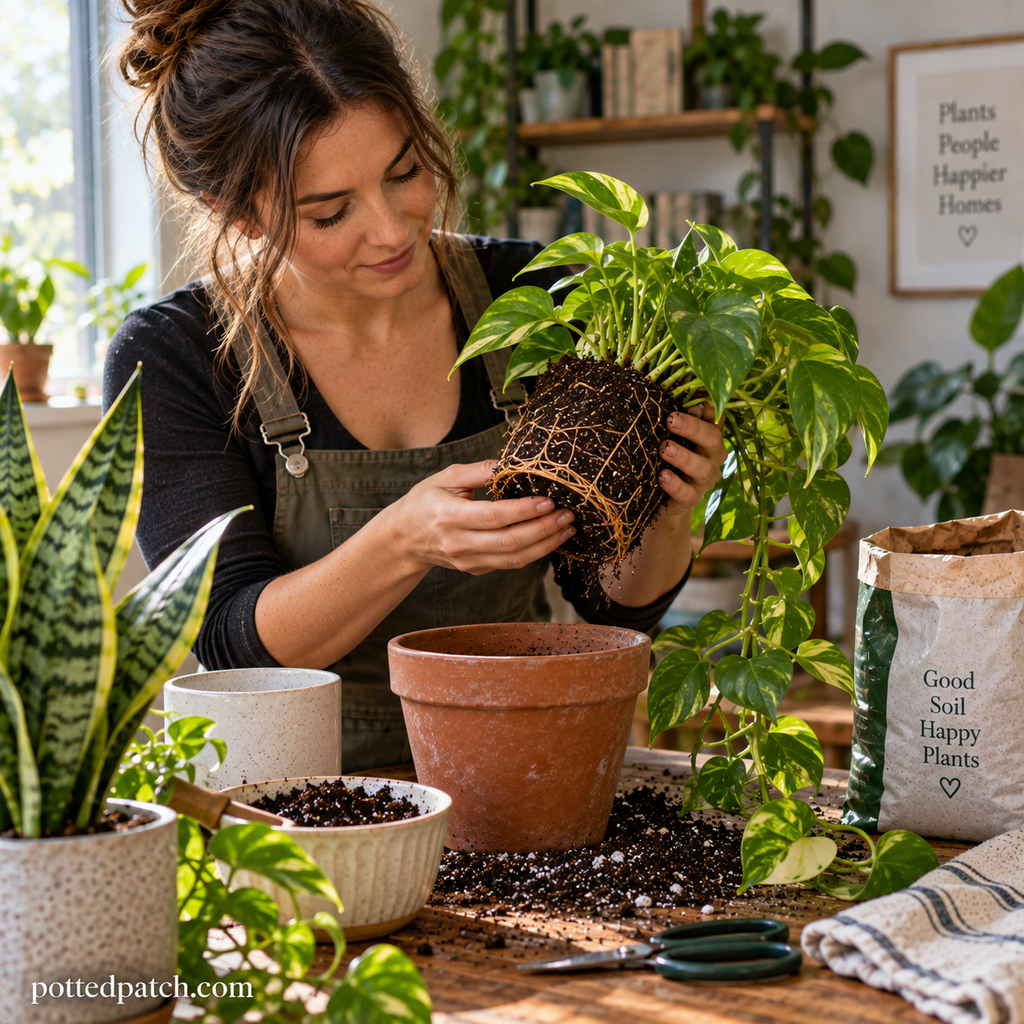
Repotting shouldn’t automatically be part of your monthly routine.
Many indoor plants can remain in the same container for quite a while.
Possible signs that it’s time to investigate repotting include:
- A heavily crowded root system
- Roots repeatedly growing through drainage holes
- The plant becoming unstable in its container
- Potting mix breaking down and compacting
- Water behaving unusually because the pot is extremely root-bound
- A plant drying much faster than expected
- Root health problems requiring intervention
When moving up in size, choose a container that’s reasonably larger than the existing root system.
Avoid moving a small plant directly into a huge pot. The large volume of unused soil can remain wet for too long.
When Should You Prune Indoor Plants?
Pruning can help manage size, remove damaged growth, and encourage certain plants to become fuller.
You might prune when:
- Leaves or stems are completely dead
- Vines have become excessively long
- Growth is sparse or leggy
- A plant needs reshaping
- Damaged tissue should be removed
- You’re taking cuttings for propagation
Always use clean, sharp tools.
Before making major cuts, learn where that particular species produces new growth. Different plants respond differently to pruning.
How Often Should You Clean Plant Leaves?
There’s no exact schedule.
Check them during your monthly inspection and clean them when dust becomes noticeable.
Plants near open windows, kitchens, fans, or high-traffic areas may accumulate debris more quickly.
A soft damp cloth is sufficient for many broad-leaved houseplants.
Plants with fuzzy, delicate, or specialized foliage may require a different cleaning method, so check the needs of the species before wiping or rinsing them.
Do Indoor Plants Need Misting?
Misting is often treated as an essential part of houseplant care, but most beginners don’t need to walk around spraying every plant each morning.
Some tropical species prefer higher humidity.
However, occasionally wetting the leaves doesn’t necessarily create the stable humidity those plants prefer.
If you’re growing humidity-sensitive plants, focus on the overall environment rather than relying exclusively on misting.
Many beginner-friendly houseplants tolerate normal household humidity without a complicated routine.
How to Keep Track of Your Plants
Once your collection grows beyond a handful of plants, remembering everything can become difficult.
You don’t need an elaborate spreadsheet.
A simple note on your phone can include:
- Plant name
- Approximate location
- Date purchased
- Last repotting date
- Fertilizer notes
- Pest problems
- Propagation notes
You generally don’t need to record every watering unless doing so helps you learn your plants’ patterns.
Remember, the goal is to simplify plant care rather than create additional paperwork.
A Simple Weekly Plant Care Checklist
If you’re unsure where to begin, use this routine once a week:
- Walk through your plant collection.
- Check soil moisture.
- Water only plants that need it.
- Empty excess water from saucers.
- Look at leaves and new growth.
- Check occasionally for pests.
- Remove dead or fallen leaves.
- Make sure each plant is still receiving appropriate light.
That’s enough for routine care for many common houseplants.
You don’t need to repot, fertilize, prune, mist, and rearrange everything every week.
A Simple Monthly Plant Care Checklist
Once a month, add a slightly more thorough inspection:
- Clean noticeably dusty leaves.
- Inspect leaf undersides and stems.
- Check pots and drainage holes.
- Look underneath saucers for trapped moisture.
- Inspect stakes and plant supports.
- Evaluate whether any plant has outgrown its location.
- Check whether seasonal light has changed.
- Make notes about plants showing ongoing problems.
Most of the time, you’ll discover that very little needs to be done.
That’s a good thing.
How to Handle a New Plant
New plants deserve a little extra attention before joining the rest of your collection.
When you bring one home, inspect the leaves, stems, soil surface, and container.
Look for obvious signs of pests or disease.
If possible, keep new plants somewhat separated from established plants while you continue monitoring them.
Also resist the urge to immediately:
- Repot it
- Fertilize it
- Prune it heavily
- Move it repeatedly
- Water it without checking the soil
The plant has already experienced a major environmental change by moving from the nursery or store into your home.
Give it time to adjust unless there’s a specific problem requiring immediate attention.
What to Do When a Plant Looks Unhealthy
Beginners often make several changes at once.
A plant starts yellowing, so it gets watered, fertilized, repotted, moved to another window, and misted—all within the same afternoon.
Now it’s difficult to know what the original problem was or how the plant is responding.
Instead, investigate systematically.
1. Check the Soil
Is it extremely dry or still soaking wet?
2. Evaluate the Light
Has the plant been receiving enough usable light?
3. Inspect for Pests
Look carefully at foliage and stems.
4. Consider Recent Changes
Was the plant recently moved, repotted, fertilized, exposed to cold, or placed in stronger sunlight?
5. Inspect the Roots When Necessary
If symptoms and soil conditions suggest a root problem, inspecting the root system may help reveal what’s happening.
Make one or two logical corrections and give the plant time to respond.
Common Beginner Plant Care Mistakes
Most beginners don’t lose plants because they aren’t trying hard enough.
Often, they’re trying too hard.
Overwatering
This is one of the most common problems.
Check the soil instead of watering automatically.
Not Providing Enough Light
Plants need light to grow.
If a plant continually produces weak growth or declines despite reasonable watering, reconsider its placement.
Constantly Moving Plants
Choose an appropriate location and give the plant time to adjust.
Repotting Too Soon
A new plant doesn’t necessarily need a new pot immediately.
Using Pots Without Proper Drainage
Decorative pots are fine, but you still need a strategy for excess water.
Keeping the plant in a draining nursery pot inside a decorative cachepot is an easy option.
Fertilizing a Struggling Plant
Fertilizer doesn’t automatically repair stress caused by damaged roots, pests, poor lighting, or incorrect watering.
Find the underlying problem first.
Expecting Perfect Leaves
Healthy plants aren’t plastic decorations.
Leaves age. Tips brown. Small tears happen.
Judge the health of the entire plant rather than expecting every leaf to remain flawless forever.
Build Your Routine Around Your Lifestyle
The best indoor plant care routine isn’t the most detailed one.
It’s the one you’ll actually follow.
If you have five low-maintenance plants, you might spend ten minutes checking them each weekend.
Someone with 75 tropical plants will naturally need a more involved routine.
Don’t build your plant collection around what looks impressive online. Build it around the amount of time, light, and space you actually have.
It’s perfectly reasonable to keep only a few plants.
Healthy plants are the goal—not the largest collection.
Frequently Asked Questions
Should I check my indoor plants every day?
You can visually notice them each day, but most established houseplants don’t require daily maintenance. A more thorough inspection once a week is usually practical for a beginner collection.
Should I water my plants every week?
Check them every week, but don’t necessarily water them every week. Water according to each plant’s moisture needs and current soil conditions.
What is the easiest plant care schedule for beginners?
Use a weekly inspection rather than a watering schedule. Check moisture, foliage, pests, drainage, and placement. Add monthly cleaning and seasonal adjustments when needed.
How often should I fertilize indoor plants?
It depends on the plant, fertilizer, growing conditions, and season. Follow the product directions and fertilize according to the plant’s needs, particularly during active growth. Avoid assuming that more frequent fertilizing produces faster growth.
How often should houseplants be repotted?
There’s no universal timetable. Repot when the plant or potting mix actually needs it rather than automatically repotting every year.
Should I rotate my houseplants?
Many foliage plants benefit from occasional rotation if they’re growing strongly toward a window. Rotation can encourage more balanced growth, but it doesn’t need to become a daily or weekly task.
How long does plant care take each week?
A small collection of easy-care plants may require only a few minutes for a weekly inspection, with occasional additional time for watering, pruning, cleaning, repotting, or pest treatment.
Final Thoughts
A good indoor plant care routine should make owning plants easier, not more stressful.
For beginners, the simplest approach is to stop thinking of plant care as a rigid schedule.
Instead, create a regular habit of checking your plants.
Once a week, look at the soil, foliage, drainage, light, and general condition of each plant. Water the ones that need it and leave the others alone. Once a month, spend a little more time cleaning leaves and inspecting pots, roots, supports, and growing conditions.
Then adjust your routine as the seasons change.
Over time, you’ll begin recognizing your plants’ patterns without thinking much about them. You’ll know which pot dries quickly, which plant starts drooping when thirsty, and which corner becomes too dark during winter.
That’s when indoor plant care gets much easier.
You aren’t memorizing dozens of rules anymore. You’re learning how to observe your plants—and respond when they actually need you.