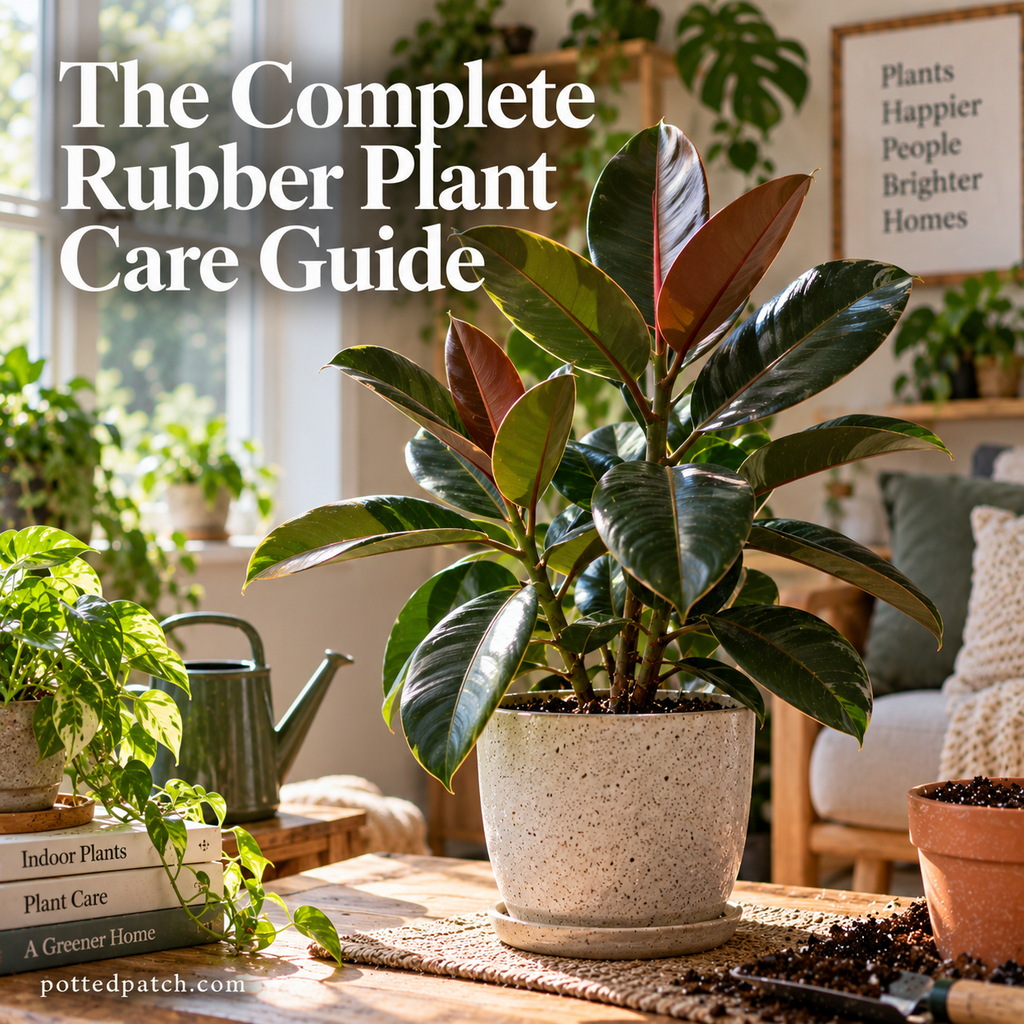
Rubber Plants have a way of making a room feel greener without taking over every available surface. Their large, glossy leaves and upright growth give them the presence of a small indoor tree, yet their basic care is surprisingly manageable.
The Rubber Plant, Ficus elastica, can also be quite forgiving once it settles into the right location.
Most problems start when something in its environment gets out of balance. Soil that stays wet for too long can lead to yellowing leaves and root trouble. Poor light may result in weak growth, while sudden environmental changes can trigger leaf drop.
Fortunately, you don’t need a complicated routine to keep one healthy.
This complete Rubber Plant care guide covers light, watering, soil, humidity, fertilizing, pruning, repotting, propagation, pests, and the common problems you’re most likely to encounter indoors.
Rubber Plant Care at a Glance
Here’s a quick overview of what most Rubber Plants prefer:
- Light: Bright, indirect light
- Water: Water after the upper portion of the soil has dried
- Soil: Loose, well-draining indoor potting mix
- Humidity: Average to moderately humid indoor conditions
- Temperature: Warm, stable household temperatures
- Fertilizer: Moderate feeding during active growth
- Pruning: As needed to control height and encourage branching
- Repotting: When the root system becomes crowded
- Propagation: Stem cuttings or air layering
- Growth habit: Upright, tree-like growth
Rubber Plants can become large indoor specimens over time, so good placement and occasional pruning become increasingly important as the plant matures.
What Is a Rubber Plant?
The Rubber Plant, Ficus elastica, is a tropical evergreen native to parts of South and Southeast Asia.
In its natural environment, it can grow into a substantial tree. Indoors, container size, available light, pruning, and household conditions keep it much smaller.
Rubber Plants are best known for their thick, glossy leaves.
Depending on the variety, foliage may be:
- Deep green
- Nearly burgundy
- Green and cream
- Green, cream, and pink
- Various combinations of dark and light variegation
While individual varieties may respond somewhat differently to light, their general care requirements are similar.
How Much Light Does a Rubber Plant Need?
Bright, indirect light is a good starting point for most Rubber Plants.
Adequate light supports:
- Stronger growth
- Larger leaves
- Shorter spacing between leaves
- Better coloration
- Faster soil drying
- A fuller overall appearance
Rubber Plants can adapt to somewhat lower light, but growth usually slows.
A plant kept in insufficient light may develop:
- Long spaces between leaves
- Small new leaves
- Weak or leaning growth
- Reduced variegation
- Very slow growth
Can a Rubber Plant Take Direct Sun?
Rubber Plants can tolerate some direct sunlight when properly acclimated.
The key word is acclimated.
A plant that has spent months in relatively low indoor light shouldn’t suddenly be moved into several hours of intense direct sun.
That can result in scorched or bleached foliage.
Increase direct sun exposure gradually and monitor the leaves.
Variegated Rubber Plants and Light
Variegated varieties generally benefit from brighter conditions because portions of their leaves contain less chlorophyll.
Insufficient light can contribute to weaker growth or reduced variegation.
At the same time, pale sections of variegated foliage can be more vulnerable to intense sun damage.
Bright, filtered light is often an excellent compromise.
Where Should You Put a Rubber Plant?
Choose a location with good natural light and relatively stable conditions.
Rubber Plants can become fairly large, so think beyond what fits today. A small plant on a tabletop may eventually work better as a floor plant near a window.
Avoid placing it directly beside:
- Heating vents
- Air-conditioning vents
- Cold exterior doors
- Drafty windows
- Radiators
- Other areas with major temperature fluctuations
Rubber Plants can react to sudden changes by dropping leaves, so once you find a location where yours is growing well, avoid moving it unnecessarily.
How Often Should You Water a Rubber Plant?
There’s no universal watering schedule.
Instead of watering every seven days, check the soil.
Allow the upper portion of the potting mix to dry before watering again.
You can check with your finger or use a wooden skewer to get a better sense of moisture deeper in the container.
When the plant needs water:
- Water slowly and evenly across the soil.
- Thoroughly moisten the root ball.
- Continue until excess water drains from the bottom.
- Allow the container to drain completely.
- Empty any water collected in the saucer or decorative pot.
Then wait until the soil has partially dried before watering again.
What Affects How Often You Need to Water?
Water use changes according to:
- Light levels
- Temperature
- Humidity
- Pot size
- Plant size
- Root density
- Soil composition
- Season
- Growth rate
A large Rubber Plant beside a bright window during summer can use water much faster than a smaller plant in moderate winter light.
Let the soil tell you when it’s time.
Signs of an Overwatered Rubber Plant
Overwatering is less about giving the plant a thorough drink and more about keeping its root zone wet for too long.
Possible signs include:
- Yellowing leaves
- Leaf drop
- Persistently wet soil
- Drooping despite moist soil
- Dark or soft roots
- Unpleasant smells from the potting mix
- Softening near the lower stem
If the soil takes a very long time to dry, consider why.
Common causes include:
- Watering too frequently
- Insufficient light
- Dense soil
- Poor drainage
- An oversized container
Correcting the underlying cause is more effective than simply giving the plant smaller amounts of water.
What Does Rubber Plant Root Rot Look Like?
Healthy roots should generally feel firm.
Roots affected by rot may appear:
- Dark brown or black
- Soft
- Mushy
- Slimy
- Fragile
- Unpleasant smelling
If you find extensive root damage:
- Remove the plant from its container.
- Gently remove enough soil to inspect the roots.
- Cut away clearly rotten roots using clean tools.
- Remove badly degraded potting mix.
- Repot into fresh, well-draining soil.
- Make sure the container has drainage holes.
- Adjust the conditions that caused the soil to stay wet.
A plant with severe root loss may need additional recovery time before normal growth resumes.
Signs of an Underwatered Rubber Plant
Rubber Plants can tolerate the soil drying somewhat between waterings, but they shouldn’t remain completely dry for extended periods.
Possible signs include:
- Drooping leaves
- Curling foliage
- Dry leaf edges
- Very dry soil
- Soil pulling away from the pot
- Leaf loss
- Slowed growth
If the potting mix has become extremely dry, water slowly.
Very dry soil can sometimes repel water, causing it to run down the sides of the container without thoroughly soaking the root ball.
Best Soil for a Rubber Plant
Rubber Plants prefer a loose potting mixture that retains some moisture while still draining well.
A standard indoor plant mix can work, particularly when combined with ingredients that improve aeration.
Useful amendments include:
- Perlite
- Pumice
- Fine orchid bark
- Coco coir
You don’t need a complicated recipe.
The goal is to provide the roots with both moisture and oxygen.
A Simple Rubber Plant Soil Mix
A practical starting mixture is:
- 2 parts indoor potting mix
- 1 part perlite or pumice
- 1 part fine orchid bark
Adjust according to your environment.
If your plants dry very quickly, you may want slightly more moisture retention. If soil tends to stay wet for many days, increasing aeration can help.
Does a Rubber Plant Need Drainage Holes?
Drainage holes are strongly recommended.
They allow you to thoroughly water the entire root ball without trapping excess moisture at the bottom of the container.
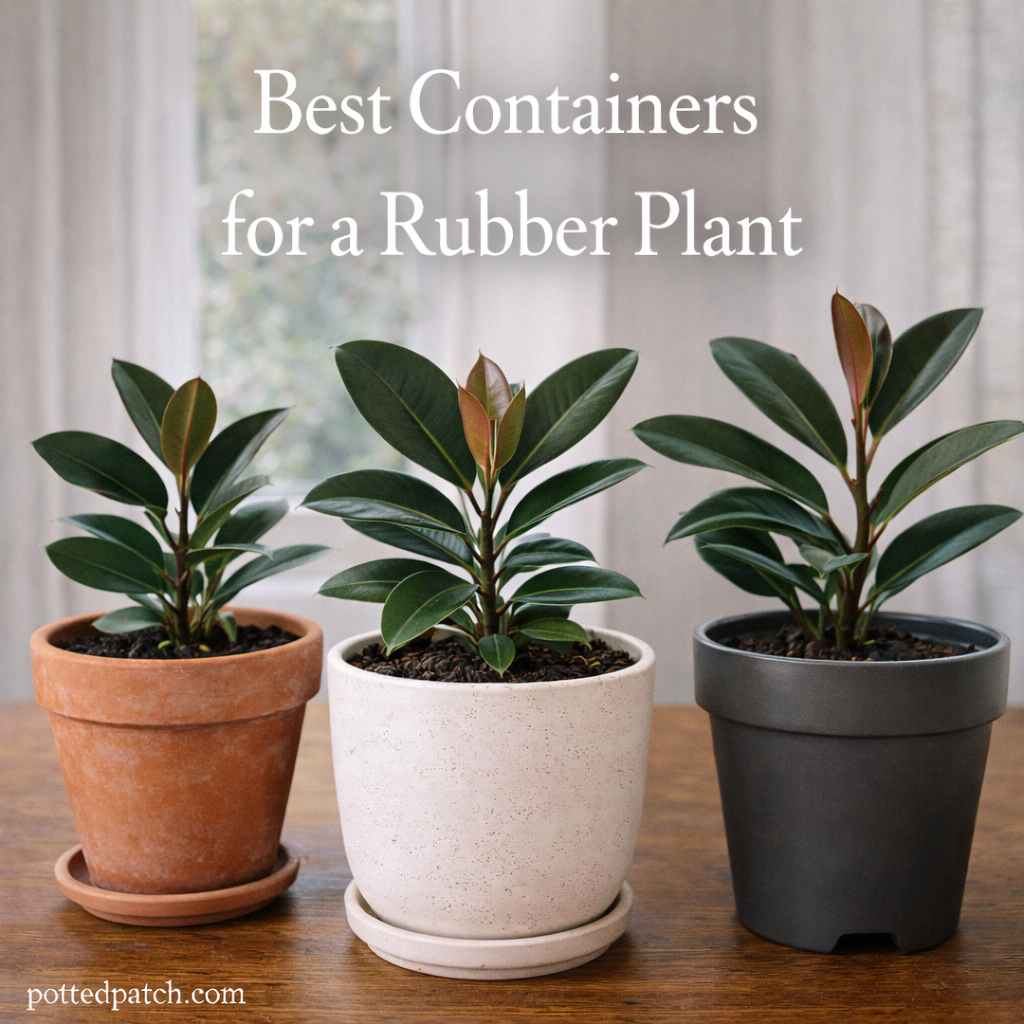
If you prefer a decorative planter without drainage, keep the Rubber Plant inside a nursery pot.
Remove the inner pot when watering, let it drain completely, and then return it to the decorative container.
Never allow the nursery pot to sit in standing water.
Choosing the Right Pot Size
Rubber Plants can eventually become large, but that doesn’t mean a small plant should immediately be placed in a huge pot.
Oversized containers contain more soil than the roots currently need.
That extra soil can remain wet for a long time and make overwatering more likely.
When repotting, move up gradually to a container that’s only moderately larger than the existing root system.
Temperature Requirements for Rubber Plants
Rubber Plants prefer warm, relatively stable indoor temperatures.
Typical household conditions generally work well.
Protect the plant from:
- Cold drafts
- Sudden temperature drops
- Heating vents
- Air conditioners
- Cold exterior doors
- Extreme temperature fluctuations
Consistency matters.
A sudden environmental change can sometimes cause leaf drop even when the plant was previously healthy.
How Much Humidity Does a Rubber Plant Need?
Rubber Plants appreciate moderate humidity but can usually adapt to normal household conditions.
Extremely dry air can contribute to:
- Brown leaf edges
- Dry tips
- Difficulty with new growth
- Increased pest problems in some situations
If your home becomes particularly dry during winter, a humidifier can provide more consistent humidity.
Should You Mist a Rubber Plant?
Misting isn’t necessary for routine Rubber Plant care.
It provides only a temporary change in moisture around the foliage.
If your indoor air is genuinely too dry, improving room humidity with a humidifier is more effective.
How to Fertilize a Rubber Plant
Rubber Plants can put on substantial growth under good conditions.
During active growth, use an appropriate balanced houseplant fertilizer according to the product directions.
Avoid overfeeding.
Excess fertilizer can contribute to:
- Salt buildup
- Brown leaf tips
- Root stress
- Damaged foliage
Reduce fertilizer when growth slows significantly.
Don’t fertilize a severely stressed plant simply because it isn’t growing. Check light, roots, watering, and pests first.
How Fast Do Rubber Plants Grow?
Growth rate depends heavily on conditions.
A healthy Rubber Plant receiving good light, appropriate water, warmth, and nutrition can produce noticeable growth during its active season.
Plants growing in lower light will usually grow more slowly.
Other factors include:
- Variety
- Plant maturity
- Root health
- Container size
- Temperature
- Season
If your plant is healthy but growing slowly during winter, that may be completely normal.
How Big Can a Rubber Plant Get Indoors?
Rubber Plants can become impressive indoor trees.
Exact size depends on the variety, growing conditions, pruning, and container size.
Over several years, a well-grown plant may reach ceiling height if it’s allowed to grow without pruning.
Fortunately, Rubber Plants respond well to strategic pruning, making their size relatively manageable.
How to Prune a Rubber Plant
Pruning can help control height, remove damaged growth, and encourage branching.
Use clean, sharp pruning shears.
You may want to prune when:
- The plant is becoming too tall
- Growth looks unbalanced
- You want to encourage branching
- A stem is damaged
- Leaves or branches are unhealthy
Rubber Plants contain a milky latex sap that appears when stems or leaves are cut.
Avoid getting the sap in your eyes or mouth, and wash it from your skin if contact causes irritation.
Protect nearby furniture and flooring as well, since dripping sap can be messy.
How to Make a Rubber Plant Branch
Young Rubber Plants often grow upward as a single stem.
If you’d prefer a bushier, more tree-like shape, pruning the main growing stem can encourage buds below the cut to develop into new branches.
To encourage branching:
- Decide where you want the plant to branch.
- Identify a suitable point above a node.
- Use clean, sharp pruning shears.
- Make a clean cut.
- Continue providing good light and normal care.
- Watch for new growth developing below the pruning point.
Branching isn’t always perfectly predictable.
One plant may develop several new shoots while another produces only one.
Good light helps support stronger new growth after pruning.
Should You Stake a Rubber Plant?
A healthy Rubber Plant with good light often develops a strong stem, but tall or leaning plants may occasionally benefit from temporary support.
Before staking, consider why the plant is leaning.
Insufficient light can cause weak, stretched growth.
If that’s the problem, a stake will support the symptom without correcting the underlying cause.
Improve the plant’s lighting while providing support if necessary.
How to Repot a Rubber Plant
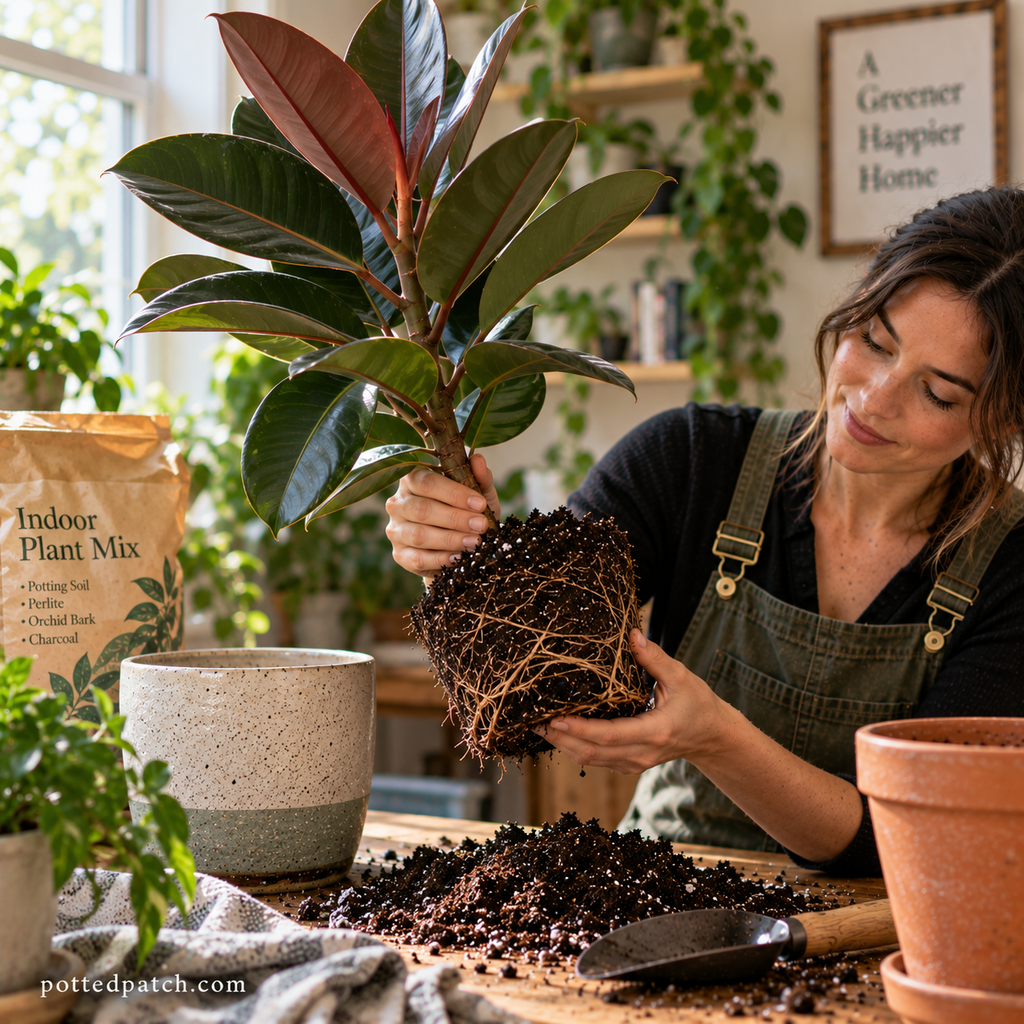
Repot when the root system actually needs additional space rather than following a strict yearly schedule.
Signs may include:
- Roots heavily circling the container
- Roots growing extensively through drainage holes
- Soil drying unusually quickly
- A tightly packed root ball
- Degraded or compacted soil
- Growth becoming restricted by severe root crowding
To repot:
- Choose a container slightly larger than the current root ball.
- Prepare fresh, well-draining potting mix.
- Carefully remove the Rubber Plant from its pot.
- Inspect the root system.
- Remove clearly dead or rotten roots if necessary.
- Gently loosen severely circling roots.
- Position the plant at approximately its previous depth.
- Fill around the roots with fresh soil.
- Avoid tightly compacting the potting mix.
- Water thoroughly and allow excess water to drain.
Large Rubber Plants can be heavy and awkward to handle, so having another person help can make repotting easier.
How to Propagate a Rubber Plant
Rubber Plants can be propagated from stem cuttings.
Choose a healthy section of stem that includes appropriate nodes.
Propagating a Rubber Plant From a Stem Cutting
A basic approach is:
- Choose a healthy stem.
- Make a clean cut using sanitized pruning shears.
- Make sure the cutting contains at least one node.
- Remove unnecessary lower leaves.
- Keep one or more healthy leaves when practical.
- Place the cutting into an appropriate propagation medium.
- Provide warmth and bright, indirect light.
- Maintain appropriate moisture while roots develop.
Large leaves can lose considerable moisture, so some growers loosely roll or support the leaf while the cutting establishes.
Be patient. Root development isn’t always fast.
Propagating Rubber Plants by Air Layering
Air layering is another useful option, particularly for larger plants.
Instead of removing the stem immediately, you encourage roots to develop while the stem is still attached to the parent plant.
Once a healthy root system forms, the rooted section can be cut from the parent and planted separately.
Air layering can be especially useful when shortening a tall Rubber Plant because it gives you an opportunity to create another established plant from the upper section.
Why Is My Rubber Plant Dropping Leaves?
Leaf drop can happen for several reasons.
Possible causes include:
- Excessive watering
- Severe underwatering
- Sudden changes in light
- Cold drafts
- Temperature fluctuations
- Root problems
- Moving the plant
- Pest problems
Consider what changed before the leaves began falling.
A recently purchased Rubber Plant has often experienced transportation and major changes in light, humidity, and temperature.
Some adjustment may occur.
Repeated or severe leaf loss deserves closer investigation.
Why Are My Rubber Plant Leaves Turning Yellow?
Yellow leaves can have several causes.
Possibilities include:
- Overwatering
- Poor drainage
- Root rot
- Prolonged dryness
- Insufficient light
- Nutrient problems
- Environmental stress
- Natural aging
One older lower leaf gradually turning yellow isn’t necessarily concerning.
Several leaves yellowing at once, especially when the soil remains constantly wet, should prompt you to check the roots and watering conditions.
Why Does My Rubber Plant Have Brown Spots?
Brown spots can be caused by different problems, so avoid diagnosing them based on color alone.
Potential causes include:
- Sun damage
- Root stress
- Physical damage
- Watering problems
- Certain leaf diseases
- Pest damage
Consider where the spots occur and whether they’re dry, soft, spreading, or associated with other symptoms.
If spotting continues to spread rapidly, isolate the plant while you investigate.
Why Are My Rubber Plant Leaves Curling?
Curling leaves may indicate environmental stress.
Possible causes include:
- Dry soil
- Very low humidity
- Excessive heat
- Root problems
- Sudden environmental changes
- Pest activity
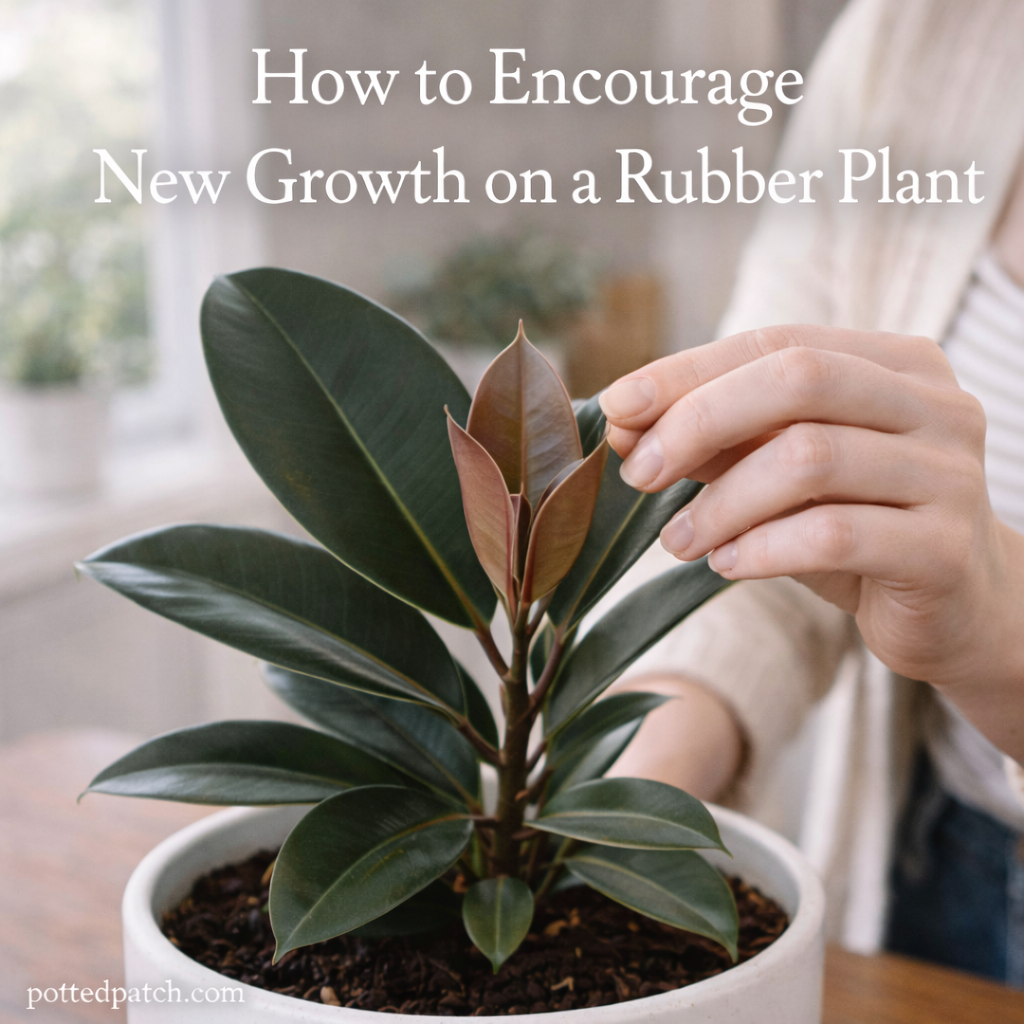
New Rubber Plant leaves also emerge tightly rolled before opening.
Don’t mistake a healthy developing leaf for a problem.
Why Are My Rubber Plant Leaves Small?
New leaves becoming progressively smaller can indicate that growing conditions aren’t supporting vigorous growth.
Check:
- Light levels
- Root health
- Nutrition
- Watering consistency
- Temperature
Insufficient light is particularly worth investigating if the spaces between leaves are also becoming longer.
Why Is My Rubber Plant Leaning?
Plants naturally grow toward their strongest light source.
If your Rubber Plant is leaning toward a window, rotate the container periodically to encourage more balanced growth.
A plant that develops very weak or stretched stems may need brighter light.
Tall plants can also become top-heavy, particularly if most foliage is concentrated near the top.
Strategic pruning can help create a more balanced shape.
Common Rubber Plant Pests
Rubber Plants can occasionally develop common houseplant pests.
Watch for:
- Spider mites
- Mealybugs
- Scale insects
- Thrips
- Aphids
Their broad leaves make inspections relatively easy.
Look at:
- Leaf undersides
- New growth
- Stems
- Areas where leaves attach
- Both sides of mature leaves
Warning signs may include:
- Fine webbing
- Sticky residue
- White cottony material
- Small attached bumps
- Speckled foliage
- Distorted new growth
- Tiny moving insects
What to Do if You Find Pests
Separate the affected Rubber Plant from nearby houseplants.
Depending on the pest, treatment may include:
- Rinsing the foliage
- Physically removing visible insects
- Pruning heavily damaged material
- Using an appropriately labeled horticultural or insecticidal product
Follow product instructions carefully.
Continue inspecting the plant afterward because pest treatment often requires repeated monitoring.
How to Clean Rubber Plant Leaves
Large Rubber Plant leaves collect dust easily.
Fortunately, they’re also relatively simple to clean.
Use a soft, damp cloth and gently wipe each leaf while supporting it with your other hand.
Cleaning the foliage:
- Removes visible dust
- Keeps the plant looking attractive
- Makes pest inspection easier
- Gives you an opportunity to notice developing problems
Avoid aggressive rubbing.
There’s generally no need to use commercial leaf-shine products.
Rubber Plant Care During Winter
Your Rubber Plant’s needs can change significantly during winter.
Shorter days often mean slower growth and lower water use.
The soil may take considerably longer to dry.
Indoor heating can also reduce humidity.
During winter:
- Check soil before watering
- Expect watering frequency to decrease
- Provide good indirect light
- Keep the plant away from heating vents
- Protect it from cold drafts
- Monitor humidity
- Reduce fertilizer when growth slows
- Inspect occasionally for pests
Don’t automatically follow the same routine you used during summer.
Common Rubber Plant Care Mistakes
Rubber Plants are relatively manageable, but a few mistakes repeatedly cause problems.
1. Watering on a Fixed Schedule
Check the soil first.
Your plant’s water use changes throughout the year.
2. Keeping the Soil Constantly Wet
Rubber Plant roots need both moisture and oxygen.
3. Giving the Plant Too Little Light
Rubber Plants can tolerate moderate light, but strong growth generally requires brighter conditions.
4. Suddenly Moving It Into Intense Sun
Acclimate the plant gradually to stronger direct sunlight.
5. Using an Oversized Pot
Too much unused soil can remain wet around the roots.
6. Overfertilizing
More fertilizer doesn’t automatically produce faster growth.
7. Ignoring the Plant’s Future Size
A small Rubber Plant can eventually become a substantial floor plant.
Plan its placement accordingly.
8. Making Too Many Changes at Once
When a Rubber Plant starts dropping leaves, it’s tempting to repot it, move it, fertilize it, prune it, and change the watering routine immediately.
That can create even more stress.
Identify the most likely problem and make deliberate adjustments.
Rubber Plant Care FAQ
Are Rubber Plants Easy to Care For?
Yes. Once established in suitable light with a sensible watering routine, Rubber Plants are relatively straightforward indoor plants.
How Often Should I Water a Rubber Plant?
Check the soil rather than following a fixed schedule.
Water after the upper portion of the potting mix has dried, then water thoroughly and allow the excess to drain.
Does a Rubber Plant Need Direct Sunlight?
Not necessarily.
Bright, indirect light works well for most Rubber Plants. Some direct sunlight can be tolerated when the plant is gradually acclimated.
How Do I Make My Rubber Plant Bushier?
Strategic pruning can encourage branching below the cut.
Providing good light afterward helps support healthy new growth.
Should I Rotate My Rubber Plant?
Rotating the plant periodically can encourage more balanced growth when most of its light comes from one direction.
Do Rubber Plants Like to Be Root-Bound?
They can tolerate somewhat snug containers, but severe root crowding can eventually interfere with water uptake and growth.
Repot when the root system clearly needs more room.
How Long Do Rubber Plants Live?
With suitable indoor conditions and ongoing care, Rubber Plants can live for many years and develop into substantial indoor specimens.
Is a Rubber Plant Toxic to Pets?
Rubber Plants contain irritating sap and aren’t a good choice for pets that regularly chew houseplants.
Keep the plant somewhere curious cats, dogs, and other pets can’t reach it.
If you believe your pet has eaten part of a Rubber Plant or is showing concerning symptoms after contact with the plant, contact your veterinarian or an appropriate animal poison-control service for guidance.
Final Thoughts on Rubber Plant Care
A healthy Rubber Plant doesn’t need constant attention.
Give it plenty of bright, indirect light, use a loose potting mix with good drainage, and water thoroughly after the soil has partially dried. Keep temperatures relatively stable and fertilize modestly while the plant is actively growing.
As your Rubber Plant gets taller, pruning becomes one of your most useful tools.
A carefully placed cut can control height and encourage branching, helping turn a single upright stem into a fuller indoor tree.
Most importantly, watch how the plant responds to its environment.
Leaf spacing, soil drying time, new leaf size, foliage color, and root health all provide useful clues. When something changes, look at those signals before changing your entire care routine.
Get the fundamentals right, and a Rubber Plant can grow from a modest nursery plant into one of the most impressive pieces of greenery in your home.