

Boston ferns have a way of making almost any room feel greener. Their long, arching fronds create a soft, full look that works especially well in hanging baskets, plant stands, and bright corners of the home.
They’re also famous for being a little dramatic.
Let a Boston fern get too dry and you may suddenly find crispy leaflets scattered across the floor. Give it too much water without proper drainage, and the roots can struggle. Add dry indoor air to the mix, and those lush green fronds can quickly develop brown tips.
Fortunately, Boston fern care isn’t complicated once you understand what the plant prefers. The biggest difference compared with many popular houseplants is that Boston ferns don’t like their soil to dry out completely.
Give yours bright, indirect light, consistent moisture, reasonable humidity, and good drainage, and you’ll have a much better chance of keeping those feathery fronds healthy.
Here’s everything you need to know about caring for a Boston fern indoors.
Boston Fern Care at a Glance
Boston fern is commonly associated with the species Nephrolepis exaltata and is grown for its dense collection of arching green fronds.
Here’s a quick overview of its basic needs:
- Light: Bright, indirect light
- Water: Keep the soil consistently moist but not waterlogged
- Humidity: Moderate to high humidity preferred
- Soil: Moisture-retentive but well-draining potting mix
- Temperature: Approximately 60–75°F (16–24°C)
- Fertilizer: Light feeding during active growth
- Repotting: When root-bound or the soil has deteriorated
- Pruning: Remove dead, brown, or damaged fronds
- Difficulty: Moderate
The biggest challenge is usually moisture management.
Boston ferns like more consistent moisture than pothos, snake plants, aloe vera, and many other common houseplants. At the same time, their roots still need oxygen.
That means moist soil is good. Soggy soil isn’t.
How Much Light Does a Boston Fern Need?
Boston ferns grow best in bright, indirect light.
Indoors, this could mean placing your fern near an east-facing window or a short distance from a brighter south- or west-facing window.
A sheer curtain can help diffuse intense sunlight.
The plant should receive enough light to maintain strong growth without spending hours baking in harsh direct sun.
Can Boston Ferns Take Direct Sun?
Gentle morning sunlight is generally less problematic than intense afternoon sun.
Strong direct sunlight can cause:
- Bleached foliage
- Brown patches
- Crispy leaflets
- Faster soil drying
- General stress
If you’re moving a fern from a darker location into brighter conditions, make the change gradually.
Can Boston Ferns Grow in Low Light?
Boston ferns can tolerate somewhat lower light than many sun-loving houseplants, but very dark conditions aren’t ideal.
A fern receiving too little light may:
- Grow slowly
- Produce weaker fronds
- Become sparse
- Lose older fronds
- Stay wet for too long after watering
That last point is important.
When light levels drop, the plant often uses water more slowly. If you continue watering at the same frequency, the soil may remain saturated.
How Often Should You Water a Boston Fern?
Boston ferns prefer consistently moist soil.
Unlike succulents, you generally don’t want the entire root ball to become completely dry before watering again.
Check the soil regularly with your finger. When the surface or upper layer begins to feel slightly dry, it’s usually time to check whether the plant needs water.
When you water:
- Water the soil thoroughly.
- Continue until excess water begins draining from the bottom of the pot.
- Allow the container to drain.
- Empty standing water from the saucer or decorative pot.
The goal is to evenly moisten the root zone without leaving it sitting in stagnant water.
Don’t Rely on a Fixed Watering Schedule
“Water once a week” sounds convenient, but it doesn’t account for your home’s conditions.
A Boston fern may dry faster or slower depending on:
- Light
- Temperature
- Humidity
- Pot size
- Pot material
- Plant size
- Soil composition
- Air circulation
- Season
A hanging Boston fern near a bright window during summer may need checking much more frequently than one growing in cooler winter conditions.
Use the soil as your guide.
What Happens When a Boston Fern Gets Too Dry?
Boston ferns can react quickly to dry soil.
Signs of underwatering may include:
- Drooping fronds
- Crispy leaflets
- Brown tips
- Leaflet drop
- Dry, brittle foliage
- Soil pulling away from the container
If the soil is extremely dry, give it a thorough watering.
Water slowly enough that the root ball actually absorbs moisture. Very dry potting mix can sometimes repel water, causing it to run directly down the sides of the container.
Will a Dried-Out Boston Fern Recover?
Sometimes.
If the roots and crown are still alive, new growth may eventually emerge even when much of the existing foliage looks terrible.
Remove completely dead fronds, restore consistent moisture, and keep the plant in appropriate light.
Don’t try to compensate by leaving the pot sitting in water. Going from severely dry soil to permanently saturated soil simply creates a different problem.
Can You Overwater a Boston Fern?
Yes.
Boston ferns like moisture, but that doesn’t mean their roots should remain submerged or oxygen-starved.
Signs of excessive moisture can include:
- Yellowing fronds
- Limp growth
- Persistently saturated soil
- Dark or soft roots
- Unpleasant-smelling soil
- Decline despite the soil being wet
If the soil stays wet for an unusually long time, check the drainage holes and consider whether the potting mix has become compacted.
Low light and oversized containers can also contribute to slow drying.
Humidity Requirements for Boston Ferns
Humidity is one of the reasons Boston ferns sometimes struggle indoors.
They generally appreciate higher humidity than the average drought-tolerant houseplant.
Dry indoor air may contribute to:
- Brown leaf tips
- Crispy leaflets
- Increased leaflet drop
- Fronds that look dry despite adequate soil moisture
This is especially common during winter when heating systems lower indoor humidity.
How to Increase Humidity Around a Boston Fern
If your home is dry, consider:
- Running a humidifier nearby
- Grouping compatible houseplants together
- Keeping the fern away from heating vents
- Moving it away from strong air-conditioning drafts
- Choosing a naturally more humid room with adequate light
A room humidifier is one of the most reliable options when humidity is consistently low.
Should You Mist a Boston Fern?
Misting can temporarily wet the foliage and slightly increase moisture immediately around the plant, but the effect doesn’t last long.
You don’t have to mist a Boston fern to keep it healthy.
If humidity is genuinely too low, improving the room’s humidity is more effective than relying on occasional misting.
Best Temperature for a Boston Fern
Boston ferns generally prefer moderate indoor temperatures.
A range of roughly 60–75°F (16–24°C) is comfortable for most indoor plants.
Protect your fern from:
- Cold drafts
- Heating vents
- Air-conditioning vents
- Sudden temperature swings
- Extremely hot rooms
Avoid placing the plant where its foliage is constantly exposed to blasts of hot or cold air.
Best Soil for a Boston Fern
Boston fern soil needs to perform two jobs that might sound contradictory.
It should retain moisture while also draining well.
A quality indoor potting mix that contains organic material and maintains some moisture can work well. If the mixture is extremely dense, adding an airy amendment may help improve drainage and root aeration.
The finished soil should feel loose rather than heavy and compacted.
Avoid using extremely fast-draining cactus or succulent soil by itself. Boston ferns generally need more moisture retention.
Does a Boston Fern Need Drainage Holes?
Yes, drainage is strongly recommended.
You want to be able to water thoroughly without trapping excess water around the roots.
If you love the appearance of a decorative planter without drainage, use it as an outer container.
Keep the fern in a nursery pot with drainage holes, remove it when watering, let the excess drain, and then return it to the decorative container.
Choosing a Pot for a Boston Fern
Boston ferns can grow quite full above the soil, but that doesn’t mean they need an enormous container below it.
Choose a pot that’s appropriately sized for the root system.
An oversized container holds more soil, which can remain wet for longer than necessary.
Boston ferns can grow well in:
- Plastic nursery pots
- Glazed ceramic containers
- Hanging baskets
- Self-watering containers when managed properly
- Other pots with adequate drainage
Keep in mind that porous containers such as unglazed terracotta can lose moisture faster.
For a plant that already appreciates consistent moisture, that may mean more frequent watering.
How to Fertilize a Boston Fern
Boston ferns can benefit from light feeding during active growth.
A balanced houseplant fertilizer can work well when used according to the manufacturer’s directions.
Avoid assuming that more fertilizer will produce a bigger, greener fern.
Excess fertilizer can damage roots and contribute to salt buildup in the potting mix.
When Should You Fertilize?
Spring and summer are typically the main periods of active indoor growth.
During this time, fertilize according to the product’s instructions and your plant’s condition.
Reduce or pause feeding during periods when growth slows significantly.
Never use fertilizer as the first response to a struggling plant. Check watering, light, roots, humidity, and pests first.
How to Repot a Boston Fern
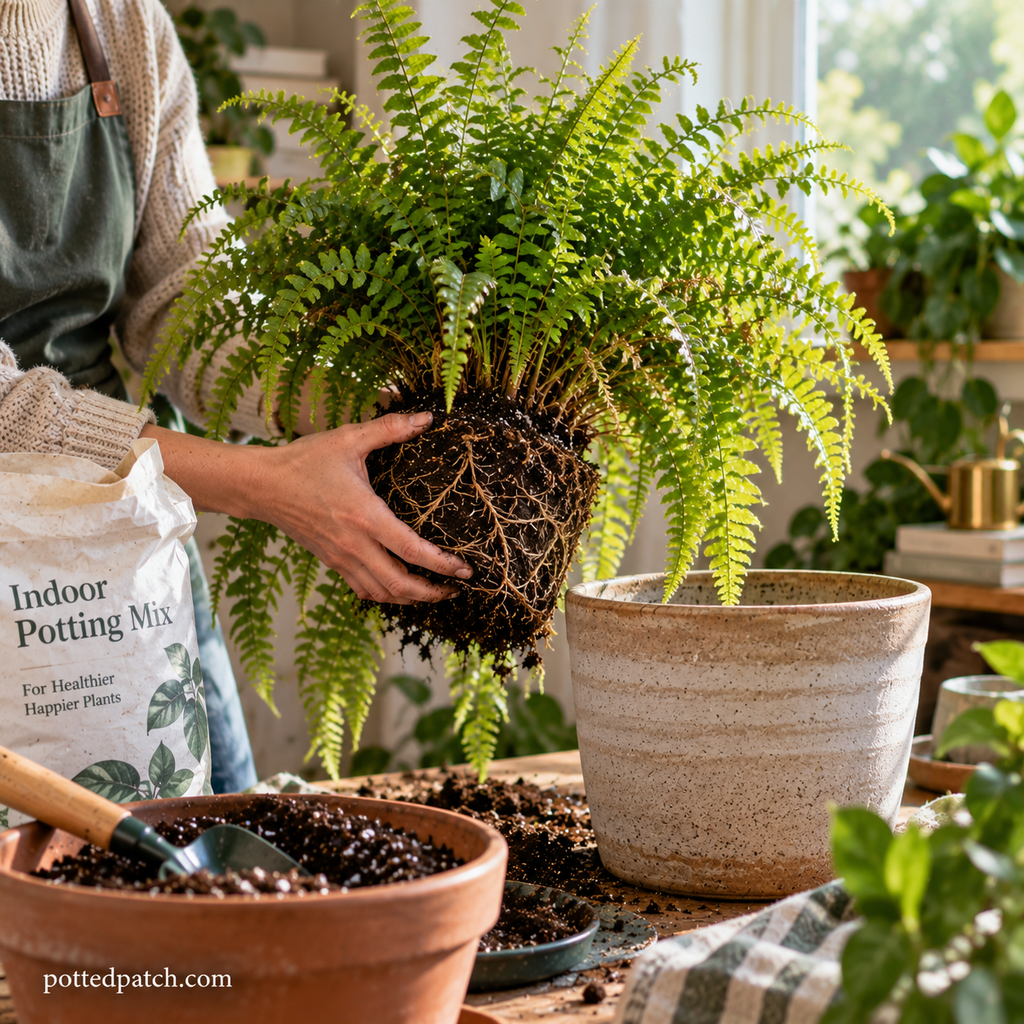
Boston ferns don’t need to be moved into a new pot every year automatically.
Consider repotting when:
- Roots have filled the existing container
- Water runs through unusually quickly because little soil remains
- The potting mix has become compacted
- Drainage has deteriorated
- The plant dries out extremely quickly
- The fern has become unstable in its container
Choose a new pot only slightly larger than the old one.
Repotting a Boston Fern Step by Step
- Choose a container with drainage holes.
- Prepare fresh, well-draining potting mix.
- Gently remove the fern from its current pot.
- Inspect the roots.
- Remove obviously dead or rotted root material if necessary.
- Position the plant at approximately its previous soil level.
- Fill around the root ball with fresh soil.
- Gently firm the mixture without heavily compacting it.
- Water thoroughly.
- Allow excess water to drain.
Keep the fern in stable conditions after repotting while it adjusts.
How to Prune a Boston Fern
Pruning a Boston fern is straightforward.
Remove fronds that are:
- Completely brown
- Dead
- Broken
- Badly damaged
- Clearly declining
Use clean, sharp scissors or pruning shears and cut unwanted fronds near the base.
Can You Cut a Boston Fern All the Way Back?
A severely damaged fern can sometimes be cut back significantly if much of its foliage has died.
If the root system and crown remain healthy, new fronds may emerge.
However, don’t heavily prune a healthy plant simply because some older fronds have minor imperfections.
Green foliage is still helping the plant produce energy.
Why Is My Boston Fern Turning Brown?
Brown foliage is one of the most common Boston fern problems.
Potential causes include:
- Soil becoming too dry
- Low humidity
- Excessive direct sunlight
- Fertilizer buildup
- Root stress
- Temperature extremes
- Natural aging
Look at the pattern of damage.
If entire fronds are becoming dry and crispy while the soil repeatedly dries out, watering is an obvious place to investigate.
If only the tips are browning while the soil remains appropriately moist, humidity or mineral buildup may deserve more attention.
Why Is My Boston Fern Turning Yellow?
A few older yellowing fronds aren’t necessarily concerning.
Widespread yellowing can indicate:
- Excessive watering
- Poor drainage
- Root problems
- Insufficient light
- Nutrient issues
- Natural aging
Check the soil before adding water.
A yellowing fern sitting in saturated soil doesn’t need another drink.
Why Is My Boston Fern Dropping Leaves?
Boston ferns naturally shed some older leaflets, but excessive shedding often indicates stress.
Possible causes include:
- Dry soil
- Low humidity
- Sudden environmental changes
- Excessive heat
- Cold drafts
- Root problems
If you’ve recently moved the fern, some temporary adjustment may occur.
Otherwise, check soil moisture and humidity first.
Why Does My Boston Fern Look Crispy?
Crispy foliage usually points toward moisture loss somewhere in the plant’s environment.
Check for:
- Dry soil
- Very low humidity
- Heating vents
- Intense direct sunlight
- Root damage preventing water uptake
Don’t assume crispy leaves automatically mean you should water.
If the soil is already wet, inspect the roots and growing conditions before adding more moisture.
Common Boston Fern Pests
Boston ferns can occasionally attract common houseplant pests.
These may include:
- Spider mites
- Scale
- Mealybugs
- Other sap-feeding pests
Their dense foliage can make early infestations difficult to notice.
What to Look For
Inspect your fern for:
- Fine webbing
- Sticky residue
- Small bumps attached to fronds
- Cotton-like clusters
- Speckled or faded foliage
- Tiny moving insects
Pay particular attention to the undersides of fronds.
What to Do If You Find Pests
Move the fern away from your other houseplants while you identify the problem.
A gentle shower can physically remove some pests.
For persistent infestations, use a treatment appropriate for the identified pest, such as insecticidal soap or another product labeled for indoor ornamental plants.
Always follow the product directions.
How to Clean a Boston Fern
Boston ferns have lots of small leaflets, making individually wiping every leaf impractical.
A gentle shower is often easier.
Use lukewarm water and rinse the foliage carefully. Allow the plant to drain thoroughly before returning it to its usual location.
Cleaning the fronds also gives you an opportunity to inspect for pests.
Can You Propagate a Boston Fern?
Yes.
Division is one of the most practical ways to propagate an established Boston fern at home.
How to Divide a Boston Fern
When the plant is large enough:
- Remove the fern from its container.
- Look for natural sections within the root mass.
- Carefully separate a portion with both roots and healthy foliage.
- Use a clean cutting tool if the roots are too tangled to separate by hand.
- Pot each division into an appropriately sized container.
- Use fresh potting mix.
- Water thoroughly and maintain consistent moisture while the divisions establish.
Division is easiest to combine with repotting so you don’t disturb the plant more often than necessary.
Can Boston Ferns Grow Outside?
Yes, when temperatures and conditions are appropriate.
Boston ferns are popular outdoor plants in hanging baskets, shaded patios, and porches during warm weather.
They generally prefer protected locations rather than intense midday sun.
If you move an indoor fern outside, gradually introduce it to the brighter environment.
Also remember that outdoor conditions can cause the soil to dry much faster due to:
- Higher temperatures
- Wind
- Increased airflow
- Brighter light
Check soil moisture more frequently.
Before bringing the fern back indoors, inspect it carefully for pests.
Where Should You Put a Boston Fern Indoors?
Look for a location that combines good light with protection from environmental extremes.
Good possibilities include:
- Near an east-facing window
- A short distance from a bright south-facing window
- Behind a sheer curtain
- A bright bathroom with adequate natural light
- A bright kitchen
- A plant stand near a window
Bathrooms are sometimes recommended because they can be more humid, but don’t put a fern in a dark bathroom simply for the humidity.
Light still matters.
Boston Fern Care in Winter
Winter can be one of the trickiest times for indoor Boston ferns.
Shorter days mean less light, while heating systems often make indoor air significantly drier.
At the same time, cooler conditions can cause soil to dry more slowly.
During winter:
- Continue checking soil regularly
- Don’t let the root ball become completely dry
- Avoid keeping the soil saturated
- Reduce fertilizer when growth slows
- Move the plant away from heating vents
- Monitor humidity
- Provide plenty of indirect light
- Protect the fern from cold drafts
Don’t automatically use the same watering frequency you followed during summer.
Let the plant and soil conditions guide you.
A Simple Boston Fern Care Routine
Boston ferns respond well to regular attention, but that doesn’t mean you need to obsess over them.
Every few days:
- Check the upper soil for moisture
- Look for drooping or crispy foliage
- Make sure the pot isn’t sitting in water
Every week or two:
- Inspect the undersides of fronds for pests
- Remove completely dead foliage
- Rotate the pot if growth is leaning toward the light
Periodically:
- Check drainage
- Clean dusty foliage
- Inspect for compacted soil
- Check whether the roots have outgrown the pot
The most important habit is simply catching dry soil before the entire root ball becomes parched.
Common Boston Fern Care Mistakes
Many Boston fern problems can be traced to a handful of common mistakes.
Try to avoid:
- Allowing the soil to become completely dry repeatedly
- Keeping the soil permanently waterlogged
- Using a pot without drainage
- Placing the fern in harsh direct afternoon sunlight
- Growing it in an extremely dark room
- Keeping it directly beside heating or cooling vents
- Ignoring very low indoor humidity
- Overfertilizing
- Repotting into an unnecessarily large container
- Treating every brown frond as a signal to add water
The best approach is consistency rather than extremes.
Frequently Asked Questions About Boston Fern Care
Are Boston Ferns Hard to Keep Alive?
They’re not especially difficult, but they’re less tolerant of neglect than many drought-resistant houseplants.
Consistent soil moisture and reasonable humidity make a big difference.
How Often Should You Water a Boston Fern?
There’s no universal number of days.
Check the soil regularly and water when the upper layer begins to dry. Avoid allowing the entire root ball to remain dry for extended periods.
Do Boston Ferns Need Direct Sunlight?
No.
Bright, indirect light is generally ideal. Gentle morning sun may be tolerated, but strong direct sunlight can scorch the fronds.
Do Boston Ferns Like Humidity?
Yes.
They generally appreciate moderate to high humidity, particularly compared with many common indoor plants.
Should I Mist My Boston Fern Every Day?
Daily misting isn’t necessary.
If your indoor air is consistently dry, a humidifier is more effective at maintaining meaningful humidity around the plant.
Why Does My Boston Fern Keep Getting Brown Leaves?
Dry soil, low humidity, excessive sunlight, fertilizer buildup, temperature stress, and natural aging can all contribute.
Check the plant’s environment before changing your watering routine.
Should I Cut Dead Fronds Off My Boston Fern?
Yes.
Completely dead or badly damaged fronds can be removed near the base using clean pruning tools.
Can a Brown Boston Fern Come Back?
It depends on the health of the crown and root system.
A fern that has lost much of its foliage from temporary drought may produce new growth if its roots remain alive. A plant with extensive root rot may be much more difficult to recover.
Where Is the Best Place for a Boston Fern?
Choose a bright location with indirect light, stable temperatures, and reasonable humidity.
Keep the fern away from harsh direct sunlight and strong heating or cooling vents.
Final Thoughts
Boston ferns have a reputation for being demanding, but most of their care comes down to one basic idea: don’t let conditions swing too far in either direction.
Keep the soil consistently moist without leaving the roots waterlogged. Give the plant plenty of bright, indirect light, and provide reasonable humidity so the delicate foliage doesn’t constantly dry out.
Then pay attention to changes.
Drooping fronds, brown tips, yellow foliage, and excessive leaf drop are clues that something in the plant’s environment may need adjusting. Check the soil, light, humidity, temperature, and roots before reacting.
Once you find the right location and watering rhythm, a Boston fern can reward you with a dense cascade of green fronds that makes an impressive addition to an indoor plant collection.