

If your Money Tree (Pachira aquatica) looks healthy but isn’t producing much new growth, don’t worry — it’s usually a simple care adjustment.
Money Trees are naturally vigorous growers indoors when their basic needs are met. With the right light, watering routine, pruning strategy, and feeding schedule, you can stimulate fuller foliage and stronger new stems within a few weeks.
Here’s exactly how to encourage new growth on a Money Tree — step by step.
Understand How a Money Tree Grows
Before encouraging growth, it helps to understand its natural pattern.
Money Trees:
- Grow from the tips of stems (apical growth)
- Produce new leaves from nodes along the stem
- Grow faster in spring and summer
- Slow down in fall and winter
If your plant is in a dormant season, patience may be the only “fix” needed.
Step 1: Increase Bright, Indirect Light
Light is the #1 driver of new growth.
Money Trees thrive in bright, indirect light. If your plant is sitting in a dim corner, growth will slow dramatically.
Ideal Light Conditions
- Near an east-facing window (gentle morning sun)
- A few feet back from a south- or west-facing window
- In a bright room with filtered light
If leaves look small, pale, or spaced far apart on the stem, it likely needs more light.
Tip: Rotate your plant every 1–2 weeks so all sides receive even light exposure.
Step 2: Prune to Trigger Branching
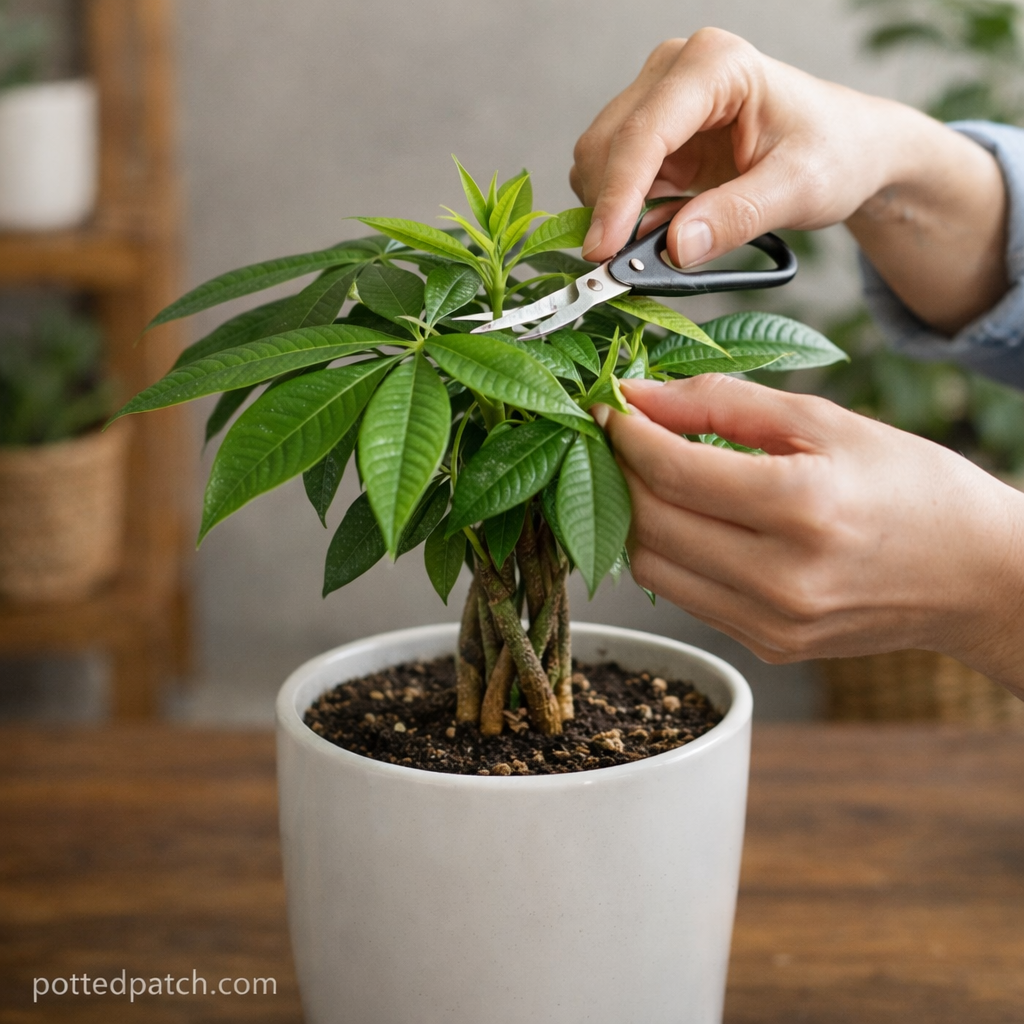
Pruning is one of the most effective ways to stimulate new growth.
When you trim the top of a stem, the plant redirects energy to lower nodes, encouraging branching and fuller growth.
How to Prune Properly
- Use clean, sharp pruning shears.
- Cut just above a leaf node (the small bump where a leaf attaches).
- Avoid removing more than 25–30% of the plant at once.
You’ll typically see new shoots forming below the cut within a few weeks during active growing season.
Step 3: Feed During the Growing Season
Money Trees need nutrients to produce new leaves.
Feed only during spring and summer.
Fertilizer Guidelines
- Use a balanced liquid houseplant fertilizer (10-10-10 or 20-20-20)
- Dilute to half strength
- Apply every 4 weeks
Avoid fertilizing in fall and winter — it won’t stimulate growth and may stress the plant.
Step 4: Check Your Watering Routine
Improper watering slows growth more than most people realize.
Signs You’re Underwatering
- Drooping leaves
- Dry soil pulling away from the pot
- Slowed or stalled growth
Signs You’re Overwatering
- Yellowing leaves
- Mushy stems
- Fungus gnats
- Root rot smell
Water only when the top 1–2 inches of soil feel dry. Always empty the saucer after watering.
Healthy roots = healthy new growth.
Step 5: Repot If Rootbound
If your Money Tree hasn’t grown in a long time, roots may be cramped.
Signs It’s Rootbound
- Roots circling the bottom of the pot
- Water runs straight through quickly
- Growth has completely stalled
Repot into a container 1–2 inches larger with fresh, well-draining soil. This gives roots room to expand and signals the plant to grow upward.
Step 6: Improve Humidity
Money Trees prefer moderate humidity.
Dry indoor air can slow growth, especially in winter.
Ways to boost humidity:
- Use a small humidifier
- Group plants together
- Place the pot on a pebble tray with water (water below the pot base)
Even a slight increase can encourage new leaf production.
Step 7: Maintain Consistent Temperatures
Money Trees grow best between 65–80°F.
Avoid:
- Cold drafts
- Heating vents
- Sudden temperature swings
Consistent warmth supports steady, healthy growth.
How Long Does It Take to See New Growth?
During spring and summer, you may see:
- New leaf buds within 2–4 weeks
- Noticeable stem elongation within 4–8 weeks
In fall and winter, growth may pause completely — this is normal.
Common Mistakes That Prevent New Growth
- Keeping the plant in low light
- Overwatering “to help it grow”
- Fertilizing during dormancy
- Not pruning at all
- Letting roots stay cramped for years
Fixing just one of these often makes a big difference.
Final Thoughts
Encouraging new growth on a Money Tree isn’t complicated — it’s about optimizing light, pruning strategically, feeding appropriately, and maintaining healthy roots.
When conditions are right, Money Trees respond quickly with lush, vibrant foliage.
If your plant isn’t growing yet, adjust one factor at a time and monitor for a few weeks. With consistency, you’ll see new life emerging soon.